
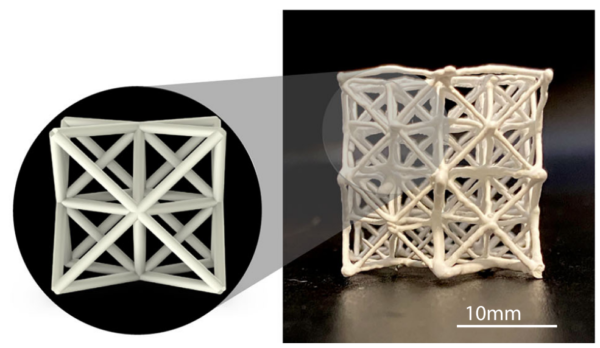
Researchers have developed a framework for designing and 3D-printing piezoelectric truss metamaterials with customizable anisotropic responses. This innovation uses generative machine learning and advanced manufacturing techniques to achieve novel piezoelectric behaviors, paving the way for a new generation of electro-active materials.
Understanding the Challenges
Piezoelectric materials are crucial in various engineering fields due to their ability to convert mechanical energy into electrical energy and vice versa. This unique property makes them essential in applications ranging from biomedical devices to aerospace engineering. However, the inherent directionality of piezoelectric materials, dictated by their crystal structure, limits their property space. This constraint restricts the range of piezoelectric responses that can be achieved, hindering the development of materials with tailored functionalities.
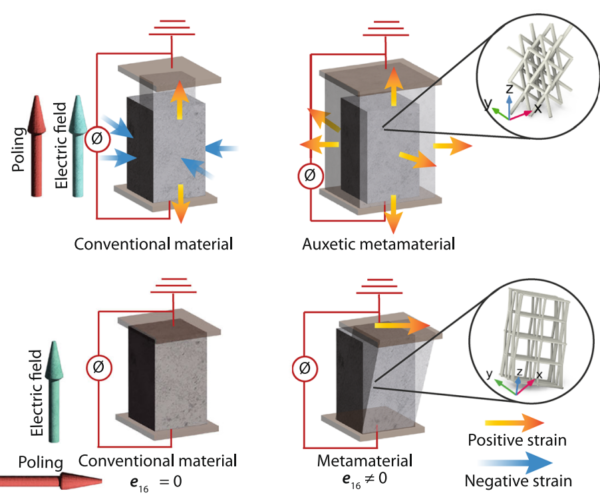
Traditional methods to enhance piezoelectric properties have focused on material synthesis and macro-scale design optimizations. Despite these efforts, the crystal symmetry of conventional piezoelectric materials like lead zirconate titanate (PZT) and polyvinylidene fluoride (PVDF) limits the number of non-zero piezoelectric coefficients. This limitation prevents the realization of certain desirable functionalities, such as negative piezoelectricity and direction-specific responses, which could significantly benefit various applications.
With the advent of technologies like micro- and nanoelectromechanical systems, the demand for exotic and tunable electromechanically responsive systems is increasing. The challenge lies in overcoming the limitations imposed by crystal symmetry to explore the full anisotropic design space of piezoelectric materials. This calls for innovative approaches to design and fabricate materials with customizable piezoelectric responses.
Innovative Approach and Techniques
The research team tackled the challenge of designing piezoelectric materials with customizable responses by leveraging the concept of metamaterials. These architected materials, constructed from tessellations of unit cells, offer a promising avenue for tailoring piezoelectric properties. Specifically, the study focused on beam-based truss metamaterials, known for their lightweight and mechanically robust characteristics.
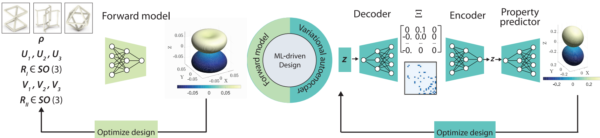
To explore the vast design space of piezoelectric metamaterials, the researchers employed a generative machine learning approach. This method involved training a machine learning framework with design-property pairs of truss metamaterials, enabling the generation of designs corresponding to desired piezoelectric properties. The framework utilized two distinct descriptions of truss metamaterials, one providing diverse responses and the other enhancing manufacturability.
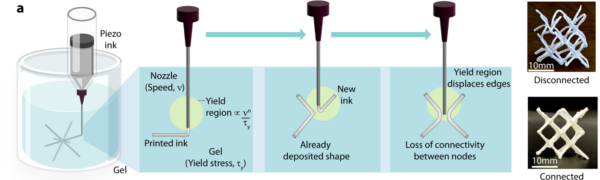
Fabricating these complex structures posed a significant challenge, particularly due to the brittleness of piezoelectric materials and the need for high-temperature processing. To overcome these hurdles, the team developed an in-gel 3D printing technique. This method involved synthesizing a photosensitive resin-based ink infused with piezoelectric microparticles, allowing for the extrusion of desired shapes. The printing technique ensured the connectivity of struts while maintaining shape accuracy through structural support provided by the gel.
Breakthrough Findings
The innovative approach resulted in the successful design and fabrication of piezoelectric truss metamaterials with tunable responses. The optimized metamaterials demonstrated an improvement of over 48% in the specific hydrostatic piezoelectric coefficient compared to bulk PZT. Remarkably, the study also achieved the rare phenomenon of higher transverse piezoelectric coefficients than longitudinal coefficients.
By designing metamaterial unit cells with various piezoelectric responses, such as maximized hydrostatic coefficients and auxetic behaviors, the research showcased the potential of this approach. The study highlights the ability to achieve selective piezoelectric coefficients and customize responses to specific applications, marking a significant advancement in the field of piezoelectric materials.
Future Prospects
This research opens new avenues for the development of electro-active materials with tailored piezoelectric properties. The ability to customize responses at the mesoscale could revolutionize applications across multiple domains, from robotics to electronics. The framework and fabrication method developed in this study provide a foundation for future innovations in piezoelectric metamaterials.
We extend our gratitude to the authors for their valuable contribution to the field. If you have insights or inquiries regarding this research, we encourage you to reach out and share your thoughts.
Reference: Saurav Sharma, Satya K. Ammu, Prakash Thakolkaran, Jovana Jovanova, Kunal Masania, & Siddhant Kumar. “Piezoelectric truss metamaterials: data-driven design and additive manufacturing.” npj Metamaterials (2025). DOI: https://doi.org/10.1038/s44455-025-00009-2