
Researchers examine sedimentation dynamics in the Lower Yellow River, focusing on the Xiaolangdi Reservoir’s influence on sediment transport. This study analyzes flood impacts from 2000 to 2023, offering insights into optimizing dam regulation to maintain river equilibrium and mitigate erosion, balancing ecological and human needs.
Transformative Effects of Dams on River Systems
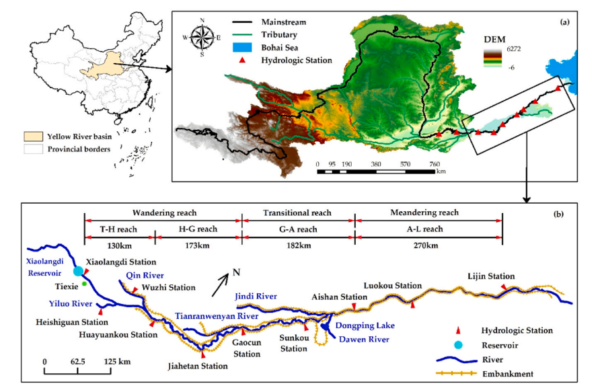
The construction and operation of large dams have significantly impacted river systems, particularly by altering runoff and sediment transport processes. This transformation can lead to notable changes in sedimentation dynamics and river morphology, affecting ecosystems and human activities dependent on these rivers. The Lower Yellow River (LYR) in China exemplifies this, where the Xiaolangdi Reservoir, operational since late 1999, has dramatically influenced the region’s hydrology.
The Xiaolangdi Reservoir was constructed to manage the Yellow River’s flow, aiming to control floods, generate electricity, and provide water for irrigation. However, its operation has also led to a 40% reduction in annual runoff and a 90% decrease in sediment load entering the LYR. These changes have shifted the sedimentation dynamics from aggradation, where sediment builds up, to erosion, where the riverbed is worn away.
Understanding how these changes affect the LYR is crucial for developing strategies to manage river systems effectively. The study by Xueqin Zhang and colleagues focuses on analyzing the spatiotemporal variations in sedimentation in response to the reservoir’s operation, particularly during 159 floods released between 2000 and 2023. The research aims to provide insights into maintaining a stable dynamic equilibrium in the LYR, where both erosion and aggradation are minimized.
Decoding Flood Sediment Concentrations
The research team conducted a comprehensive analysis of the LYR, focusing on the period from 2000 to 2023, during which 159 floods were released from the Xiaolangdi Reservoir. The study area, a 755-km stretch from Tiexie to Lijin, includes a diverse range of river channel types, from wandering to meandering, and is monitored by seven major hydrological stations.
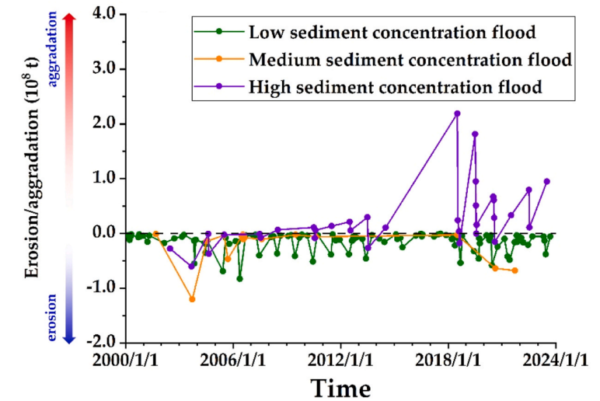
To understand the sedimentation dynamics, the researchers categorized floods based on their average sediment concentration (Sav). They identified three types of floods: low (Sav 10 kg/m³) sediment concentration floods. This classification allowed them to examine how different sediment concentrations influenced channel erosion and aggradation.
The study also considered the Xiaolangdi Reservoir’s regulation modes, which have evolved over time to optimize flood control and sediment management. Initially, the reservoir focused on storing clear water and releasing sediment-laden floods. Over the years, more sophisticated strategies have been implemented to balance multiple objectives, including power generation and water supply.
Key Findings on Sedimentation Dynamics
The research revealed that the LYR reached a dynamic equilibrium after a period of significant erosion from 2000 to 2004, followed by a gradual decrease in erosion magnitude until 2017. Low and medium sediment concentration floods generally resulted in erosion, while high sediment concentration floods caused either erosion or aggradation, depending on other factors.
For the LYR to maintain a stable dynamic equilibrium, the study recommends keeping the sediment concentration of floods released from the Xiaolangdi Reservoir below 40 kg/m³. This threshold helps balance erosion and aggradation, ensuring minimal impact on the river’s morphology.
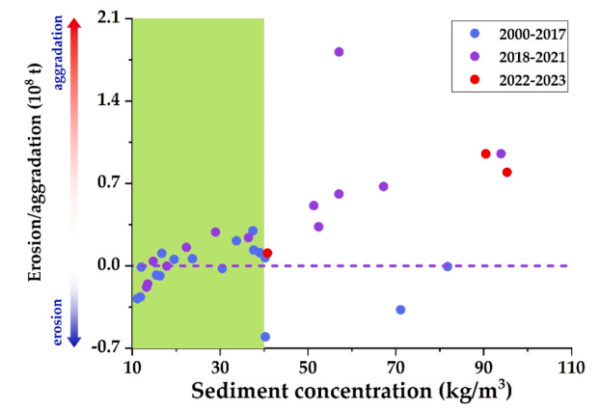
The findings underscore the importance of tailored reservoir regulation strategies to manage sedimentation effectively in dam-regulated rivers. By understanding the relationship between sediment concentration and channel dynamics, river managers can optimize operations to preserve river health and functionality.
Broader Implications and Future Directions
This research provides a valuable framework for managing sedimentation in dam-regulated rivers, offering insights that could be applied to similar systems worldwide. The study highlights the need for ongoing monitoring and adaptive management strategies to address the complex interactions between reservoir operations and river dynamics.
Future research could explore the long-term impacts of different regulation modes on river ecosystems and communities, contributing to more sustainable river management practices. The authors invite further discussion and collaboration to enhance our understanding of sedimentation dynamics and improve reservoir regulation strategies.
Reference: Xueqin Zhang, He Qing Huang, Yong Li, Chunjin Zhang, Min Zhang. “Flood sedimentation dynamics in dam-regulated river channels: A case study of the Lower Yellow River.” Journal of Hydrology: Regional Studies 64 (2026) 103136. DOI: https://doi.org/10.1016/j.ejrh.2026.103136