
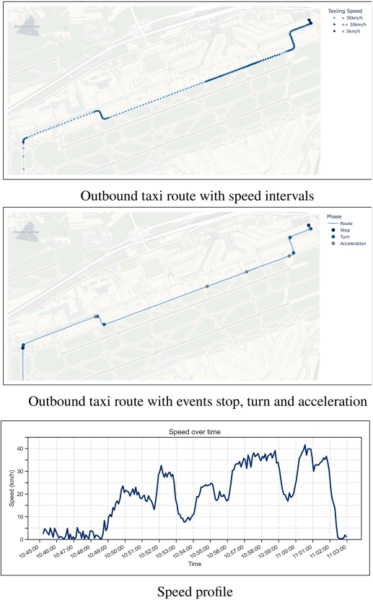
Amid rising aviation emissions, researchers have crafted machine learning models that refine fuel consumption predictions during aircraft taxiing. This advancement offers a promising path for sustainable airport operations, addressing a key phase where emissions significantly impact the environment.
The Growing Emissions Challenge
The aviation industry faces mounting pressure to reduce emissions as global passenger numbers continue to rise. According to the International Air Transport Association, passenger numbers are expected to double by 2043, potentially exacerbating the environmental impact of air travel. In 2019, the transport sector was responsible for 28.5% of the EU’s greenhouse gas emissions, with air traffic contributing around 4% of this total. A significant portion of these emissions occurs not only during flight but also on the ground, particularly during taxiing processes. For short-haul flights, taxiing can account for up to 10.1% of total fuel consumption, highlighting the importance of addressing emissions during this phase of flight operations.
Traditionally, airport ground operations have focused on safety, economic, and logistical considerations. However, the growing emphasis on sustainability necessitates a shift towards emission reduction as a key objective in airport management and planning. Accurate quantification of emissions during taxiing is crucial for implementing effective emission-oriented planning and management strategies. This research addresses the need for improved models to estimate fuel consumption and emissions during taxiing, thereby providing actionable insights for stakeholders in the aviation industry.
Innovative Research Approach
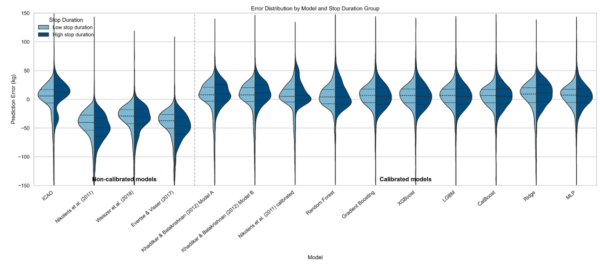
The researchers embarked on a comprehensive evaluation of existing taxiing fuel models using a rich dataset from a European hub airport. The study compared linear models based on ICAO fuel burn indices with more sophisticated models that incorporate operational factors and ambient conditions. The aim was to assess the accuracy of these models in predicting fuel consumption during taxiing.
A key innovation in this research was the application of machine learning (ML) techniques to identify relationships not captured by traditional models. By leveraging real-world taxiing data, the researchers developed ML models that offer a more nuanced understanding of the factors influencing fuel consumption. These models were calibrated using empirical data to ensure their practical applicability in airport operations.
In addition to evaluating existing models, the study explored the potential of speed-profile models, which consider the dynamic nature of taxiing operations, such as acceleration and deceleration phases. These models offer a physics-based approach to estimating fuel consumption by introducing thrust as an intermediate variable. By applying Newton’s laws of motion, the researchers were able to estimate instantaneous thrust demand and link it to fuel consumption rates.
Key Findings and Insights
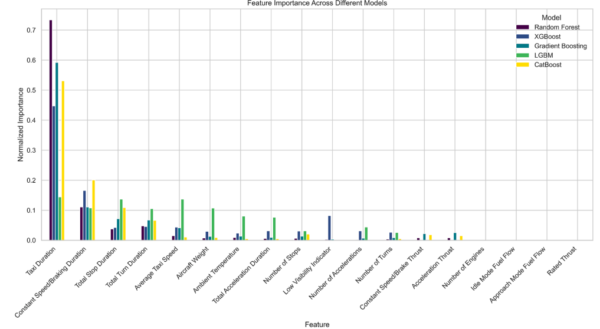
The findings of this research demonstrate that machine learning approaches provide more accurate predictions of fuel consumption during taxiing compared to traditional methods. The ML models outperformed linear models based on ICAO fuel burn indices, highlighting their potential for improving emissions estimation in airport operations. Notably, the study found that empirically calibrated thrust settings were higher than those suggested by literature defaults, indicating a need for further refinement of existing models.
Despite the improvements offered by the ML models, some unexplained variance remains, suggesting that there is still room for enhancement. The research underscores the importance of integrating advanced emission models into airport operations to help stakeholders implement effective emission reduction strategies. These insights are crucial for fostering more sustainable aviation practices and reducing the ecological footprint of air travel.
Future Directions in Sustainable Aviation
This research provides a significant step forward in the quest for greener aviation practices by enhancing the accuracy of fuel consumption predictions during taxiing. The integration of machine learning models into airport operations holds the potential to revolutionize emission reduction strategies, offering a pathway to more sustainable air travel. The study’s findings encourage further exploration and refinement of these models to address the remaining unexplained variance and optimize their application in real-world scenarios.
We extend our gratitude to the authors for their valuable contribution to the field of green aviation. If you have insights or innovative ideas related to this research, we invite you to reach out and share your perspectives.
Reference: Tim Knacker, Till Dannewald, Thomas Kirschstein. “Estimation of aircraft fuel consumption and emissions during taxiing processes.” DOI: https://doi.org/10.1016/j.trd.2026.105330