
Researchers from Delft University of Technology investigate how bed slopes affect turbidity currents interacting with obstacles. Using Large Eddy Simulations, they provide insights into sediment transport dynamics, potentially advancing hydraulic system management and addressing sediment-related challenges in reservoirs and marine environments.
The Dynamics of Turbidity Currents
Turbidity currents are underwater flows driven by density differences between sediment-laden water and surrounding water. These currents transport sediment from continental shelves to the deep ocean, shaping marine geological features. However, they pose challenges in hydraulic systems like reservoirs, where they can clog outlets, obstruct hydropower intakes, and reduce storage capacity, leading to operational inefficiencies and increased maintenance costs.
To mitigate these issues, engineers deploy obstacles within reservoirs to control sediment deposition. These obstacles aim to slow down, divert, or stop turbidity currents, encouraging sediments to settle before reaching critical infrastructure. The effectiveness of these interventions can vary significantly depending on the reservoir’s physical characteristics, particularly the slope of the sediment bed.
While previous studies have examined the dynamics of turbidity currents over flat or sloping beds, the specific effects of bed slope on the interaction between these currents and obstacles have remained largely unexplored. Understanding these interactions is vital for optimizing the design and placement of obstacles to enhance sediment management strategies in reservoirs and other hydraulic systems.
Advanced Simulations for Complex Flows
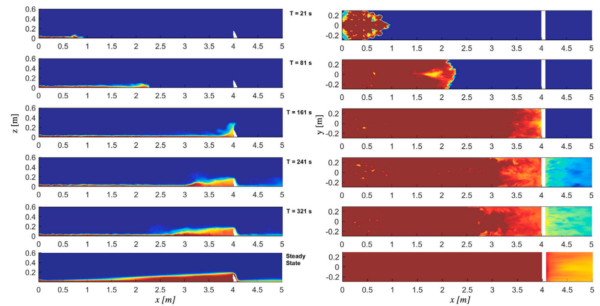
The research conducted by Said Alhaddad and his colleagues at Delft University of Technology addresses this knowledge gap by employing a high-resolution numerical model based on the Large Eddy Simulation (LES) approach. This method allows for a detailed analysis of the flow dynamics and sediment transport processes associated with turbidity currents interacting with obstacles over varying bed slopes.
The study focuses on six different bed slopes, ranging from 0% to 4.5%, to simulate conditions typically found in reservoirs. The LES approach is particularly well-suited for this research because it balances computational efficiency with the ability to capture the complex, anisotropic nature of turbulence in turbidity currents. Unlike Direct Numerical Simulation (DNS), which is computationally prohibitive for such large-scale problems, LES resolves the larger turbulent scales while filtering out smaller eddies, providing an accurate representation of the flow dynamics at a manageable computational cost.
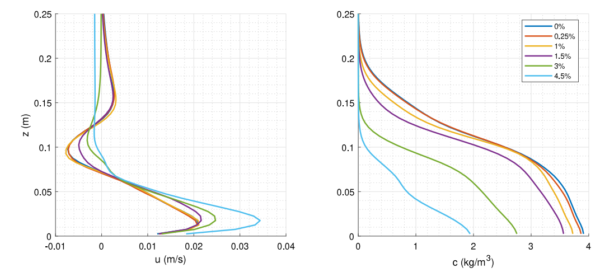
The researchers used a mixture approach to model the sediment-laden water, solving for the concentrations of individual sediment fractions while applying a single set of momentum equations for the mixture. This approach enabled them to analyze how different bed slopes influence the velocity and sediment concentration profiles upstream of a triangular obstacle.
To validate their model, the team compared their simulations against experimental data from previous studies, ensuring that their findings were grounded in real-world observations. This rigorous validation process enhances the credibility of their results and underscores the potential applicability of their insights to practical engineering challenges.
Revealing the Impact of Bed Slopes
The study’s results reveal that steeper bed slopes significantly enhance the sediment transport capacity of turbidity currents. This increase is primarily due to higher flow velocities rather than increased sediment concentrations. As a result, sediment deposition rates along the bed are reduced, leading to a decline in the obstacle’s sediment-retention efficiency.
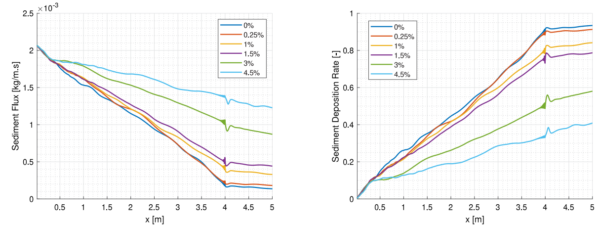
Interestingly, the researchers observed that recirculation zones, which are areas of reversed flow that can trap sediments, are present on milder slopes (0–1.5%) but disappear on steeper slopes (3–4.5%). This indicates that inertial effects dominate on steeper slopes, allowing the currents to maintain higher velocities and transport more sediment past the obstacle.
These findings suggest that the design and placement of obstacles in reservoirs should consider the slope of the sediment bed to optimize sediment retention and minimize downstream sediment transport. By tailoring interventions to specific slope conditions, engineers can enhance the effectiveness of sediment management strategies and reduce the operational challenges posed by turbidity currents.
Future Directions in Sediment Management
This research provides valuable insights into the dynamics of turbidity currents and their interaction with obstacles, offering a foundation for more effective sediment management in hydraulic systems. By understanding how bed slopes influence sediment transport, engineers can design more efficient interventions to protect critical infrastructure and maintain reservoir capacity.
Future research could explore the interaction of turbidity currents with different obstacle shapes and configurations, as well as the effects of varying sediment concentrations and flow velocities. Such investigations could further refine our understanding of these complex systems and inform the development of innovative solutions for managing sediment transport in diverse environments.
We thank the authors for their significant contribution to this field. If you have insights or questions regarding this research, we encourage you to reach out and engage with the ongoing conversation.
Reference: Alhaddad, S., Wu, C. S., & de Wit, L. (2026). Effect of bed slope on turbidity currents interacting with an obstacle: Insights from Large Eddy Simulations. Marine Geology, 493, Article 107720. DOI: https://doi.org/10.1016/j.margeo.2026.107720