
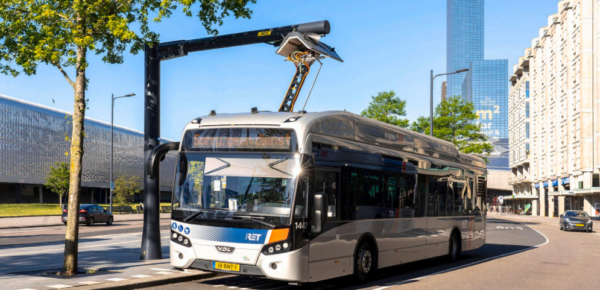
Delft University of Technology presents a framework integrating traffic and power grid simulations to evaluate the impact of electric bus opportunity charging. This approach aims to balance mobility and energy systems, enhancing the efficiency and sustainability of urban transport solutions.
The Challenges of Electric Bus Adoption
Electric buses (EBs) are pivotal in reducing greenhouse gas emissions and improving air quality, supporting global decarbonization efforts in public transportation. However, transitioning to electric bus fleets (EBFs) poses challenges, particularly due to the energy demands on local power grids. While EBs offer a cleaner alternative, their charging requirements can lead to operational inefficiencies and grid instability, especially with opportunity charging, which allows buses to recharge at stops along their routes, imposing intermittent and intense electricity demands on local grids.
The complexity of managing EBFs lies in effectively coordinating both mobility and energy systems. Existing literature and implementations often optimize one system while oversimplifying the other, resulting in potential inefficiencies and operational challenges. For example, public transport operators in the Netherlands have faced disruptions due to insufficient grid capacity and underestimated charging times, highlighting the risks of neglecting energy infrastructure.
Addressing these challenges requires an integrated approach that considers both the mobility needs of EBs and the energy constraints of local power grids. This approach ensures the effective and reliable deployment of EBFs, supporting sustainable urban development and helping achieve emission-free public transport goals by 2030. This research proposes a framework to assess the impact of bus opportunity charging strategies on the power grid, enhancing the operational efficiency and sustainability of EBFs.
Innovative Framework for Simulation
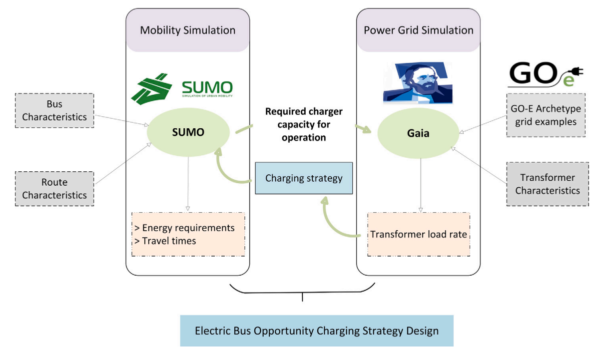
The research introduces a framework integrating a traffic simulation model (SUMO) with a power grid simulation model (Gaia) to evaluate the impact of electric bus opportunity charging strategies on local distribution grids. SUMO assesses the energy consumption and charging needs of EBs based on detailed data on vehicle movements, traffic signal interactions, and traffic management strategies. This model helps determine how opportunity charging affects travel times and energy efficiency.
Gaia evaluates the impact of EB opportunity charging on local distribution grids using real-life consumption data and GO-E archetypes derived from anonymized grid data from Dutch postal codes. Gaia provides a detailed analysis of how opportunity charging affects grid stability and capacity, offering insights into the interplay between mobility and energy systems.
The integrated framework is applied to a real-world case study of bus line 36 in Rotterdam, the Netherlands. Five distinct charging strategies, varying in charging capacities and schedules, are tested to assess their ability to meet the operational demands of the bus fleet while minimizing the impact on the local power grid. This case study serves as an empirically grounded example to demonstrate the framework’s practicality and effectiveness.
Key Findings and Conclusions
The application of the integrated simulation framework to Rotterdam’s bus line 36 shows that designing an electric bus route with opportunity charging is feasible only when both mobility and energy systems are carefully coordinated. The study tested five different charging strategies, each varying in capacity and scheduling, to identify the optimal approach that meets operational demands while minimizing grid impact.

The results indicate that the framework provides valuable insights into the effects of opportunity charging on grid capacity and stability. By combining the capabilities of SUMO and Gaia, the framework offers a comprehensive decision support system for public transport operators, enabling more informed and robust decisions regarding EB opportunity charging strategies.
Future Prospects and Impact
This research advances the management of electric bus fleets by integrating mobility and energy systems. The framework enhances operational efficiency and supports the sustainable deployment of EBFs, contributing to global emission reduction targets. Future research could explore applying this framework to other urban areas, further validating its effectiveness and adaptability.
Reference: Gao, J., van Noort, S., Spoelstra, J., & de Almeida Correia, G. H. (2026). An integrated mobility and energy simulation framework for assessing the impact of bus opportunity charging strategies on the power grid. Transportation Research Interdisciplinary Perspectives, 36, Article 101900. DOI: https://doi.org/10.1016/j.trip.2026.101900