
This study examines how user awareness of interacting with AI versus humans affects emotional and psychological dynamics with virtual avatars. Insights from the research provide guidance for designing AI systems that enhance user satisfaction and engagement, crucial as AI becomes more integrated into everyday interactions.
Understanding Human-AI Interaction
In an era where artificial intelligence (AI) is increasingly integrated into daily life, understanding the nuances of human-AI interaction is crucial. With advancements in Large Language Models (LLMs), AI chatbots can simulate near-human-like conversations, raising questions about the psychological effects of interacting with AI, especially through human-like avatars. The study conducted by Silvia Erika Kober and colleagues at the University of Graz addresses these issues, focusing on the emotional and psychological impacts of AI in communication.
As virtual avatars become more prevalent in domains such as gaming, education, and clinical settings, understanding their influence on user experience is essential. These avatars can be controlled by humans or AI, leading to different user perceptions and emotional responses. The study seeks to uncover how user awareness of interacting with an AI or a human affects emotional engagement, trust, and overall experience. This is particularly relevant as AI systems increasingly pass the “Turing Test,” making it difficult for users to distinguish between AI and human interactions.
The research explores the concept of social presence, the feeling of being with the virtual avatar during communication. This sense of presence affects rapport, self-disclosure, and emotional responses. The study also examines how the likability of an avatar, influenced by user awareness and feelings of eeriness, impacts social evaluations. Understanding these dynamics is vital for designing AI systems that effectively engage users and foster positive interactions.
Innovative Research Approach
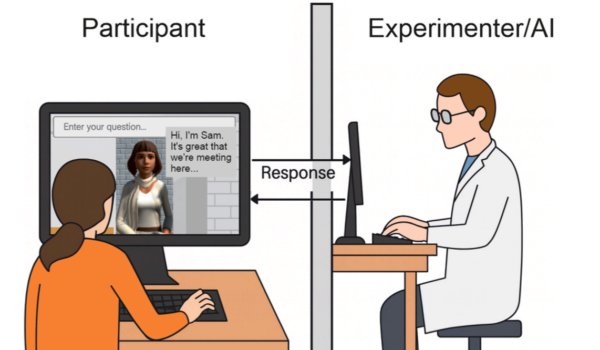
The study involved 42 female participants randomly assigned to either an informed group, aware of whether they were interacting with an AI or a human, or an uninformed group, unaware of the speaker’s identity. Participants engaged in conversations with a virtual avatar that conveyed messages generated by either an AI or a human. The topic of discussion was their last holiday, chosen to elicit natural conversational dynamics.
The researchers employed subjective questionnaires and objective measures, such as sentiment analysis, to assess users’ emotional responses. This dual approach allowed for a comprehensive evaluation of the emotional tone of the interactions and the participants’ subjective experiences. The study also kept the visual appearance and gender of the virtual avatar constant to avoid confounding variables related to avatar design and gender roles.
By varying both the type of interaction partner (human vs. AI) and participants’ awareness of the partner’s identity, the study aimed to uncover the effects of these variables on emotional responses, social presence, likability, and the attribution of a self-concept to the avatar. This approach provides valuable insights into the complex dynamics of human-AI communication.
Key Findings and Insights
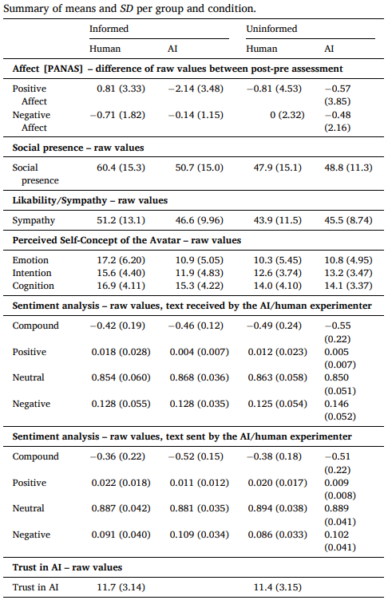
The study revealed intriguing findings about the impact of user awareness on emotional and psychological responses during interactions with virtual avatars. In the uninformed group, participants could not reliably distinguish between AI and human interactions, indicating that AI systems are becoming increasingly adept at simulating human-like communication. However, in the informed group, interactions with a human led to a stronger increase in positive affect, a greater sense of social presence, and stronger attribution of emotions and intentions to the avatar compared to AI interactions.
Regardless of awareness, messages generated during human interactions were more positive than those from AI. Additionally, both AI and human-generated messages were more positive than those sent by participants. These findings highlight the nuanced effects of user awareness on emotional engagement and underscore the importance of considering user perceptions in the design of AI communication systems.
Future Directions and Applications
This research offers valuable insights into the design of AI systems, emphasizing the importance of user awareness in shaping emotional and psychological responses. By understanding these dynamics, developers can create AI systems that enhance user satisfaction and engagement. The study also raises intriguing questions about the future of human-AI interaction, particularly as AI systems continue to evolve and become more integrated into daily life.
We thank the authors for their contribution to this important field of study. If you have insights or experiences to share regarding human-AI interaction, we encourage you to reach out and join the conversation.
Reference: Silvia Erika Kober, Simon Streit, Guilherme Wood. “AI or human? Exploring the effects of user awareness in conversational dynamics with virtual avatars.” Computers in Human Behavior 181 (2026) 108984. DOI: https://doi.org/10.1016/j.chb.2026.108984