
TU Delft researchers present an LSTM-BiLSTM architecture that combines sleeper-level framing of axle-box acceleration signals with LSTM-based temporal feature extraction and bidirectional processing to deliver accurate, simultaneous estimation of railpad and ballast stiffness at individual sleeper resolution — even under realistic measurement noise.
The Critical Need for Accurate Track Stiffness Monitoring
Railway track stiffness is a primary indicator of infrastructure condition and degradation. It is influenced by ballast quality, substructure support, fastening systems, and dynamic loading, and sudden or progressive changes often signal issues such as fouled ballast, hanging sleepers, or mud pumping. Accurate stiffness profiles support effective condition-based maintenance across large networks.
Drive-by monitoring using axle-box accelerometers (ABA) offers a scalable, cost-effective alternative to fixed sensors or computationally intensive inverse methods. However, converting these noisy, sequential vibration signals into reliable stiffness estimates at the level of individual sleepers has proven challenging. Earlier data-driven models, including convolutional networks and unidirectional recurrent architectures, have shown limitations in capturing the bidirectional temporal dependencies inherent in vehicle-track interaction and in achieving the spatial resolution required for localised damage detection.
The Proposed LSTM-BiLSTM Framework and Key Innovations
The study introduces a fully end-to-end deep learning pipeline built on two practical innovations grounded in track physics.
Sleeper-level framing
The raw ABA signal is segmented into frames corresponding to the distance between sleepers, each centred on a sleeper position. This domain-specific preprocessing converts the continuous vibration record into a sequence of bearing-span segments directly linked to individual sleepers, enabling estimation at true beam-node resolution.
Two-stage architecture
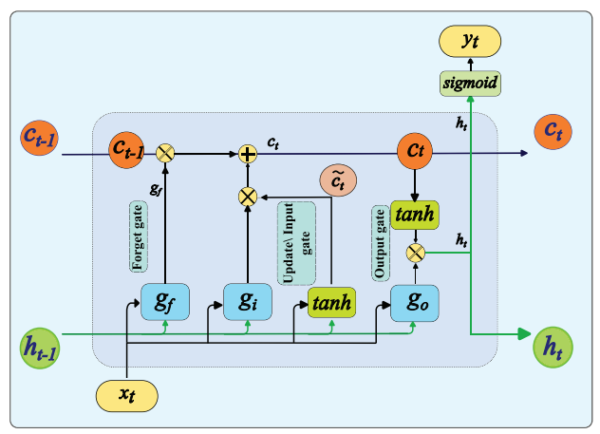
- Feature extraction (lower level): Each frame is processed by a single LSTM layer with 128 units, selected after comparison with a 1D-CNN extractor. The LSTM variant better captures short-term temporal dynamics within each segment.
- Condition estimation (upper level): The resulting feature sequence is passed to a stacked bidirectional LSTM (BiLSTM) network consisting of two layers (128 and 64 units). By processing the sequence in both forward and backward directions, the model accounts for the physical influence of stiffness variations on vibration responses both ahead of and behind the wheel. The BiLSTM outputs are concatenated and fed into two dense layers to predict railpad stiffness (kₚ) and ballast stiffness (k_b) simultaneously.
The complete model is trained end-to-end using back-propagation on raw acceleration data, eliminating the need for manual feature engineering.
Case Study
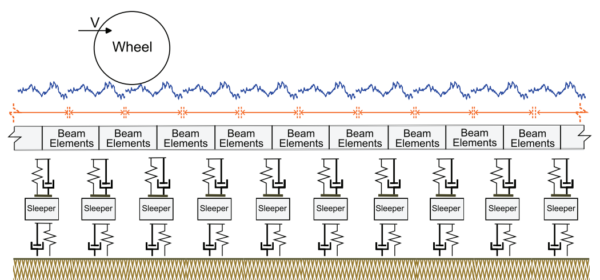
The framework was evaluated using a validated finite-element vehicle-track interaction model (Shen et al., 2023) simulating a 10-sleeper segment at 65 km/h. Datasets included uniform stiffness conditions and local reductions affecting one or three sleepers, with stiffness values drawn from realistic healthy and degraded ranges. Both noise-free and 15 % additive white Gaussian noise scenarios were considered. Four model variants — CNN-LSTM, LSTM-LSTM, CNN-BiLSTM, and the proposed LSTM-BiLSTM — were compared on 15 000 records per scenario, split 60/20/20 for training, validation, and testing.
Performance and Key Findings
The LSTM-BiLSTM model achieved the lowest errors across all configurations.
Noise-free test set
- Railpad stiffness (kₚ): RMSE 0.82 MN/m, MAPE 0.61 %
- Ballast stiffness (k_b): RMSE 0.06 MN/m, MAPE 0.35 %
- Overall MAPE: 0.47 %
15 % noise test set
- Railpad stiffness (kₚ): RMSE 2.72 MN/m, MAPE 1.70 %
- Ballast stiffness (k_b): RMSE 0.13 MN/m, MAPE 0.70 %
- Overall MAPE: 1.20 %
The bidirectional processing reduced MAPE and RMSE by nearly 50 % compared with unidirectional LSTM counterparts. The model accurately estimated absolute stiffness values and correctly identified and localised reductions in one or three sleepers, even when defect locations were randomised. Predictions remained stable under noise, closely matching ground-truth profiles across test segments.
The authors state:
“The proposed methodology can accurately and automatically estimate railway track stiffness and identify local stiffness reductions in the presence of noise using drive-by measurements… The results demonstrate the potential of incorporating temporal analysis in the feature extraction phase and emphasize the pivotal role of bidirectional temporal information in infrastructure health condition estimation.”
Implications and Future Directions
The study shows that combining physics-informed framing with bidirectional recurrent processing enables high-resolution stiffness monitoring from drive-by measurements. The resulting estimates can support more targeted maintenance decisions and improve the effectiveness of network-wide asset management.
The authors identify three main areas for continued work: benchmarking against recent CNN and LSTM variants, validation using field measurements under real operating conditions, and refinement of the framing approach to accommodate variable train speeds and diverse track configurations. The methodology also appears applicable to other beam-type structures such as bridges.
We thank Reza Riahi Samani, Alfredo Nunez Vicencio, and Bart De Schutter for this clear and practical contribution to railway infrastructure monitoring.
Engineers working on drive-by systems or with relevant field data are invited to share their insights — we welcome thoughtful discussion and potential collaboration.
Reference
Riahi Samani, R., Nunez Vicencio, A., & De Schutter, B. (2025). Bidirectional Long Short-Term Memory Approach for Infrastructure Health Monitoring Using On-Board Vibration Response. Transportation Research Record.
DOI: 10.1177/03611981251342236