
MSc Thesis

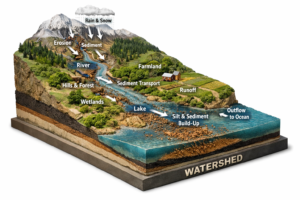
Why Are Some Watersheds More Sediment-Productive Than Others? An Explainable AI Approach

High-frequency turbidity sensors from 134 USGS stations, paired with RUSLE erosion estimates and explainable random forest models, map sediment yield and delivery ratios across the contiguous United States, revealing that human-modified landscapes dominate sediment transport efficiency while natural factors control total production, and highlighting priority sub-basins for targeted management in the Upper Mississippi and Chesapeake […]

Why Are Some Watersheds More Sediment-Productive Than Others? An Explainable AI Approach Read More »


Machine Learning for Iceberg Stability: Ground Imagery and Logistic Regression Offer New Practical Insights

Analyzing thousands of icebergs captured in time-lapse footage from Alaska and Greenland, this research demonstrates that logistic regression applied to visible width and height can help estimate the probability of instability providing engineers with a foundational, field-derived method for assessing capsize risk in Arctic coastal environments. The Challenge of Iceberg Capsize in Arctic Waters Iceberg

Machine Learning for Iceberg Stability: Ground Imagery and Logistic Regression Offer New Practical Insights Read More »

Indoor Positioning Using Augmented Reality

Imagine stepping into a smoke-filled building during an emergency, where every second counts and traditional navigation fails—yet augmented reality glasses reveal your precise location on a digital floor plan, guiding rescuers to safety. In his 2020 MSc thesis, Laurens Oostwegel pioneered a solution using the Microsoft HoloLens to combat SLAM’s drift errors through continuous spatial

Indoor Positioning Using Augmented Reality Read More »