
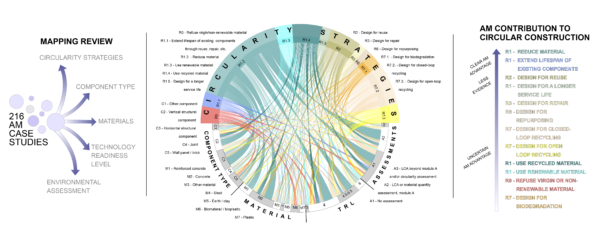
Additive manufacturing (AM) offers promising potential to enhance circular construction by enabling innovative design strategies. This research examines AM’s role in improving sustainability in construction, focusing on material efficiency, adaptability, and environmental assessments. Explore how AM could transform the building industry towards a circular economy.
Rethinking Construction: Embracing Circularity
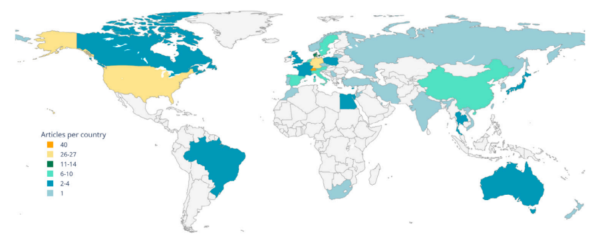
The construction industry significantly contributes to global resource consumption, waste generation, and greenhouse gas emissions. As environmental challenges intensify, sustainable production and consumption in construction are increasingly crucial. Circular economy principles, emphasizing reducing, reusing, and recovering materials, offer a pathway towards environmental sustainability across the life cycle of built assets. However, implementation remains limited due to the complex interplay of materials, design processes, supply chains, and regulatory frameworks.
Additive manufacturing (AM), commonly known as 3D printing, presents a potential solution to these challenges. By fabricating objects layer by layer from digital models, AM can produce geometrically complex and customized parts with minimal waste. This capability aligns with circular practices such as material-efficient design, reuse of existing materials, and design for repairability. Despite its promise, the contribution of AM to circularity in construction has not been thoroughly analyzed, with most existing research focusing on reducing up-front embodied impacts rather than improving whole-life-cycle sustainability.
This research aims to bridge this gap by synthesizing how AM has contributed to circularity in construction and how these contributions have been assessed. The study identifies key circularity strategies employed in AM projects, evaluates their environmental benefits, and highlights areas for future research. By doing so, it provides valuable insights for both researchers and practitioners seeking to leverage AM for sustainable construction.
Mapping the Future: Circularity through AM
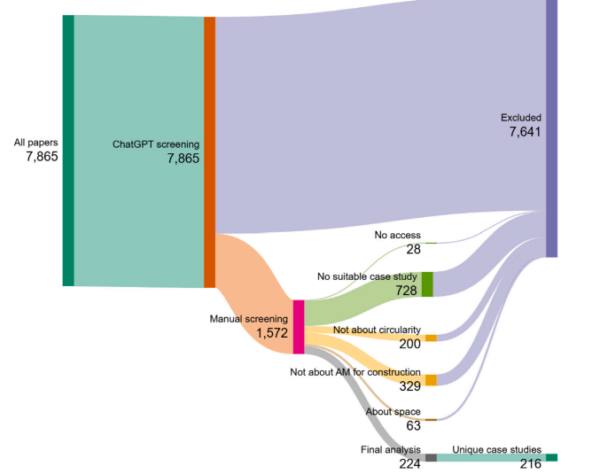
The research employs a mapping review method, a comprehensive approach designed to provide a ‘big picture’ synthesis of evidence across a broad field. This method is particularly suited for identifying research gaps and guiding future investigations. The study is informed by PRISMA-ScR guidelines for scoping reviews, ensuring a systematic and reproducible process.
A key component of the methodology is the use of the 10R framework developed by Reike et al. (2018), which provides a detailed hierarchy of circularity strategies. This framework includes ten value-retention and waste-reduction strategies: refuse, reduce, reuse, repair, refurbish, remanufacture, repurpose, recycle, recover, and remine. The research adapts this framework to classify AM projects, focusing on strategies relevant to producers rather than consumers.
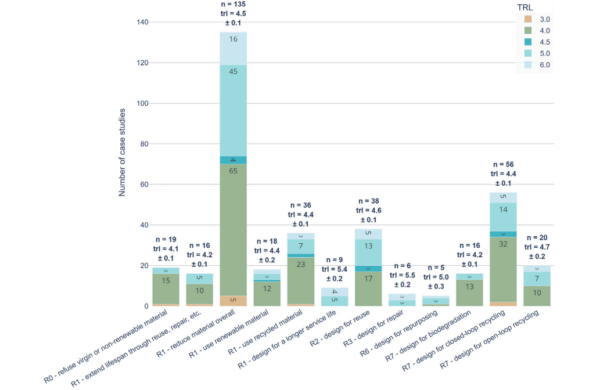
The study identifies 216 unique AM case studies, analyzing them in terms of circularity strategies, environmental assessments, component types, materials, and technological readiness levels (TRLs). A large language model-assisted method is used to prefilter articles, ensuring an efficient and accurate screening process. This innovative approach allows the researchers to cover a wide scope, providing a comprehensive overview of AM’s contribution to circular construction.
Findings: AM’s Impact on Circular Construction
The analysis reveals that AM shows the clearest contribution to reducing material use, particularly for horizontal structures. Interest is growing in strategies to increase material circulation, with AM showing promise for adapting existing components to new uses. However, evidence for environmental benefits remains limited, as only 41% of cases were assessed. These assessments often lacked comprehensive life-cycle coverage and comparisons to conventional manufacturing.
The research concludes that while AM has significant potential to enhance circularity in construction, its current contributions are under-analyzed. The study highlights the need for future research to explore the reuse and repair of existing components, combine multiple strategies, assess whole-life-cycle impacts, and validate performance under real-world constraints. By addressing these gaps, AM can play a crucial role in advancing sustainable construction practices.
Charting a Sustainable Path: The Future of AM in Construction
This research underscores the transformative potential of additive manufacturing in promoting circularity in construction. By enabling innovative design strategies and material efficiency, AM can significantly reduce the environmental impact of the building industry. However, realizing this potential requires a concerted effort to address current research gaps and validate AM’s benefits under practical conditions.
Future research should focus on comprehensive environmental assessments, exploring the reuse and repair of existing components, and integrating multiple circularity strategies. By advancing our understanding of AM’s role in circular construction, we can pave the way for a more sustainable and resilient built environment.
We thank the authors for their valuable contribution to this critical field. For those interested in furthering this research or sharing insights, please reach out and join the conversation.
Reference: Silvennoinen, Heidi; Honic-Eser, Meliha; Slavkovic, Katarina; Block, Philippe; De Wolf, Catherine. “Additive manufacturing for circular construction — a review of design strategies and their assessment.” Sustainable Production and Consumption 64 (2026): 204–221. DOI: https://doi.org/10.3929/ethz-c-000797083