
This study uses a data-driven Bayesian network to analyze maritime occupational accidents, identifying key risk factors and offering insights for improving seafarer safety. It addresses a critical gap in understanding and preventing occupational hazards in the maritime industry through statistical analysis and Bayesian modeling.
Navigating Maritime Occupational Risks
The maritime industry is a cornerstone of global trade, with over 50,000 ships and nearly 2 million seafarers ensuring the seamless transportation of goods worldwide. Despite its pivotal role, the industry poses significant occupational hazards that jeopardize the safety and health of seafarers. Unique working conditions aboard ships, such as extended contracts, isolation from family, and volatile environments, contribute to the heightened risks faced by these workers.
Existing studies reveal concerning statistics: seafarers experience higher mortality rates, injuries, and illnesses compared to shore-based workers. For example, British seafarers are 21 times more likely to suffer workplace fatalities and have a 70% higher risk of injury than their land-based counterparts. The lack of professional medical care onboard exacerbates the severity of occupational accidents, underscoring the need for effective prevention and management strategies.
While prior research has predominantly focused on the broad causes of marine accidents, there is a notable lack of objective, data-driven studies on maritime occupational accidents. This gap impedes the development of effective measures to enhance seafarers’ working conditions and safety. To address this, the study by Jilong Yu and colleagues employs advanced statistical techniques and Bayesian network modeling to analyze maritime occupational accidents, offering valuable insights for stakeholders in the maritime industry.
Innovative Data-Driven Analysis
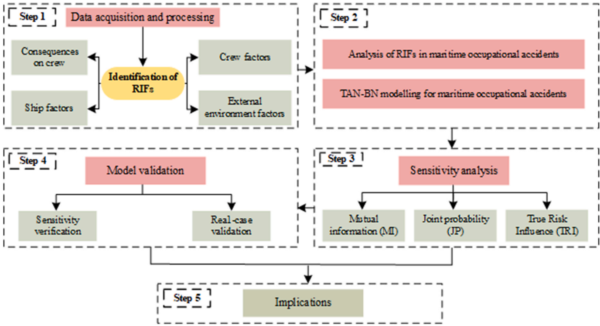
The research team conducted a comprehensive analysis of 505 maritime occupational accident cases spanning from 2013 to 2021. They identified 17 Risk Influential Factors (RIFs) related to crew consequences, ship factors, human factors, and external environmental factors. The study utilized statistical analyses to delineate the principal characteristics and trends of these accidents, providing a solid foundation for further investigation.
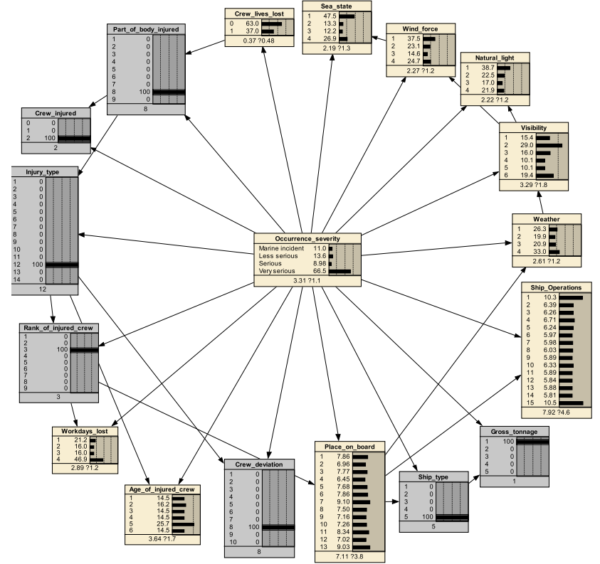
To enhance the predictive accuracy of their findings, the researchers developed and refined a Tree-Augmented Naive Bayesian Network (TAN-BN) model. This model pinpointed five primary factors impacting accident severity, including the number of injured crew members, the specific body part affected, the nature of the injury, the rank of the injured personnel, and their age. Sensitivity analysis and real-world accident cases were employed to validate the model’s robustness, confirming its capability to identify underlying causes effectively.
The study’s data-driven approach marks a significant advancement over previous qualitative analyses, which often relied on subjective interpretations and limited sample sizes. By leveraging historical accident data and advanced modeling techniques, the research provides a more objective and comprehensive understanding of maritime occupational accidents.
Key Findings and Insights
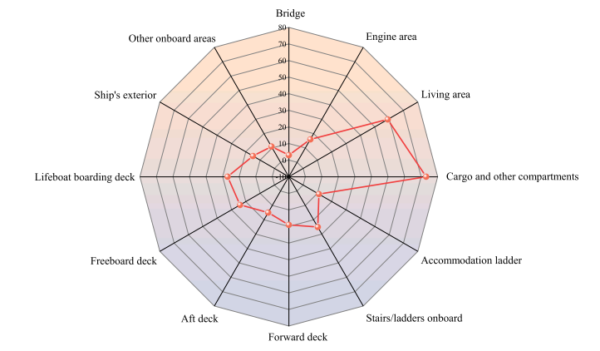
The study’s findings underscore the importance of addressing specific risk factors to enhance seafarer safety. The TAN-BN model demonstrated robust predictive accuracy, effectively identifying the primary factors influencing accident severity. The research highlights the critical role of crew characteristics, such as age and rank, in determining the likelihood and impact of injuries.
Moreover, the study emphasizes the significance of external environmental factors and ship-related aspects in shaping accident outcomes. These insights provide a valuable foundation for maritime authorities, shipping companies, and other stakeholders to develop targeted interventions aimed at reducing occupational hazards and improving safety measures.
Practical Implications and Future Directions
This research offers practical implications for maritime stakeholders, providing essential perspectives for developing policies and measures to prevent maritime occupational accidents. By identifying key risk factors and leveraging advanced modeling techniques, the study paves the way for more effective safety regulations and post-accident management strategies.
The authors’ innovative approach sets a new standard for analyzing maritime occupational accidents, offering a data-driven framework that can be adapted and expanded in future research. Stakeholders in the maritime industry are encouraged to consider these findings and collaborate on implementing effective safety measures.
Reference: Jilong Yu, Jian Zhao, Xinjian Wang, Yuhao Cao. “Maritime occupational accidents analysis: A data-driven Bayesian network approach.” Ocean and Coastal Management 269 (2025) 107785. DOI: https://doi.org/10.1016/j.ocecoaman.2025.107785