
This study introduces a refined model for estimating atmospheric weighted mean temperature, improving the accuracy of precipitable water vapor measurements using GNSS data. By addressing regional climatic variability, it enhances GNSS-based meteorology, offering a valuable tool for precise atmospheric water content estimation in varying conditions.
Enhancing Precision in Water Vapor Measurement Techniques
In atmospheric sciences, accurately measuring precipitable water vapor (PWV) is crucial due to its significant role in weather forecasting and understanding global warming dynamics. PWV represents the total amount of water vapor in a column of the atmosphere and is a key parameter for meteorological applications. Traditional techniques for measuring PWV, such as radiosondes and microwave radiometers, are often limited by their high costs and low spatial and temporal resolution. This has led to an increased reliance on Global Navigation Satellite System (GNSS) meteorology, which offers a cost-effective and precise alternative for obtaining PWV data.
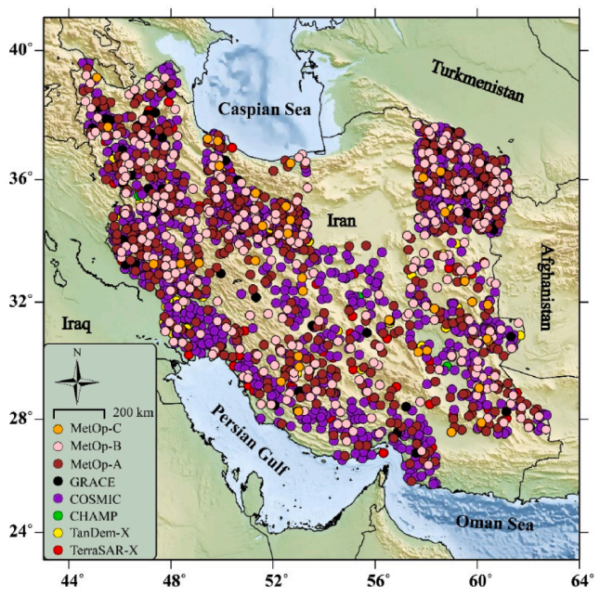
from various satellites used for Tm calculation.
However, one of the primary challenges in GNSS meteorology is the accurate estimation of the atmospheric weighted mean temperature (Tm), a critical parameter for converting zenith wet delay (ZWD) to PWV. The conversion relies on the relationship between PWV and ZWD, which is expressed through specific equations involving Tm. Any errors in estimating Tm can introduce significant uncertainties in PWV calculations, affecting the precision of meteorological assessments.
Traditional models for estimating Tm, such as the Bevis model, often fail to account for regional climatic variability, leading to reduced accuracy in localized applications. These models typically rely on surface temperature measurements, which may not be available at all GNSS sites, further limiting their applicability. Moreover, these empirical models are often one-dimensional, considering only a single parameter, such as time, without incorporating the complexity of atmospheric conditions.
To address these challenges, the study by Arash Tayfehrostami and Yazdan Amerian introduces a novel approach to Tm estimation. The research focuses on developing a refined model that incorporates radiosonde observations and multi-mission GNSS radio occultation (RO) data. This approach aims to enhance the accuracy of Tm estimation by considering vertical water vapor distribution and temperature linearity, tailored specifically for the diverse climatic conditions in Iran.
Advanced Modeling Approach Yields Significant Improvements
The research introduces a novel integral formulation for estimating the atmospheric weighted mean temperature (Tm), utilizing a combination of radiosonde observations and GNSS radio occultation (RO) profiles. This innovative approach is designed to address the limitations of existing models by incorporating regional climatic variability and avoiding reliance on surface temperature measurements, which are often unavailable in GNSS data.
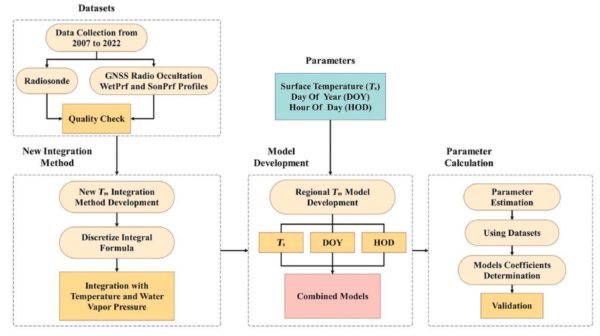
The methodology involves the development of three regional Tm models, each constructed based on annual, semiannual, and diurnal periodicities, along with surface temperature (Ts). These models vary in structure and complexity, allowing for a more accurate representation of atmospheric conditions across different regions in Iran. The models were validated against independent radiosonde observations from 2022, demonstrating significant improvements in accuracy compared to the Bevis model.
Specifically, Models Two and Three outperformed the Bevis model, reducing the root mean square error (RMSE) by 30.7%. When evaluated against GNSS RO profiles, Model One, which excludes Ts due to its inaccessibility in RO data, yielded the highest accuracy with a 42.6% improvement in RMSE over the Bevis model. These results underscore the effectiveness of the proposed models in enhancing the precision of Tm estimation, particularly in regions with limited surface data availability.
To further assess the practical impact of the proposed Tm model, the researchers derived PWV from GNSS data at two stations in Tehran and Tabriz during the second half of 2022. The PWV values obtained using Tm from Model One were compared with those derived from co-located radiosonde observations. The results showed a substantial reduction in RMSE and mean absolute error (MAE) by up to 54% and 53.8% in Tabriz, and 50.6% and 52.9% in Tehran, respectively, compared to the Bevis model.
These findings highlight the potential of regionalized Tm modeling to significantly enhance GNSS-based PWV estimation. By avoiding dependence on surface temperature measurements, the proposed models offer a robust solution for accurate atmospheric water content estimation in areas with limited data availability. This advancement is particularly valuable for meteorological research and applications, providing a reliable tool for monitoring and predicting atmospheric conditions.
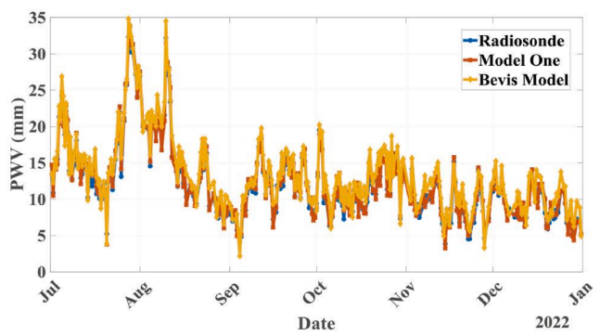
radiosonde data, Model One, and the Bevis Model during the second half of 2022.
The study’s comprehensive approach, utilizing a combination of radiosonde and GNSS RO data, represents a significant step forward in the field of GNSS meteorology. The improved accuracy of Tm estimation not only enhances PWV retrieval but also contributes to a better understanding of atmospheric processes, ultimately supporting more accurate weather forecasting and climate studies.
In conclusion, this research provides a valuable contribution to the field of atmospheric sciences, offering a refined model for estimating Tm that addresses the limitations of traditional approaches. The promising results demonstrate the potential of the proposed models to improve GNSS-based meteorological assessments, paving the way for further advancements in the field.
We extend our gratitude to the authors for their innovative work and invite readers to explore the full study for a deeper understanding of this advancement in atmospheric science.
Reference: Arash Tayfehrostami, Yazdan Amerian, A new model for estimating atmospheric weighted mean temperature from radiosonde and multi-mission GNSS radio occultation data, Geodesy and Geodynamics, 2025. DOI: https://doi.org/10.1016/j.geog.2025.09.009