
This study delves into Mobility as a Service (MaaS) adoption across varied global contexts, emphasizing the need for tailored strategies. By analyzing user perceptions in ten cities, it uncovers the diverse factors influencing MaaS uptake and its potential to enhance sustainable transport solutions.
Understanding the Challenges
Mobility as a Service (MaaS) aims to integrate various mobility services into a single digital platform, promising to transform urban mobility with personalized trip planning and payment options. Despite its potential, MaaS adoption has been slow, hindered by social-psychological factors and diverse user needs. Understanding these factors is crucial, as they significantly impact the success of MaaS initiatives.
The study by Orozco-Fontalvo et al. addresses this gap by examining attitudes and perceptions driving MaaS adoption. It highlights that a one-size-fits-all approach is insufficient due to varied needs and contexts. By focusing on ten cities across Europe, Latin America, Africa, and Asia, the research aims to understand how different urban contexts influence user perceptions and intentions regarding MaaS.
This research is vital as it highlights challenges faced by MaaS in both developed and developing regions. In cities with advanced transport systems, MaaS must be tailored to address specific unmet needs. Conversely, in cities with less developed networks, where dissatisfaction is prevalent, MaaS can fill significant service gaps and enhance satisfaction.
Research Approach and Innovation
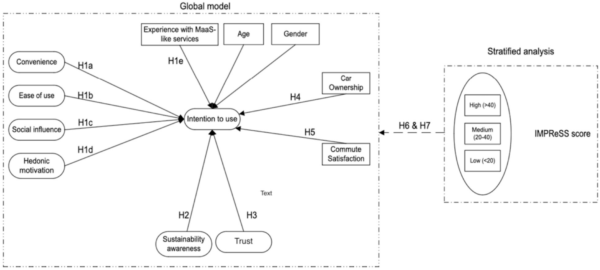
The research by Orozco-Fontalvo et al. employs a robust framework to explore factors influencing MaaS acceptance across ten global cities. Utilizing the Extended Unified Theory of Acceptance and Use of Technology (UTAUT2), the study tests whether latent constructs directly influence the intention to use MaaS. This framework identifies key social-psychological drivers shaping user behavior and acceptance.
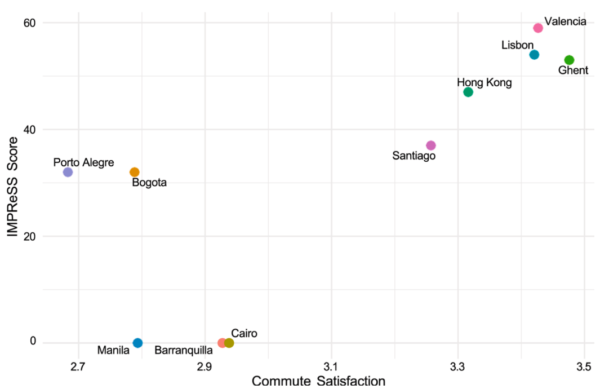
Surveys conducted in cities across Latin America, Europe, Asia, and Africa assessed user preferences and attitudes toward MaaS and new mobility services. Cities were grouped by their MaaS development stage using the IMPReSS score, allowing nuanced analysis of how urban contexts and transport system developments impact user perceptions and intentions.
A Multigroup Structural Equation Model (SEM) examined associations between the IMPReSS score, city attributes, and respondents’ characteristics. This approach identified latent constructs significantly influencing MaaS acceptance and explored how they vary with transport system development. The study’s cross-sectional approach provides insights into regions often underrepresented in MaaS research, particularly in the Global South.
Key Findings and Insights
The study reveals that constructs like Performance Expectancy and Social Influence significantly increase the intention to use MaaS, while Commute Satisfaction reduces it. The strength and significance of these constructs vary with the level of transport system development in surveyed cities. MaaS holds the greatest potential in cities with lower transport digitalization and integration, where dissatisfaction creates opportunities for acceptance.
In developed systems with highly integrated services, MaaS must be tailored to address specific unmet needs. The study underscores the importance of flexible, context-sensitive implementation strategies for MaaS, informed by social-psychological drivers, to promote sustainable transport choices effectively.
Future Directions and Impact
The research by Orozco-Fontalvo et al. offers guidance for policymakers and transportation stakeholders to design MaaS strategies aligned with urban transport systems’ strengths and developmental trajectories. By considering diverse needs and contextual factors influencing user acceptance, stakeholders can develop more effective and sustainable mobility solutions. Insights into the Global South are particularly valuable, highlighting MaaS’s potential to address significant service gaps and enhance satisfaction in these regions.
We thank the authors for advancing our understanding of MaaS adoption. If you have insights or wish to engage further with this research, feel free to reach out and share your thoughts.
Reference: Orozco-Fontalvo, M., Oviedo-Trespalacios, O., Useche, S., He, S. Y., Mangones, S., Gutierrez, M., Christ, A. K., Hook, H., Abouelela, M., & More Authors (2026). Global contexts, local intentions: modeling MaaS acceptance across 10 cities. Transportation Research Part A: Policy and Practice, 207, Article 104951. DOI: https://doi.org/10.1016/j.tra.2026.104951