
This study analyzes macroplastic deposition on river floodplains across 14 events, including five floods, along Dutch rivers, demonstrating higher deposition during severe floods and varying mechanisms based on flood type, offering valuable data for addressing riverine plastic pollution in environmental management.
Understanding Macroplastic Pollution in Rivers
Macroplastic pollution, plastic items larger than 5 mm, poses a significant environmental challenge, affecting ecosystems, wildlife, and human infrastructure globally. Rivers, frequently located near urban areas with inadequate waste management, often exhibit higher plastic concentrations than marine environments. This leads to problems such as ingestion by animals and blockages in drainage systems, which can increase flood risks.
Riverbanks and floodplains function as primary sinks for macroplastics, potentially storing more than the river surface, water column, or sediments. Floods intensify the issue by mobilizing existing deposits and adding new debris from affected areas. However, the destination of this plastic, whether transported downstream or retained on floodplains, has not been fully understood. Previous studies documented deposition in specific flood events, such as the 2021 Meuse flood, but did not explore variations across multiple events or the influence of flood characteristics like magnitude and duration.
This understanding is essential for environmental engineers, as increasing plastic production and more severe floods due to climate change could heighten pollution distribution, impacting water quality and biodiversity.
Research Methodology and Analytical Framework
The study examined macroplastic deposition from 2018 to 2024 across 14 events, including five floods, along the Dutch Meuse and IJssel rivers. The Meuse is a rain-fed river covering 260 km in the Netherlands, while the IJssel is a 120 km distributary of the Rhine influenced by rain, snowmelt, and lake levels.
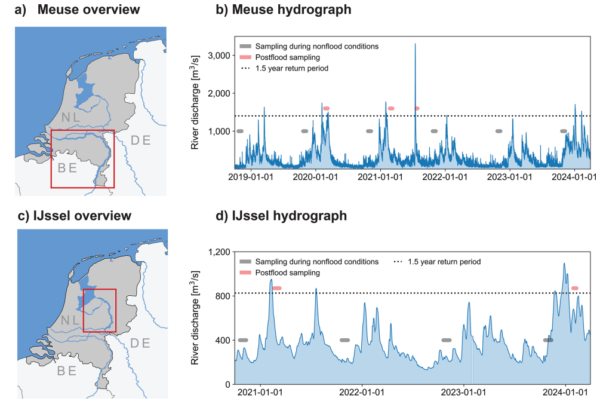
Data were sourced from Schone Rivieren citizen monitoring using the River-OSPAR protocol to count and categorize visible macroplastics in standardized transects. For the 2021 Meuse summer flood and 2024 IJssel winter flood, field campaigns employed modified transects to assess post-flood deposits prior to cleanup. Item counts were converted to mass based on empirical category weights from a separate study.
Flood severity was determined using return periods calculated with Gumbel and generalized Pareto distributions, with durations defined by exceedance of bankfull thresholds. Spatial variations were evaluated using gauging station data.
The modeling framework utilized event-specific generalized linear models incorporating ten factors drawn from literature on plastics, sediments, and wood: floodplain features (width, vegetation height and coverage, slope), river attributes (sinuosity, channel width and slope), and proximity to sources (upstream boundary, wastewater treatment plants, tributaries). These were extracted from datasets including Ecotopen for boundaries and digital surface and elevation models for topography.
Models were refined iteratively for optimal fit using R² and Akaike information criterion, with robustness assessed through leave-one-out cross-validation and bootstrapping. Standardization highlighted variable importance, allowing predictions independent of hydrological conditions.
Core Findings and Outcomes
Macroplastic deposition rose with flood severity, showing correlations with return periods (Spearman’s ρ = 0.52, Pearson’s ρ = 0.65) and discharge (Spearman’s ρ = 0.76, Pearson’s ρ = 0.84). The 2021 Meuse flood (over 100 years) deposited 11.2 g/m², more than double nonflood levels (5.0 g/m²), while the 2024 IJssel flood (3 years) reached 3.3 g/m², triple baseline. Stocks totaled 4620 tons on the Meuse and 610 tons on the IJssel, corresponding to 62-83 years and 15-41 years of annual river transport, respectively.
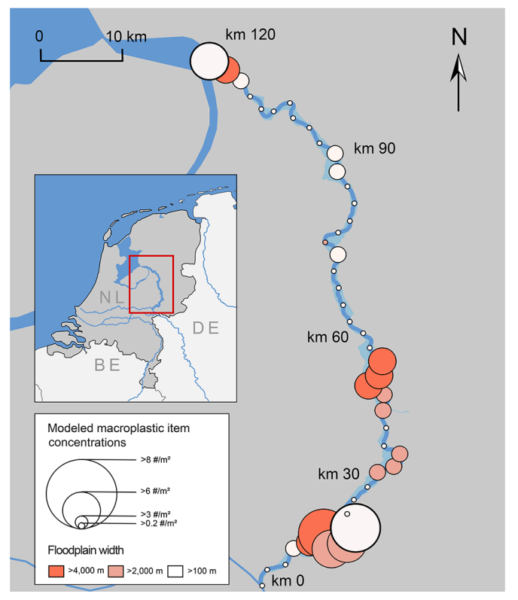
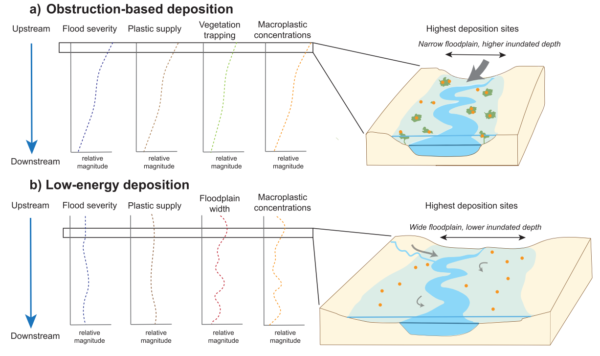
Models predicted concentrations for the major floods (R² = 0.93 for Meuse 2021, 0.83 for IJssel 2024). For the Meuse event, upstream distance was primary, indicating obstruction-based deposition in vegetated areas with steep slopes, declining downstream. The IJssel event featured low-energy deposition, influenced by floodplain width reducing velocities and tributary proximity.
Two deposition types were identified: obstruction-based for the extreme summer flood, with accumulation in vegetation; low-energy for the prolonged winter flood, with settling in wide sections.
Implications and Forward Outlook
With projections of increased flood severity and plastic inputs, this research supports development of predictive models incorporating additional sources, facilitating targeted interventions across varied river systems.
We acknowledge the contributions of Louise J. Schreyers and the research team. Professionals with relevant data or collaboration ideas are encouraged to contact the authors. As stated in the study, “Flood severity and plastic entry into the environment are both projected to increase. Therefore, we expect an even more prominent role for floods in the global distribution of plastic pollution.”
Reference: Schreyers, L. J.; Hauk, R.; Wallerstein, N.; Teuling, A. J.; Uijlenhoet, R.; van der Ploeg, M.; van Emmerik, T. H. M. Flood Characteristics Drive River-Scale Macroplastic Deposition. Environ. Sci. Technol. 2025, 59, 19414–19423.