
Researchers utilize machine learning to model forest fire susceptibility in Brandenburg, Germany, analyzing current and future scenarios. This study offers vital insights for forest management, emphasizing the role of human and vegetation factors in fire prediction and prevention, aiding in strategic planning and risk mitigation.
The Growing Menace of Forest Fires
Forest fires have become a significant global challenge, with their frequency and intensity increased by climate change and human activities. These fires not only threaten ecosystems and biodiversity but also pose severe risks to human livelihoods and infrastructure. In Germany, particularly in the federal state of Brandenburg, forest fires have been a persistent issue, exacerbated by long periods of drought and human negligence. The region’s coniferous forests, characterized by dry summer conditions and sandy soils, are especially vulnerable.
Understanding the conditions that lead to forest fires and identifying areas most susceptible to them are critical for developing effective prevention and management strategies. This research addresses the urgent need to model forest fire susceptibility (FFS) by integrating various environmental and anthropogenic factors. By doing so, it aims to enhance early warning systems and inform strategic planning to mitigate the devastating impacts of forest fires.
Leveraging Machine Learning for Accurate Predictions
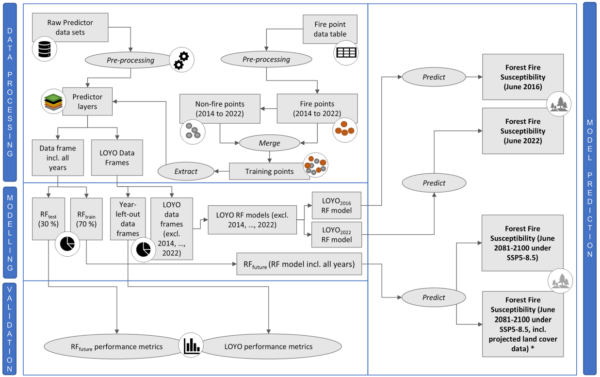
The research employs a random forest (RF) machine learning algorithm to model FFS in Brandenburg, Germany, using a comprehensive set of predictors. These include topographic, climatic, anthropogenic, soil, and vegetation parameters, analyzed at a high spatial resolution of 50 meters. The study focuses on two temporal scenarios: the current period (2014–2022) and future projections (2081–2100).
To represent current conditions, the years 2016 and 2022 were selected based on their climatic characteristics. The year 2016 serves as a baseline with average conditions, while 2022 represents a dry year, reflecting the increasing frequency of extreme weather events. For future scenarios, the study uses the SSP5-8.5 pathway, which assumes high fossil-fuel development, to predict FFS under projected climatic conditions.
The RF model’s accuracy, ranging between 69% and 71%, demonstrates its reliability in predicting FFS. The study’s approach includes predictors such as the distance to campsites and military training sites, expanding existing research on forest fires. This comprehensive analysis provides valuable insights into the key drivers of forest fires, highlighting the significant role of human activities and vegetation in fire susceptibility.
Key Insights into Forest Fire Susceptibility
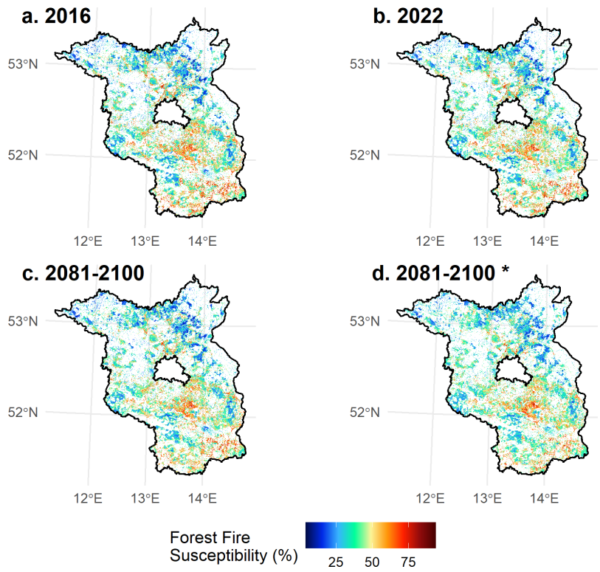
The study’s findings underscore the critical importance of anthropogenic and vegetation parameters in modeling FFS. The RF model successfully identifies areas in Brandenburg that are most susceptible to forest fires, both currently and under future climate conditions. This information is invaluable for forest managers and environmental planners, enabling them to focus prevention efforts on high-risk areas.
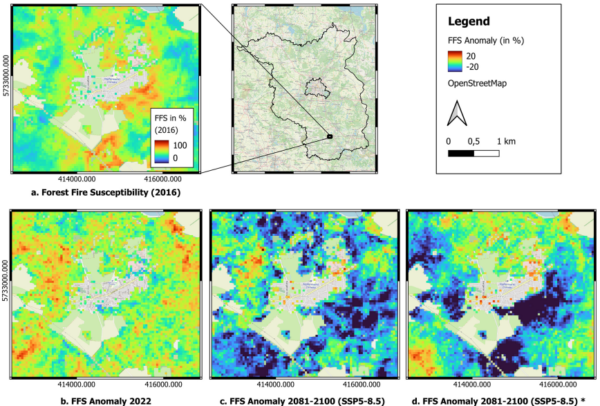
The research highlights the potential for increased forest fire risk in Brandenburg due to climate change, with future scenarios indicating a rise in fire-prone conditions. By providing a detailed analysis of FFS at a local scale, the study offers a robust tool for enhancing fire prevention and management strategies.
Advancing Fire Management Strategies
This research represents a significant advancement in forest fire prediction, offering a powerful tool for mitigating the impacts of climate change on forest ecosystems. The integration of machine learning with high-resolution geospatial data sets a new standard for local-scale fire susceptibility modeling.
Future research could further refine these models by incorporating additional environmental and socioeconomic factors. The study’s approach could be adapted to other regions facing similar challenges, providing a blueprint for global efforts to combat forest fires.
We thank the authors for their valuable contribution to this critical field. If you have insights or wish to collaborate, please reach out to the research team.
Reference: Katharina H. Horn, Stenka Vulova, Hanyu Li, and Birgit Kleinschmit. Modelling current and future forest fire susceptibility in north-eastern Germany. Nat. Hazards Earth Syst. Sci., 25, 383–401, 2025. DOI: https://doi.org/10.5194/nhess-25-383-2025