
Exploring River Dynamics: A Review of Three Decades of Studies on Human-Induced Changes in the Lower Rhine, Emphasizing 2D Modeling for Transverse Sediment Variations, Bifurcation Stability, and Non-Erodible Layer Effects in Large-Scale Bed Profile Management
Human Interventions in the Lower Rhine: Challenges and Significance
The lower Rhine, including the Niederrhein in Germany and the delta branches in the Netherlands downstream from Xanten, has been subject to human modifications since Roman times, with intensified changes from 1850. These include dike construction to narrow floodplains, river training works to create single-thread channels, bend cut-offs, dam and weir installations, bifurcation realignments, sediment mining, dredging, and recent restorations under the Room for the River program. Such alterations have initiated bed erosion and sedimentation responses, posing difficulties in identifying causes and forecasting future developments from delayed effects or new measures.
These issues are significant for civil engineering in areas of flood protection, navigation, freshwater allocation, and ecosystem maintenance. Retrogressive erosion results in downstream bed flattening and upstream steepening, as observed in the Niederrhein, Bovenrijn, and Waal. This can affect infrastructure, similar to widening-related erosion in the Meuse during the 2021 flood that impacted pipelines. The Pannerdense Kop and IJsselkop bifurcations, which distribute discharge, exist in a quasi-equilibrium state that is unstable but evolves slowly, with potential for abrupt shifts in extreme floods that could strain dike capacities. Variations in bed sediment composition over space and time complicate efforts to stabilize profiles by aligning flow velocity gradients with sediment gradients. Amid climate variability and growing waterway demands, these factors highlight the need for integrated, long-distance river system analyses.
Research Methods and Modeling Developments
This review compiles findings from 30 years of research by Deltares and Delft University of Technology, supported by Rijkswaterstaat commissions. Projects include bifurcation modeling at Pannerden, the DVR fairway initiative, assessments of training walls and sediment nourishments, and the IRM bed-level policy. Data sources encompass multibeam echosoundings, borings, vibrocores, and grab samples from Dutch and German institutions.
The approach begins with analyses of the 1D Saint-Venant-Exner equations, assuming uniform river width. These equations address sediment balance and flow, differentiating hyperbolic wavelike responses to upstream sediment alterations (local, downstream propagation) from parabolic diffusive responses to downstream water levels (immediate, upstream extension). Diagrams depict scenarios such as erosion waves from reduced upstream sediment or retrogressive patterns from narrowing.
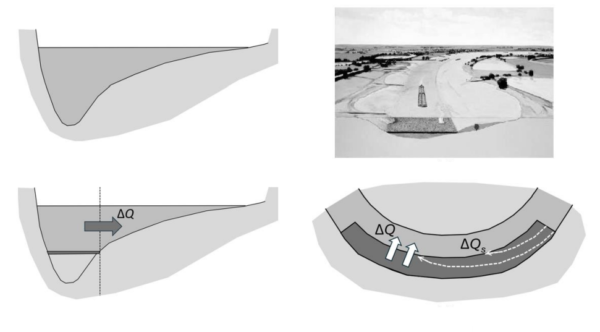
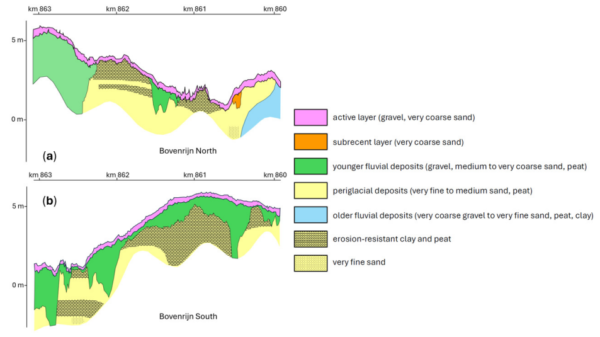
The review identifies limitations in 1D models for longitudinal profiles, supporting the use of 2D models like Delft3D. Developed from 1980s collaborations, these incorporate mixed sediment through fractional transport, hiding-exposure adjustments, and active-layer formulations. Reasons for 2D include transverse sediment variations challenging 1D validity, bifurcation sediment division dependent on local geometry beyond 1D relations, and non-erodible layer effects in bends producing variable outcomes from helical flow and discharge shifts. Bifurcation stability uses 1D phase-plane methods with power-law formulas, while 2D accounts for dynamic factors like navigation. Bed composition analyses extend Exner equations for mixtures, advocating combined echosounder and boring data to address gaps.
This integration of theory, numerical methods, and data provides a framework for simulating river complexities.
Results and Conclusions
Findings indicate that interventions like river training, bend cut-offs, and mining drive retrogressive erosion in the lower Rhine, with downstream flattening and upstream steepening in profiles. Sediment nourishment at the German-Dutch border provides local sedimentation, consistent with wavelike patterns, while widening may increase upstream erosion through backwater effects, requiring comprehensive assessments.
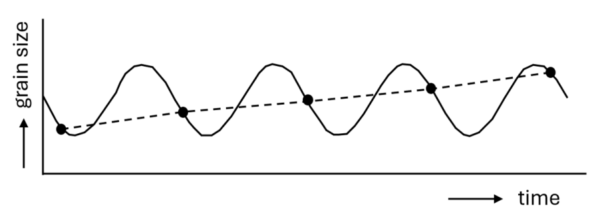
2D modeling is required for predictions, as 1D cannot address transverse variations, bifurcation sediment distribution (with bed level steps invalidating certain approaches), or non-erodible layers’ effects. Bed sediment shows surface patchiness with more uniform subsurface layers, but modeling faces issues like active-layer sensitivity and hiding-exposure constraints. Bifurcations are in quasi-equilibrium, unstable but slow-developing, with stability limits at exponents such as p > b/3; 2D reveals influences from navigation.
The authors conclude: “The Pannerdense Kop and IJsselkop bifurcations are in a state of quasi-equilibrium, essentially unstable but developing slowly.” They note sediment composition as a key knowledge gap, recommending studies on upper-bed size and structure.
Implications and Future Directions
The review supports advancements in 2D and potentially 3D models for initiatives like Room for the River 2.0, aiding predictions of avulsions and adaptations to changing flood regimes.
We thank Erik Mosselman and Kees Sloff for their contribution to river engineering. For related insights or collaborations on sediment or modeling topics, contact erik.mosselman@deltares.nl. For further reading, refer to: Mosselman, E.; Sloff, K. Insights in Processes and Modelling of the Morphological Evolution of the Lower Rhine. Water 2026, 18, 407. https://doi.org/10.3390/w18030407.