
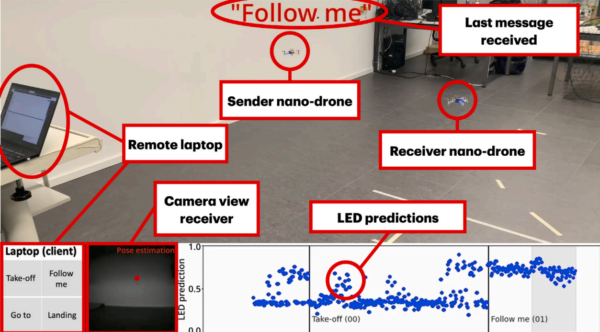
Inspired by fireflies, researchers have developed a visible light communication system for nano-drones. This approach uses convolutional neural networks to enable efficient, low-power communication, advancing drone swarm technology in resource-constrained environments. The system leverages existing onboard hardware, enhancing reliability without specialized equipment.
Overcoming Nano-Drone Communication Hurdles
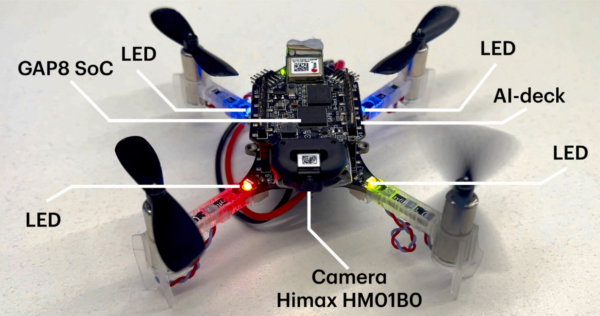
The realm of autonomous drones is rapidly expanding, with swarms of these flying machines being deployed for a variety of applications, from environmental monitoring to search and rescue missions. However, as drones become smaller, particularly nano-drones with diameters less than 10 cm and weights under 50 g, they face significant constraints in terms of onboard resources. These constraints include limited sensor capabilities, minimal computational power, and restricted memory, all of which pose challenges for effective communication and coordination within drone swarms.
Traditional communication methods, such as WiFi and Bluetooth, while effective, can be power-intensive and susceptible to interference, making them less ideal for nano-drones. This is where visible light communication (VLC) comes into play. VLC offers a promising alternative by using light-emitting diodes (LEDs) to transmit data, a method that is both low-power and less prone to interference. However, implementing VLC in nano-drones has its own set of challenges, primarily due to the need for specialized hardware, which can be bulky and power-hungry.
In this context, the research by Luca Crupi and colleagues is noteworthy. By drawing inspiration from the natural world—specifically, the bioluminescence of fireflies—their study introduces a VLC system that leverages the existing hardware on nano-drones, such as cameras and LEDs, to facilitate communication. This approach not only addresses the power and size constraints but also enhances the reliability of communication within drone swarms.
Innovative System Design and Methodology
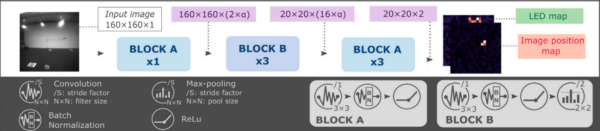
The researchers have developed a visible light communication system that allows nano-drones to exchange messages through the blinking of LEDs, similar to how fireflies communicate. The core of this system is a fully convolutional neural network (FCNN) that runs on an ultra-low-power GreenWaves GAP8 system-on-chip. This FCNN, compact with just 7,500 parameters, is responsible for processing images captured by a low-resolution camera on the receiving drone to predict the state of the LEDs on the sending drone.
The FCNN produces two low-resolution output maps from each input image. The first map indicates the probability of a nano-drone’s presence in the image, while the second map predicts whether the drone’s LEDs are on. This data is then fed into a synchronization-free decoder, which identifies the start of a new message and decodes the payload. The entire process is designed to run in real-time, with the FCNN achieving 39 frames per second.
Two alternative architectures for the FCNN, namely FCNN-small and FCNN-large, were assessed for their performance versus computational and memory costs. This flexibility allows the system to be tailored to specific requirements, balancing accuracy and resource usage. The system’s design prioritizes power efficiency, consuming only 101 milliwatts, making it highly suitable for the limited power budgets of nano-drones.
Promising Results and Conclusions
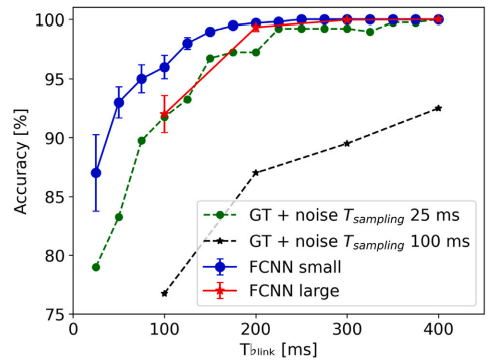
The research’s outcomes are impressive. The FCNN achieves an area under the curve (AUC) of 0.87 for the binary LED classification task, marking an improvement of 27% over previous nano-drone VLC systems. The system supports data throughput ranging from 2.8 to 8.6 bits per second with a per-bit accuracy of 93%, and from 0.6 to 1.6 bits per second with an accuracy of 99.8%.
These results demonstrate the system’s capability to provide reliable communication between nano-drones using only the onboard camera and LEDs, without the need for specialized hardware. This innovation not only enhances the communication capabilities of nano-drones but also opens up new possibilities for their deployment in complex environments where traditional communication methods may fail.
Future Potential and Implications
The implications of this research are vast. By enabling efficient and low-power communication between nano-drones, this VLC system can complement existing communication channels, such as WiFi and Bluetooth, and provide a robust alternative in scenarios where radio channels are unavailable or compromised. Moreover, the system’s reliance on commonly available hardware makes it an accessible and cost-effective solution for enhancing nano-drone capabilities.
Looking ahead, this research could pave the way for new applications in security-critical messaging and two-factor authentication, particularly in environments with stringent power constraints. The potential for further optimization and adaptation of this system for a wider range of applications is immense, offering exciting prospects for the future of drone technology.
Reference: Luca Crupi, Nicholas Carlotti, Alessandro Giusti, Daniele Palossi. “Blinking like Fireflies: Convolutional neural networks for bio-inspired visible light communication between nano-drones.” Engineering Applications of Artificial Intelligence 172 (2026) 114280. DOI: https://doi.org/10.1016/j.engappai.2026.114280