
Insights into Multi-National Infrastructure Management
This study examines a configuration of seven interorganizational governance mechanisms across three levels in the BiOceanic Corridor program, addressing institutional complexities from diverse national environments in Brazil, Paraguay, Argentina, and Chile, extending prior research focused on single-institutional contexts.
Challenges in Transnational Infrastructure Governance and Their Significance
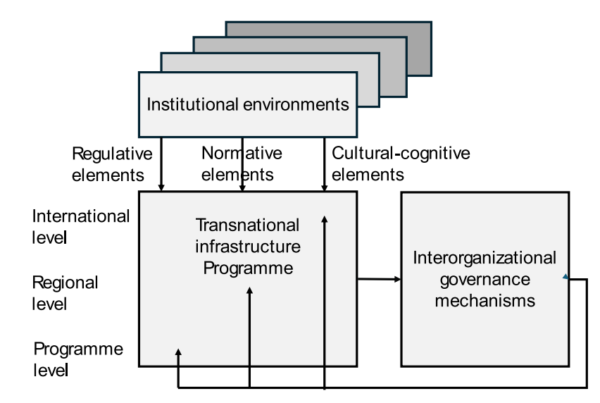
Transnational infrastructure megaprojects, such as high-speed railways or cross-border highways, play a key role in global trade, economic growth, and regional integration. These projects span multiple countries, each with distinct political systems, legal frameworks, regulations, and cultural norms, resulting in institutional complexities. Institutional environments include regulative aspects like laws and policies, normative elements such as professional standards and values, and cultural-cognitive factors including shared beliefs and assumptions. Such differences can lead to conflicts, for example in safety standards or professional practices, causing delays, increased costs, and impeded progress.
This complexity is heightened in programs without a central authority, where coordination relies on interorganizational governance mechanisms, defined as formal and informal rules facilitating collaboration between partners. Prior research has primarily addressed projects in uniform institutional settings, often overlooking multi-national dynamics. Examples include the Hong Kong-Zhuhai-Macau Bridge and Laos-China high-speed rail, which faced issues from varying legal systems, social contexts, and cultures. Inadequate governance can result in these initiatives becoming underutilized assets that fail to enhance economies or reduce poverty, potentially exacerbating regional disparities.
Transnational infrastructure influences logistics and development, particularly in South America, where economic variations and historical divisions persist. The BiOceanic Corridor, a 2250 km road connecting Brazil’s Atlantic coast to Chile’s Pacific ports through Paraguay and Argentina, aims to reduce transport times and costs since its formalization in 2015. It contends with cultural differences, for example between Portuguese-speaking and Spanish-speaking nations, economic imbalances between stronger economies like Brazil and Chile versus Paraguay and Argentina, and geopolitical considerations. Effective governance supports internal project coordination while ensuring compliance with external regulations and stakeholder requirements, promoting cooperation and collaboration to realize program objectives amid diverse institutional settings.
Research Approach: Examining Governance in Practice
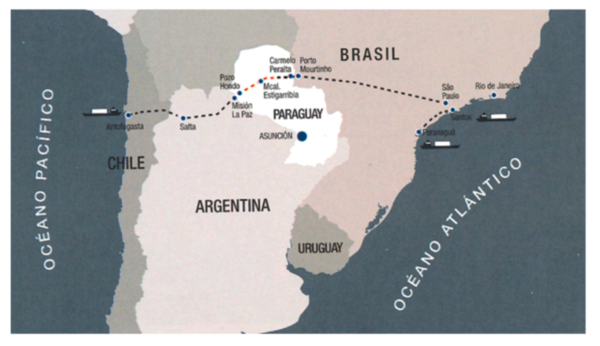
The study uses a single case study methodology to investigate interorganizational governance in the BiOceanic Corridor program, chosen for its representation of a decentralized transnational initiative across four nations. This method, based on Yin (2003), facilitates detailed analysis of real-world complexities, revealing how governance mechanisms handle institutional challenges.
Data collection incorporated three methods for comprehensive coverage. Desk research reviewed 32 documents, reports, and articles in English, Portuguese, and Spanish, addressing program objectives, organizations, budgets, and structures, with sources mainly from regions such as Chile’s Antofagasta and Brazil’s Mato Grosso do Sul. Analysis of 28 YouTube videos, categorized by international, regional, and program levels, provided insights into governance activities; content from Chilean and Brazilian channels was prominent, with engineering-related videos attracting significant views. Fieldwork in Argentina from February to March 2024 included observations of roads such as RN 51, 52, and 34, noting incomplete sections and local effects, along with informal discussions with stakeholders including truck drivers and residents. Interviews comprised two with academics from Salta and two with the Brazilian coordinator, transcribed for analysis.
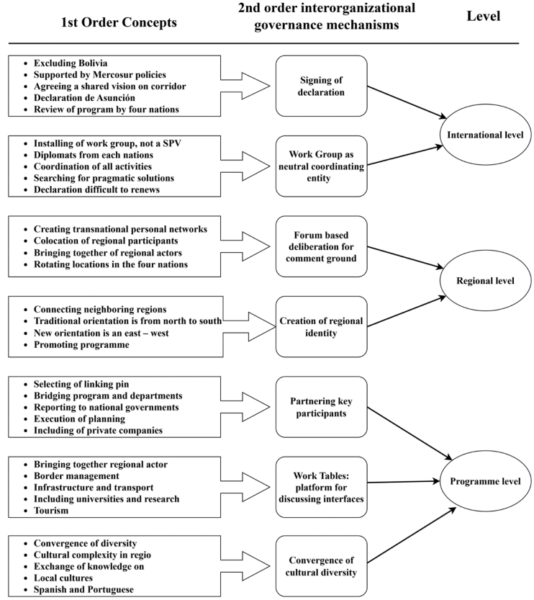
Data analysis applied inductive coding per Gioia et al. (2013): first-order concepts from the data were grouped into seven second-order mechanisms, then organized into three governance levels following Levitt and Scott (2017). The resulting narrative was confirmed with the Brazilian coordinator for precision.
The approach highlights a multilevel configuration emphasizing relational mechanisms to navigate regulative, normative, and cultural-cognitive complexities in a South American setting, providing applicable insights for managing comparable international projects.
Key Findings and Conclusions
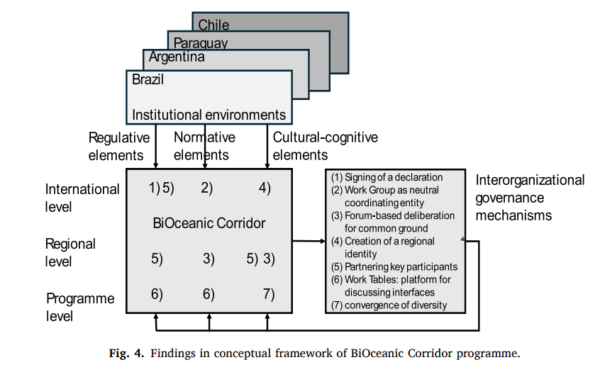
The research identifies a configuration of seven interorganizational governance mechanisms across international, regional, and program levels to coordinate the BiOceanic Corridor amid national variations.
At the international level: (1) Signing a declaration, the 2015 Asunción Declaration aligns nations under Mercosur without binding contracts, addressing regulative challenges. (2) Work group as neutral coordinator, biannual meetings of diplomats and experts align norms, resolve issues pragmatically, and mitigate political influences.
At the regional level: (3) Forum-based deliberation, rotating multilateral gatherings build networks and address inequalities, managing normative complexities. (4) Regional cultural identity creation, promotes shared heritage through sector and university collaborations, though indigenous and Mennonite communities show resistance, handling cultural-cognitive elements.
At the program level: (5) Partnering key participants, links national departments, regional authorities, private firms, and academics, but underrepresents locals and environmental groups, tackling regulative aspects. (6) Work tables, sector groups for trade, borders, infrastructure, universities, tourism, and security align standards and timelines. (7) Cultural diversity convergence, bridges divides such as language and indigenous versus colonial backgrounds, yet overlooks some community impacts.
Relational mechanisms predominate in this US$2.37 billion program, funded by governments, the private sector, and the Inter-American Development Bank, with the configuration evolving to include security in a decentralized structure.
Implications and Future Directions
As corridor programs grow worldwide, this configuration suggests potential for adaptive governance in regions with instability, with emphasis on cultural elements to support equitable outcomes and sustainability.
We thank Alfons van Marrewijk for this contribution, noting: “The findings extend current debates on governance of transnational infrastructure programmes by showing how governance mechanisms are distributed and enacted across levels to manage institutional complexity.” Reference: van Marrewijk, A. (2026). Interorganizational governance of transnational infrastructure programmes across multiple national environments: The South American BiOceanic Corridor as ‘the new Panama Canal’. International Journal of Project Management, 44(1), Article 102794. https://doi.org/10.1016/j.ijproman.2025.102794.