
This study introduces a framework to quantify the value of Seismic Structural Health Monitoring (SSHM) in enhancing the resilience of electric power networks post-earthquake. It offers a data-driven approach to optimize recovery processes, improving damage assessments and reducing service disruptions.
Resilient Electric Power Networks: A Critical Need
Electric power networks (EPNs) are essential for modern society, providing energy across various sectors. However, they are vulnerable to natural hazards like earthquakes due to their wide geographical spread and proximity to fault zones. Earthquake-induced failures can cause power outages and cascading failures in other systems, threatening public safety and economic stability.
Traditionally, post-earthquake recovery relies on manual damage assessments, which are slow and imprecise, leading to suboptimal repair prioritization and prolonged disruptions. This is particularly challenging in large-scale systems where inspections are labor-intensive and prone to errors. Enhancing EPN resilience to absorb disruptions and rapidly restore functionality is a critical priority in disaster risk management.
Despite frameworks developed over the past decades to assess EPN resilience, these often assume complete and accurate damage knowledge post-earthquake. In reality, damage is typically inferred from visual inspections, which are time-consuming and subjective, potentially leading to suboptimal recovery decisions and prolonged outages.
Simulation-Based Framework: A Novel Approach
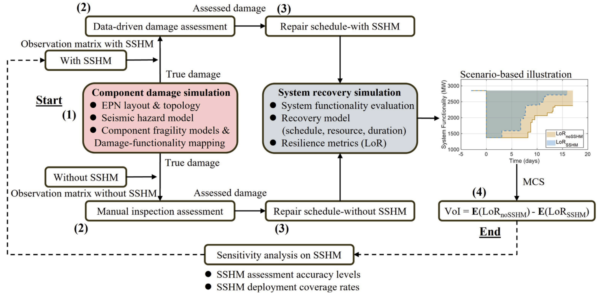
This study introduces a simulation-based framework to quantify the resilience-based value of SSHM information for post-earthquake EPN recovery. It includes four modules: probabilistic damage simulation, component-wise damage perception, system-level recovery simulation, and resilience-based Value of Information (VoI) quantification.
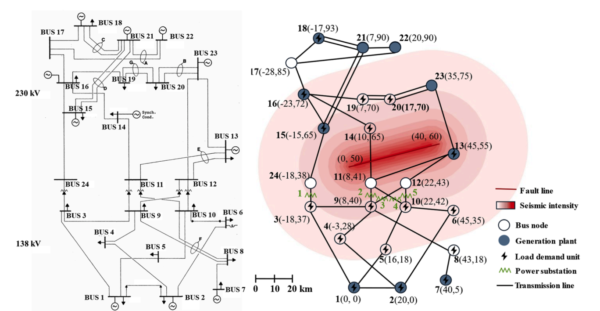
The probabilistic damage simulation module uses EPN configuration, seismic hazard data, fragility functions, and damage-functionality mapping to simulate damage scenarios. The component-wise damage perception module models the imperfect and delayed nature of post-earthquake information, simulating various monitoring scenarios from no SSHM to full SSHM with different accuracy levels.
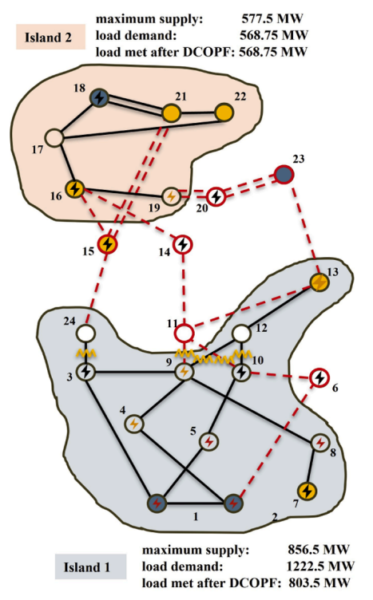
The system-level recovery simulation module evaluates system functionality through graph-based island detection and optimal power flow analysis. It simulates recovery processes considering repair scheduling, resource constraints, and repair durations. The resilience-based VoI quantification module uses the Lack of Resilience (LoR) metric to quantify SSHM’s impact on resilience.
The framework’s modular structure allows for evaluating SSHM’s influence on repair scheduling and recovery trajectories, with uncertainties propagated via Monte Carlo simulations. A case study based on the IEEE 24-bus Reliability Test System demonstrates its application, providing a quantitative foundation for evaluating SSHM’s resilience benefits.
Quantifiable Benefits of SSHM
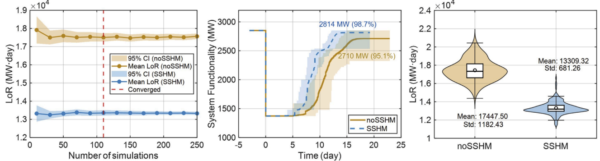
Findings reveal that SSHM improves damage awareness, significantly accelerating recovery and reducing the Lack of Resilience (LoR) by up to 21%. This reduction highlights SSHM’s potential to enhance EPN resilience by providing accurate damage assessments, optimizing repair prioritization, and minimizing disruptions.
Incorporating SSHM into recovery strategies leads to informed decision-making, reducing reliance on subjective inspections. SSHM improves situational awareness, enabling efficient repair resource allocation, prioritizing critical components, and reducing overall restoration time.
This study provides a quantitative foundation for evaluating SSHM’s resilience benefits, offering insights for sensor investment decisions in critical infrastructures. Integrating SSHM into resilience modeling advances disaster risk management, providing a data-driven approach to enhance EPN resilience.
Future Directions: Expanding SSHM’s Impact
This framework marks a significant step in quantifying SSHM’s value for EPN resilience. It offers a comprehensive approach to evaluate trade-offs in sensing accuracy, coverage, and timeliness, informing investment decisions in SSHM technologies.
Future research could apply this framework to other critical infrastructures, like transportation and water networks, to enhance resilience to natural hazards. Advancements in data assimilation and digital twinning could further improve SSHM accuracy and timeliness, benefiting post-earthquake recovery efforts.
We thank the authors for their contribution and encourage readers to engage with the research. For more details, refer to the full study.
Reference: Liang, Huangbin; Moya, Beatriz; Chinesta, Francisco; Chatzi, Eleni. “Quantifying the value of seismic structural health monitoring for post-earthquake recovery of electric power system in terms of resilience enhancement.” Reliability Engineering & System Safety 273, 2026. DOI: https://doi.org/10.1016/j.ress.2026.112292