
As satellite megaconstellations proliferate, understanding the risks of their reentry becomes crucial. This study examines the potential hazards posed by debris from these satellites, highlighting the need for improved safety measures and international regulations to address the growing threat to human safety and infrastructure.
Understanding the Growing Threat
As satellite technology advances, the deployment of megaconstellations—vast networks of satellites—has become increasingly common. These constellations, exemplified by SpaceX’s Starlink and Eutelsat’s OneWeb, aim to provide global internet coverage and other services. However, the sheer number of satellites involved presents a significant challenge: the risk of debris from uncontrolled reentries impacting the Earth’s surface. When satellites reenter the atmosphere, they often break apart due to aerodynamic forces and heat, but not all fragments burn up completely. Estimates suggest that up to 40% of a satellite’s mass can survive reentry, posing a potential hazard to people and infrastructure on the ground.
Recent incidents underscore these risks. In 2024, debris from SpaceX Dragon spacecraft trunks landed in populated areas, hitting houses in Saskatchewan and North Carolina. Such events, classified as ‘near misses,’ highlight the urgent need for effective safety management to prevent potential casualties. With the rapid expansion of satellite megaconstellations, the probability of such incidents is expected to rise. Regulatory frameworks currently permit uncontrolled reentries if the casualty risk is below a certain threshold, but these guidelines were established when satellite numbers were far lower.
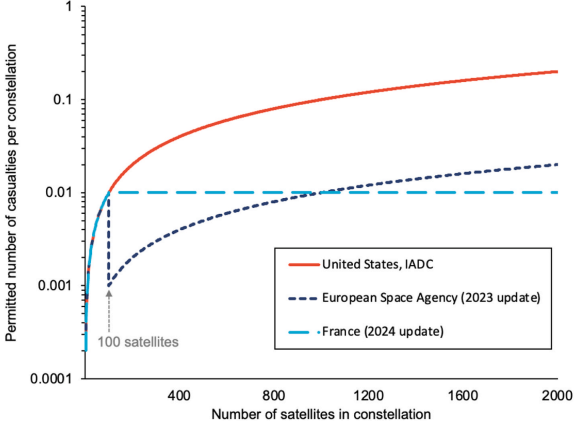
International efforts to regulate these risks vary. The United States, for instance, allows a casualty risk of 1 in 10,000 per satellite, a standard endorsed by the Inter-Agency Space Debris Coordination Committee. However, as the number of satellites increases, the cumulative risk grows, prompting some agencies to propose stricter guidelines. The European Space Agency and France have introduced more stringent standards, limiting the collective risk from large constellations.
Innovative Research Approach
The research conducted by Ewan Wright, Aaron Boley, and Michael Byers at the University of British Columbia employs an approach to estimate casualty risks from satellite reentries. Instead of relying on correlations between satellite mass and surviving debris, the study models the minimum casualty risk assuming that a lethal amount of debris survives reentry. This method circumvents the limitations of existing models, which often depend on outdated satellite designs and confidential data.
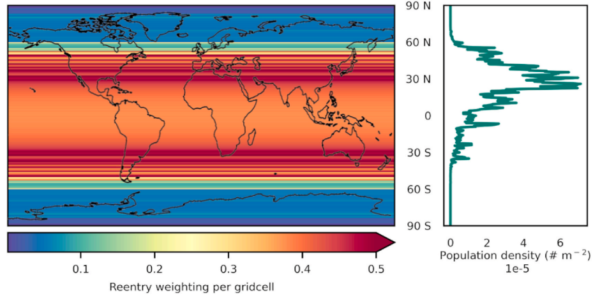
To achieve this, the researchers developed a probability density function for each satellite, determining the likelihood of reentry over various latitudes. This function accounts for the satellite’s orbital inclination and the distribution of its ground track. By integrating these probabilities across a constellation, the researchers calculated the total risk posed by multiple satellites.
The study also considers population growth, projecting a 1% annual increase in population density from 2020 data. This factor is crucial in assessing the potential impact of debris on populated areas. The researchers model the debris casualty area, which represents the combined area of lethal debris pieces, to estimate the risk of injury or death to individuals on the ground.
Key Findings and Recommendations
The findings reveal that the risk of debris from satellite megaconstellations is not merely theoretical. Incidents involving surviving debris have already occurred, and with the planned launch of thousands more satellites, the potential for future incidents is significant. The study highlights the challenges of designing satellites to fully demise during reentry, particularly as newer models increase in size and mass.
The research underscores the inadequacy of current regulations in addressing the cumulative risks posed by large constellations. While some agencies have introduced stricter guidelines, there is a lack of international consensus on acceptable risk levels. The study calls for a coordinated global effort to establish standards that ensure safety without stifling innovation in satellite technology.
Future Directions and Global Cooperation
This research provides a critical foundation for understanding and mitigating the risks associated with satellite megaconstellations. By highlighting the limitations of current models and regulations, it paves the way for more effective safety measures and international cooperation. The study’s approach to modeling casualty risks offers a valuable tool for policymakers and industry leaders as they navigate the challenges of an increasingly crowded orbital environment.
We thank the authors for their valuable contribution to this pressing issue. Those interested in furthering this research or sharing insights are encouraged to reach out and engage in this vital conversation.
Reference: Ewan Wright, Aaron Boley, Michael Byers. “Satellite megaconstellations and collective casualty risks.” Space Policy. DOI: https://doi.org/10.1016/j.spacepol.2026.101749