
Researchers at Delft University of Technology have developed a cryo-CMOS smart temperature sensor operating from 5 K to 296 K. This innovation offers high accuracy and efficiency, addressing challenges in quantum computing and space applications by providing precise thermal monitoring across a wide temperature range.
Addressing Cryogenic Challenges
The demand for cryogenic electronics is surging, driven by their critical role in fields such as medicine, space exploration, and the burgeoning domains of quantum sensing and quantum computing. Quantum processors, which typically require cryogenic conditions, necessitate an extensive cryogenic electrical interface to facilitate the scaling of quantum computers to practical applications. However, these large systems on chips (SoCs), often operating at 4 K, face challenges such as self-heating and thermal crosstalk, which can create hot spots and negatively impact the performance of temperature-sensitive qubits. To mitigate these issues, on-chip thermal monitoring is essential, yet traditional temperature sensors are bulky, expensive, and difficult to integrate, leading to measurement uncertainties.
While CMOS temperature sensors present a promising alternative, their operational range is usually limited to above -70°C. Previous attempts to extend this range to deep cryogenic temperatures have been hindered by the lack of integrated readout, reliance on external references, or limited characterization. This gap in technology has prompted the development of a compact, integrated solution that can operate effectively across a wide temperature spectrum, ensuring precise thermal monitoring without the drawbacks of traditional sensors.
Innovative Sensor Design
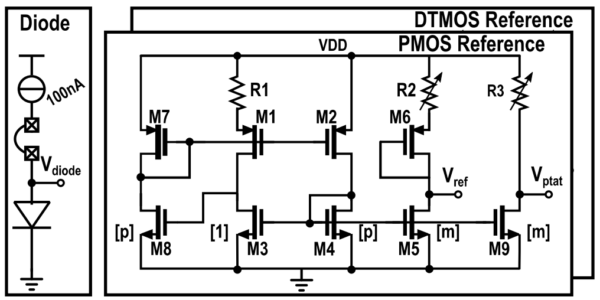
The research team at Delft University of Technology tackled these challenges by developing a cryo-CMOS temperature sensor that operates from 5 K to 296 K. The sensor leverages sensing elements such as CMOS bulk diodes and pMOS/DTMOS in weak inversion, which circumvent the poor cryogenic performance of silicon BJTs. These elements generate a complementary to absolute temperature (CTAT) voltage and a proportional to absolute temperature (PTAT) voltage, crucial for accurate temperature sensing.
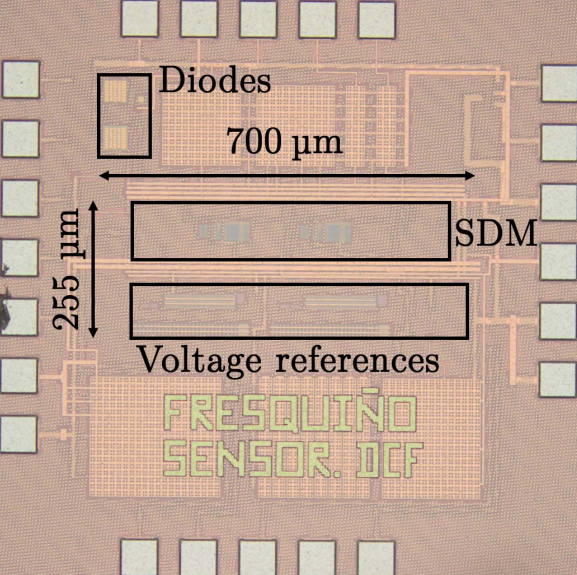
To achieve high resolution and accuracy, the researchers employed a robust switched-capacitor second-order sigma-delta modulator (SDM) for readout. This choice allows for high-resolution analog-to-digital conversion, essential for the desired sub-1-K accuracy. The SDM’s design incorporates dynamic element matching (DEM) to reduce mismatch effects, which are exacerbated at cryogenic temperatures. Additionally, the sensor’s architecture includes programmable resistor ladders to optimize the use of the ADC input range, ensuring precise digitization of the temperature signals.
Furthermore, the sensor’s design addresses the challenges posed by cryogenic conditions, such as increased on-resistance of switches and threshold voltage variations. By utilizing thick-oxide nMOS devices and implementing charge injection mitigation techniques, the researchers ensured reliable operation across the entire temperature range. The SDM’s ability to trade off speed and resolution allows for a more accurate temperature sensor without requiring design changes, achieving a resolution of 0.03 K for a 102.4-ms conversion time.
Performance and Efficiency
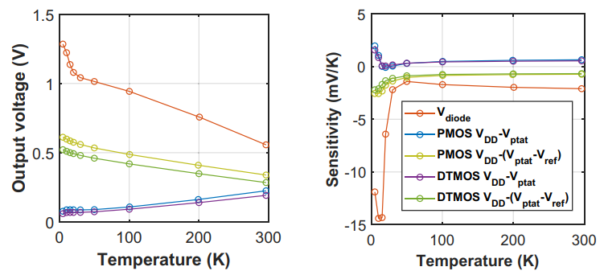
The cryo-CMOS temperature sensor demonstrated exceptional performance, achieving a maximum error of ±0.73 K across the ultrawide temperature range from 5 K to 296 K. With a resolution below 0.05 K for a 102.4-ms readout duration, the sensor exhibits remarkable precision. Additionally, it operates with a power consumption of 15.5 µW at 5 K and 93.5 µW at 296 K, highlighting its efficiency.
The integration of the sensor in a 40-nm bulk CMOS technology resulted in a compact active area of 0.19 mm², making it suitable for dense arrays in large-scale cryogenic systems. The sensor’s innovative design, which includes a second-order sigma-delta modulator and dynamic element matching, ensures high accuracy and reliability, even at deep cryogenic temperatures.
Future Prospects
This research marks a significant step forward in the development of cryogenic electronics, particularly for quantum computing and space applications. The cryo-CMOS temperature sensor’s ability to operate across an extensive temperature range with high accuracy and low power consumption makes it a promising candidate for integration into future quantum processors and other cryogenic systems.
Looking ahead, the sensor’s compact design and robust performance could pave the way for widespread adoption in various cryogenic applications, enhancing the scalability and efficiency of quantum computing technologies. The research team invites collaboration and input from the engineering community to further explore and refine this innovative technology.
Reference: Fungueiriño, C. C., Enthoven, L. A., van Staveren, J., Babaie, M., & Sebastiano, F. (2026). A Cryo-CMOS Smart Temperature Sensor for the Ultrawide Temperature Range From 5 K to 296 K. IEEE Solid-State Circuits Letters, 9, 29-32. DOI: https://doi.org/10.1109/LSSC.2025.3650657