
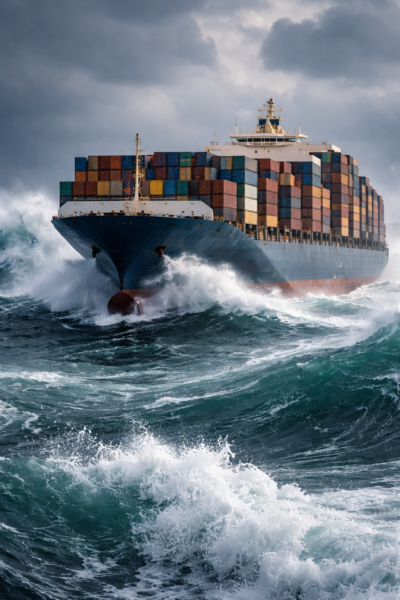
For the first time, six major ocean engineering challenges—from ship hydroelasticity to wave-mud interactions—are woven into a single, structured modelling framework, providing engineers a roadmap to predict how flexible structures and the sea influence each other.
Why This Is Important
From massive ships bending in waves to seagrass swaying in currents, the ocean is a stage for complex interactions between fluid and flexible structures. Accurately predicting these dynamics is no longer just academic—it’s critical for designing safer ships, resilient coastal defences, and efficient marine energy systems in an era of climate change and extreme seas.
Traditionally, research on Flexible Fluid-Structure Interaction (FFSI) has been fragmented. Experts have published notable reviews on specific areas, like wave-ice interactions or flapping foils, but a comprehensive synthesis was missing. This left engineers and scientists without a unified vision to compare modelling approaches across different ocean applications. The design practices and classification rules for ships and marine structures still often overlook vital hydroelastic effects, leading to potential underestimation of loads and fatigue.
This ambitious review set out to answer a central question: How can we unify the modelling knowledge across the diverse landscape of ocean FFSI problems? The goal was to create the first holistic state-of-the-art review, bridging six key application areas under one comparative framework. The approach is distinct because it doesn’t just catalogue studies; it introduces a structured “modelling pathway” that generalises how FFSI models are built—from fluid and solid idealisation to solver coupling—enabling direct comparison and knowledge transfer between previously siloed fields.
The research delivers a powerful, structured framework that demystifies FFSI modelling. Its core innovation is a unified analysis of six major problems: wave-structure interaction, global ship hydroelasticity, flexible slamming, marine propellers, aquatic vegetation, and wave-mud interactions. For each, it details the modelling assumptions—like inviscid vs. viscous flow, elastic vs. viscoelastic solids, and monolithic vs. partitioned coupling strategies. Crucially, it introduces a generalised modelling pathway, allowing readers to see the shared techniques and unique requirements across different applications. This cross-cutting insight is a first, providing a much-needed “handbook” for selecting, developing, or transferring FFSI models.
The review confirms that FFSI research has matured significantly, with advanced computational models now complementing early physical tests. However, it highlights critical gaps: hydroelastic effects are still not fully incorporated into design rules, and significant uncertainties remain in modelling flexible slamming, vegetation dynamics, and wave-mud interactions. The analysis shows that while high-fidelity CFD models capture complex nonlinearities, simpler inviscid-based models remain vital for many design-stage analyses, especially when computational efficiency is key.
Implications & Future Potential
This work equips researchers and industry engineers with a clear framework to tackle next-generation ocean systems, from ultra-large flexible ships to nature-based coastal protection. The structured comparison will accelerate innovation, inspire cross-disciplinary model transfer, and guide the development of benchmarking standards. Future work must bridge high-fidelity simulation with real-world applications, expand validation datasets, and harness AI-based methods to accelerate FFSI predictions and design optimisation.
Understanding the flexible dialogue between ocean and structure is paramount for a sustainable and safe maritime future. As the authors conclude, “future research must bridge computational modelling with real-world applications… and incorporate AI-based methods.” This monumental review provides the essential map for that journey. We thank the authors for this significant contribution. If you are working on cutting-edge marine systems, this is your essential primer.
Reference: Tavakoli, S., Singh, M., Hosseinzadeh, S., et al. (2025). A review of flexible fluid-structure interactions in the ocean: Progress, challenges, and future directions. https://doi.org/10.1016/j.oceaneng.2025.122545