This research from Delft University of Technology delves into the use of thick mapping in architectural design, focusing on railway stations as dynamic interchanges. By integrating mixed-media drawings, the study reveals spatial narratives and encourages interdisciplinary collaboration in mobility architecture.
Decoding Mobility Architecture
In today’s fast-paced world, the demand for movement and connectivity is ever-increasing, driven by contemporary living, labor, and leisure patterns. This intensifies the need for infrastructural interventions in urban environments to facilitate the spatial exchange of people, goods, and information. Infrastructures, particularly mobility hubs like railway stations, are not merely technical systems; they reshape the conditions and opportunities of modern life. The architecture of these interchanges must be reimagined to address environmental challenges, social shifts, and technological advancements.
Railway stations and similar intermodal hubs are evolving beyond their traditional roles as functional transit nodes. They are now seen as architectures of interchanges, organizing the dialogue and interaction between different agents, systems, and the environment. The design of these stations, including their spatial articulation and ambiance, significantly influences the multisensory experience of passengers. Addressing this complexity requires innovative design approaches and research methods that foster participation and integration across disciplines.
Thick mapping emerges as a critical method in this context. It offers a collaborative and design-driven research practice that enables researchers, students, designers, and practitioners to delve into complex conditions and unveil the hidden mechanisms of architectural spaces. By collecting, aggregating, and visualizing layers of geographic data, thick mapping reveals alternative spatial relationships and narratives. This approach does not prioritize one aspect over another but instead embraces a multifaceted understanding of socio-environmental challenges.
Thick Mapping in Practice
The research conducted by Ömer Faruk Ağırsoy and colleagues at Delft University of Technology employs thick mapping as a methodological framework within an international architectural design workshop. This workshop brought together 45 students from various educational levels and fields, along with academics and practitioners, in a collaborative exercise to co-create new knowledge about mobility at railway stations.
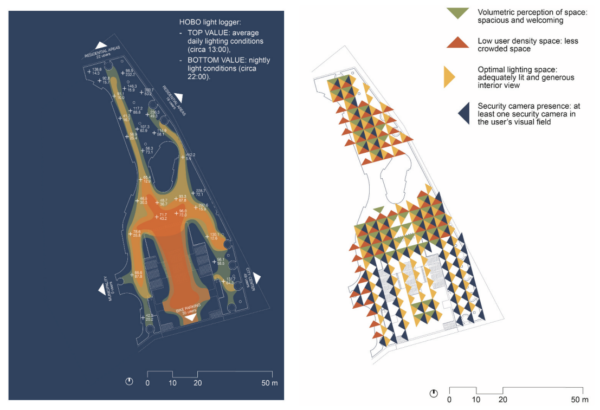
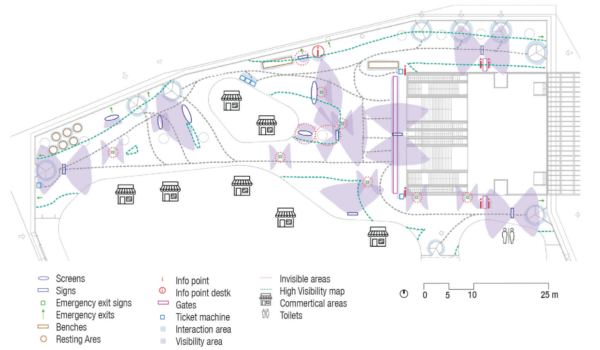
The workshop explored the architecture of interchanges through three thematic lenses: articulation (flows), light and safety (perception), and interfaces (interaction with users). By combining mixed-media drawings with thick mapping practices, participants investigated the visible and invisible relationships between mobility infrastructure, architectural space, and human perceptions in stations. This approach allowed for a deeper understanding of stations by visualizing interactions across multiple scales, systems, modalities, agents, and flows.
Thick mapping served as a methodological bridge between theory and spatial investigations, breaking down relations, scales, and layers. It facilitated visual analysis and exploration, uncovering hidden stories and providing a pedagogical framework for interdisciplinary collaboration. The workshop’s hands-on exercises and visualization experiments enabled participants to engage in embodied observation and quantitative and qualitative exploration on site.
Unveiling New Narratives
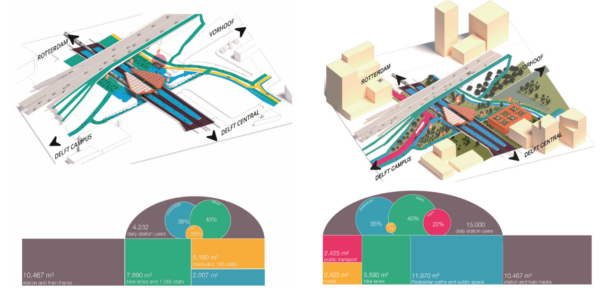
The research demonstrated that thick mapping could reveal new spatial narratives and creative potentials that define mobility architecture and its experience. It illustrated how thick mapping supports co-design across different disciplines, fostering collaboration and co-working within the interdisciplinary workshop. By visualizing the invisible relationships between mobility infrastructure, architectural space, and human interactions, thick mapping unveiled new narratives about railway stations as dynamic interchanges.
The workshop’s findings emphasized the importance of looking beyond the physical arrangement of stations to accommodate varying needs, activities, and programs. By extending the question from “what artifacts afford” to “how artifacts afford, for whom, and under what circumstances,” the research provided a deeper understanding of the complexities inherent in station architecture.
Future Directions and Impact
This research highlights the potential of thick mapping as a critical tool for addressing the complexities of mobility architecture. Its application in architectural education and practice can foster interdisciplinary collaboration and innovation in designing intermodal hubs. The study opens avenues for further exploration of thick mapping at the building scale, particularly in the context of mobility hubs.
We thank the authors for their valuable contribution to the field of architectural design and mobility research. If you have insights or wish to engage with this research, we encourage you to reach out and share your thoughts.
Reference: Ömer Faruk Ağırsoy, Francesca Monteleone, Manuela Triggianese, & Fabrizia Berlingieri (2026). Thick mapping mobility: a design-driven research for the architecture of interchanges. CoDesign, Article 2636189. DOI: https://doi.org/10.1080/15710882.2026.2636189