
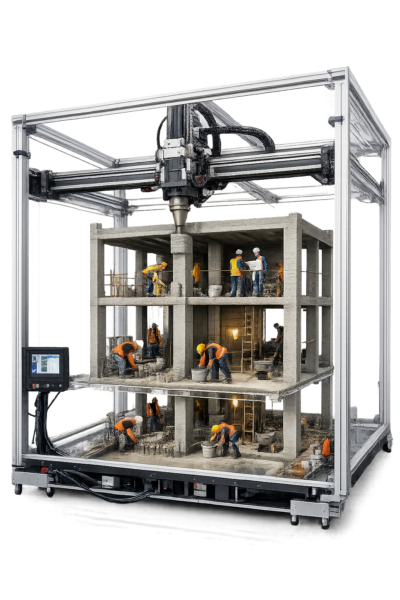
Dive into the Mechanics: How Printing Shapes Concrete’s Strength and Reliability in a Groundbreaking Interlaboratory Effort Spanning 30 Labs Worldwide
Why Mechanical Properties in 3DCP Are Critical
3D concrete printing facilitates efficient, sustainable construction, but variable mechanical properties challenge structural reliability. As applications expand internationally, this variability hinders code compliance and broader implementation, affecting engineers, builders, and communities addressing housing needs and ecological concerns.
Gaps in 3DCP Knowledge
Procedures for cast and precast concrete connect mechanical properties to composition and production, facilitating code adherence and quality control. For 3D concrete printing (3DCP), however, such connections are not established, with earlier studies showing inconsistent findings—for instance, flexural strength differences across orientations varied from -10% to -67%. Testing approaches were improvised, drawn from mortar/concrete standards without agreement on specimen handling or evaluation. This hindered comparisons and trend identification, while initial guidelines offered limited support. Industry players created custom protocols for project approvals, emphasizing the demand for standardized methods.
The study investigated how manufacturing parameters, specimen extraction, and handling impact key mechanical properties of hardened 3D printed concrete. It gathered quantitative information on variances between cast and printed specimens, strength and modulus fluctuations, property interrelations, effects of orientation and interfaces, size influences, and process factors. Distinctively, it utilized a detailed Study Plan in an extensive interlaboratory framework, incorporating varied material-facility combinations to reflect practical diversity and improve outcome relevance.
Innovations in the Study
Conducted by RILEM TC 304-ADC, this interlaboratory study (ILS-mech) collected 34 contributions from 30 laboratories across 19 countries, evaluating approximately 5,000 specimens. It formulated a comprehensive Study Plan for preparation, curing, and testing, customized to 3DCP features such as interfaces and anisotropy. The study includes orientation specifications for anisotropy, two scales (“mortar” at centimeters, “concrete” at decimeters) for size effects, extraction methods (sawing/core-drilling), and optional deviations (e.g., prolonged interface delays, varied curing). Participants employed their own systems, promoting inclusivity and realism. A publicly accessible database enables further examinations, aiding future guidelines for structural design and quality assurance.
What the Data Reveals
For mortar-scale specimens under default conditions, printed concrete displayed average compressive strength reductions relative to cast across orientations—approximately 90% in u, around 80% in v, and around 85% in w—with scatter ranging from about 50% to 120%. Flexural strength (3-point) showed increases in v.u and w.u orientations but a decrease in u.w, reflecting interface effects under tension. E-modulus in compression was lower on average for printed specimens in tested orientations. Results varied significantly across contributions, sometimes inconsistently, with no evident initial links to factors like aggregate size or hose length, although associated papers [21,22] uncover some inter-test and orientation relationships.
Real-World Impacts and Next Steps
The findings support the creation of codes, quality protocols, and RILEM recommendations for 3DCP evaluation. Applications include validated structures in building projects. Engineers, constructors, and authorities may gain from consistent data. Subsequent efforts could augment the database, enhance procedures, and formulate theoretical models to account for observed differences.
The Bigger Picture in 3DCP Advancement
With 3D concrete printing advancing, this research provides tools for its dependable application. We recognize Freek Bos and the RILEM TC 304-ADC for this contribution. Contribute ideas or engage through comments. As stated, “a theoretical framework needs to be developed to further explain the variations.” Explore further: Bos, F., et al. (2025). Mechanical properties of 3D printed concrete: A RILEM TC 304-ADC interlaboratory study — approach and main results. Materials and Structures/Materiaux et Constructions, 58(5), Article 183. https://doi.org/10.1617/s11527-025-02686-x.