
In a recent study, researchers found that the September 2023 temperature jump was nearly impossible under standard anthropogenic forcing, revealing a complex interplay of feedbacks and forcings often underrepresented in models. This study challenges current understandings of climate variability and highlights the need for improved predictive capabilities.
Decoding the September 2023 Temperature Anomaly
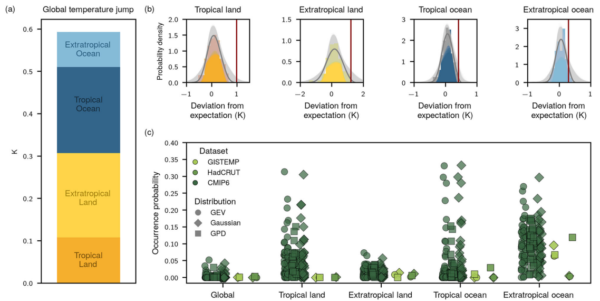
The September 2023 temperature anomaly, with an increase of nearly 0.6 °C compared to the previous year, poses significant questions about the factors driving such extreme temperature changes. This anomaly is not merely a statistical outlier but a notable deviation from expected climate patterns. Its magnitude and timing—occurring earlier than typical El Niño impacts—have prompted discussions about the roles of internal variability and external forcings in shaping our climate.
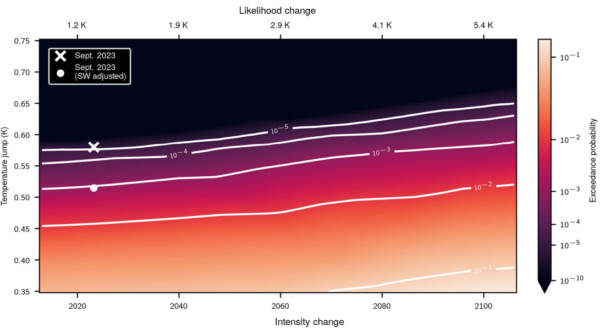
Climate models, particularly those from the Coupled Model Intercomparison Project Phase 6 (CMIP6), have struggled to simulate such an anomaly, raising concerns about their ability to accurately capture long-term warming trends and interannual variability. This discrepancy suggests potential gaps in our understanding of the processes contributing to extreme climate events. The scientific community must now determine whether this event is an outlier or indicative of more frequent extreme heat events.
The September 2023 anomaly is part of a broader trend of record-breaking global mean temperatures (GMT) that have exceeded 1.5 °C above pre-industrial levels for 12 consecutive months. This pattern underscores the urgency of understanding the drivers behind such anomalies. The transition from a La Niña to an El Niño phase has been identified as a key factor, but the rapid manifestation of heat suggests additional influences. The potential contributions of elevated stratospheric water vapor levels and declining sulfur aerosol concentrations are being scrutinized as possible external drivers.
Understanding the interplay between these factors is crucial for predicting future climate patterns. The September 2023 event highlights the need for a nuanced understanding of how internal variability and external forcings interact to produce extreme climate events. This understanding is vital for assessing whether similar events will become more common as the planet continues to warm.
Methodology and Analytical Insights
The researchers used a combination of observational data and climate model simulations to analyze the September 2023 temperature anomaly. By integrating probabilistic attribution with a process-based analysis, they aimed to account for contributions often underrepresented in climate models. This approach allowed them to assess the likelihood of such an event occurring under standard anthropogenic forcing.
The study utilized 143 years of observational data, from 1880 to 2022, to establish a baseline for evaluating the extremeness of the September 2023 anomaly. The researchers applied statistical modeling techniques, including generalized extreme value distributions, to estimate the probability of the event. These models indicated a near-zero probability of the anomaly occurring under current climate conditions.
In addition to statistical modeling, the researchers examined the spatial distribution of the temperature anomaly, focusing on regional contributions from land and ocean areas in both tropical and extratropical regions. Their analysis revealed that land regions, particularly in the extratropics, disproportionately contributed to the observed temperature jump. This finding suggests that land-based processes played a significant role in amplifying the anomaly.
To further validate their findings, the researchers compared the observed anomaly with CMIP6 model simulations. These simulations generally failed to reproduce temperature jumps of the magnitude observed in September 2023, highlighting the limitations of current models in capturing extreme climate events. However, when constrained by observed surface ocean conditions and atmospheric circulation, the models more accurately captured the land warming pattern, suggesting that realistic boundary conditions can enhance model performance.
Significant Findings and Conclusions
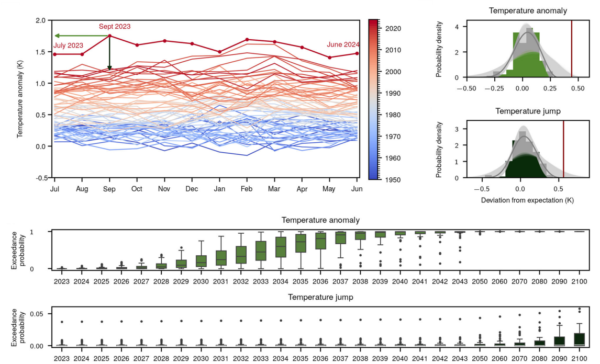
The study’s findings underscore the rarity and complexity of the September 2023 temperature anomaly. The researchers concluded that the event was virtually impossible under standard anthropogenic forcing, with a probability of only 0.1% when accounting for additional external drivers. This low probability highlights the exceptional nature of the event and suggests that internal variability alone is unlikely to account for the observed heat.
The research also revealed that the temperature jump was disproportionately concentrated over land, particularly in the extratropics. This concentration was associated with an unusual combination of shortwave forcing and water vapor feedback, which amplified the anomaly. These findings suggest that specific regional processes played a crucial role in driving the temperature jump.
Despite the current rarity of such events, the study projects that similar temperature jumps could become more likely under further warming. While an internally driven event of this magnitude remains unlikely in the coming decades, the probability of such events increases with additional warming. This projection underscores the need for continued monitoring and analysis of extreme climate events.
Implications and Future Directions
The September 2023 temperature anomaly serves as a stark reminder of the complexities and challenges in understanding and predicting extreme climate events. The study’s findings highlight the need for improved climate models that can accurately capture the interplay of internal variability and external forcings. As the planet continues to warm, understanding these dynamics will be crucial for anticipating future climate patterns and informing policy decisions.
Researchers and policymakers alike are encouraged to delve deeper into the processes driving extreme climate events. This study provides a foundation for future research and underscores the importance of integrating observational data with advanced modeling techniques. As we continue to face the realities of climate change, collaboration and innovation will be key to addressing these challenges.
Reference: Svenja Seeber, Dominik L. Schumacher, Lukas Gudmundsson & Sonia I. Seneviratne. “The observed September 2023 temperature jump was nearly impossible under standard anthropogenic forcing.” Communications Earth & Environment, 2026. DOI: https://doi.org/10.1038/s43247-026-03178-8