
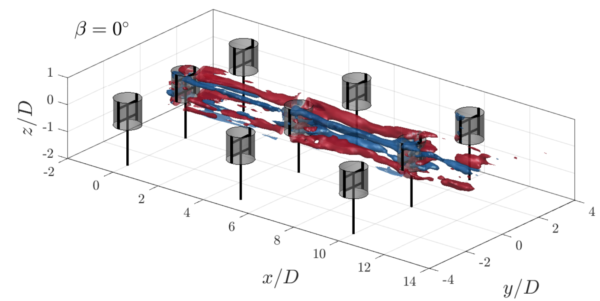
Enhancing Wake Recovery in Dense VAWT Arrays
Explore this experimental study on regenerative wind farming, where vertical-axis wind turbines in a high-density grid employ vortex generator modes via blade pitching to entrain momentum, yielding available power increases of up to 6.4 times for downstream rotors and advancing efficiency in wind energy systems.
Addressing Wake Losses in Wind Farms: Implications for Renewable Energy
Offshore wind farms benefit from consistent wind resources, but turbine clustering introduces wake losses, where upstream turbines reduce momentum for those downstream, resulting in overall efficiency reductions. Field studies indicate losses of 10% to 23% in offshore configurations, influenced by spacing from 4D to 12D and atmospheric conditions.
Wake recovery in horizontal-axis wind turbines (HAWTs) primarily involves turbulent mixing in the far wake, with vertical advection contributing near the rotor. Mitigation strategies include yaw misalignment to deflect wakes laterally or tilt adjustments to direct them vertically, generating counter-rotating vortex pairs that facilitate momentum entrainment from sides or above, potentially improving farm performance. However, these approaches can elevate fatigue loads on structures.
Vertical-axis wind turbines (VAWTs) exhibit faster wake recovery, often within 6D downstream, due to streamwise vortices from blade tips that enhance advective entrainment. Configurations with closely spaced VAWTs can improve performance through flow interactions, suggesting higher power densities compared to HAWT arrays. Despite lower individual efficiencies, VAWTs are suitable for constrained offshore environments.
This issue is significant for meeting renewable energy goals, as optimized farm designs could enhance capacity, lower costs, and support decarbonization efforts. Prior research lacks comprehensive 3D wake data for VAWT farms with control strategies. The study demonstrates regenerative wind farming, with upstream VAWTs functioning as vortex generators to replenish momentum for downstream units.
Experimental Methodology and Vortex Generator Implementation
The study was performed in the Open Jet Facility at Delft University of Technology, a closed-loop wind tunnel with a 2.85 m × 2.85 m outlet, 0.5% turbulence intensity, and uniform flow extending 6 m downstream.
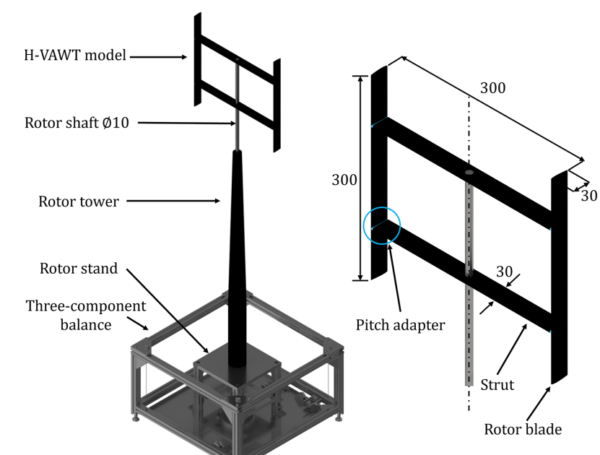
Nine H-type Darrieus VAWTs were configured in a 3 × 3 grid, with streamwise spacing of 5D and lateral spacing of 3.18D (D = 300 mm rotor diameter). Each turbine included two NACA0012 blades (chord 30 mm, span 300 mm, solidity 0.2), attached to a 10 mm shaft via a 700 mm tapered aluminum tower with bearings. Oval struts linked the blades, and DC motors maintained rotation at 70 rad/s, achieving a tip-speed ratio λ of 3.5 and Reynolds number Re_D of 6.1 × 10^4 under 3 m/s inflow.
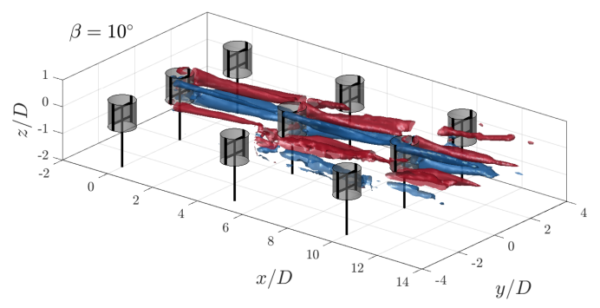
The vortex generator mode was implemented using fixed blade pitch offsets: β = -10° (pitch-out), 0° (baseline), +10° (pitch-in), facilitated by 3D-printed adapters. This adjusts load distribution across rotor quadrants, upwind windward (UW), upwind leeward (UL), downwind leeward (DL), downwind windward (DW), modifying trailing vorticity. Pitch-in emphasizes upwind loads, strengthening UW/UL vortices for downwash and deflection; pitch-out focuses on downwind, enhancing DW/DL for upwash and opposite deflection. This passive method promotes advective momentum entrainment.
Volumetric particle tracking velocimetry (PTV) captured flow fields, using helium-filled soap bubbles seeded via a 200-nozzle rake. Three high-speed cameras recorded at 500 Hz, with sub-volumes stitched into a ~5.3 m³ domain centered on the central column over 17.6D streamwise. Data processing yielded velocity uncertainty of 0.02 m/s (0.67% of U_∞).
This configuration offers 3D-resolved wake measurements for a VAWT farm with pitch control, supporting model validation and regenerative applications in grid layouts.
Findings and Outcomes
Thrust measurements for an isolated rotor confirmed that streamwise thrust increases with positive pitch and decreases with negative pitch, with corresponding shifts in lateral thrust, aligning with load redistribution across quadrants.
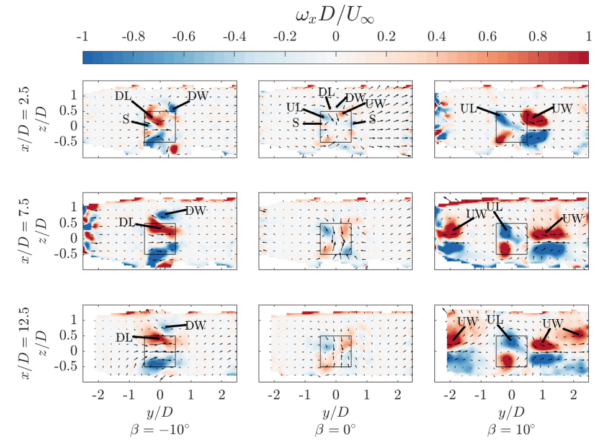
Vorticity results indicated balanced upwind/downwind structures in the baseline, while pitch-in strengthened upwind vortices (UW/UL), inducing downwash and windward deflection. Pitch-out enhanced downwind structures (DW/DL), producing upwash and leeward asymmetry.
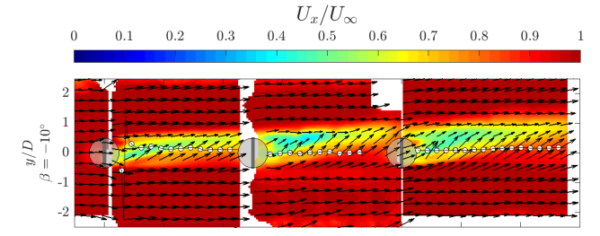
Wake topologies varied: the baseline showed pronounced deficits with windward asymmetry; pitch-in resulted in axial contraction and lateral deflection; pitch-out led to axial expansion with lateral injection, biased leeward.
Recovery assessments demonstrated reduced deficits in vortex modes, with available power (∫ U_x^3 dA) increasing by factors of 6.4 (pitch-in) and 2.1 (pitch-out) relative to baseline for inline positions. Maximum recoveries reached 72.4% at 3.2D (pitch-in) and 53% at 8.8D (pitch-out). Energy analysis highlighted advective flux as primary in pitch-in cases within the farm, with turbulence contributing secondarily.
The authors state, “The results demonstrate the strong dependence of the wake topology of a VAWT on the streamwise vorticity system, which can be effectively modified by pitching the blades… An increase in momentum entrainment in the wake is observed for both vortex generator modes of operation, highlighting the potential of achieving regenerative wind farming.”
Future Implications
These results may inform the design of denser VAWT farms, improving efficiency in limited areas. Further investigations could include staggered arrangements, atmospheric boundary layers, turbulent inflows, or combined HAWT-VAWT systems to assess loads and scalability.
Reference: Bensason, D. Y., Mulay, J. P., Sciacchitano, A., & Simao Ferreira, C. (2025). Experimental demonstration of regenerative wind farming using a high-density layout of vertical-axis wind turbines. Wind Energy Science, 10(7), 1499–1528. https://doi.org/10.5194/wes-10-1499-2025.