
A trade-off framework shows how riparian willow forests can support flood protection while maintaining biodiversity in delta landscapes.
This study examines how different willow forest management strategies influence both wave attenuation and ecological value. By combining field measurements, ecological indicators and modelling, the research evaluates how riparian forests can contribute to hybrid flood defence systems while balancing biodiversity benefits and long-term costs.
Rethinking Flood Protection in a Changing Climate
For centuries, engineered infrastructure such as dikes and seawalls has protected low-lying regions from flooding. However, rising sea levels and intensifying storms are increasing pressure on these systems and driving interest in solutions that combine engineered structures with natural landscapes.
Nature-based elements placed in front of flood defenses can reduce incoming wave energy before it reaches hard infrastructure. Vegetated foreshores, for example, can attenuate waves and potentially reduce the need for costly reinforcements such as rock revetments. These hybrid approaches are increasingly explored as part of climate adaptation strategies in river deltas and coastal areas.
Mangrove forests in tropical regions provide a well-known example. Wide mangrove belts can significantly reduce wave heights while also trapping sediment and supporting diverse ecosystems. In temperate regions, riparian willow forests may provide similar functions, but they have received less attention in flood protection research.
Willow forests commonly occur along rivers and estuaries. Their dense stems and branches can interact with incoming waves, while root systems stabilize soils and promote sediment accumulation. Experimental studies have shown that mature willow stands can reduce wave heights by roughly 5 to 25 percent over relatively short distances under controlled conditions. These characteristics suggest potential value in flood defense systems.
The Challenge: Balancing Safety and Biodiversity
In many delta regions, space is limited and environmental regulations require projects to consider ecological impacts alongside safety. This creates an important design question. Forest structures that are highly effective for wave attenuation may not necessarily provide the highest ecological value.
Managed willow stands such as pollarded or plantation forests often have dense and uniform structures that may enhance wave reduction. In contrast, less managed forests tend to develop more varied vegetation layers and dead wood, features that can support greater biodiversity.
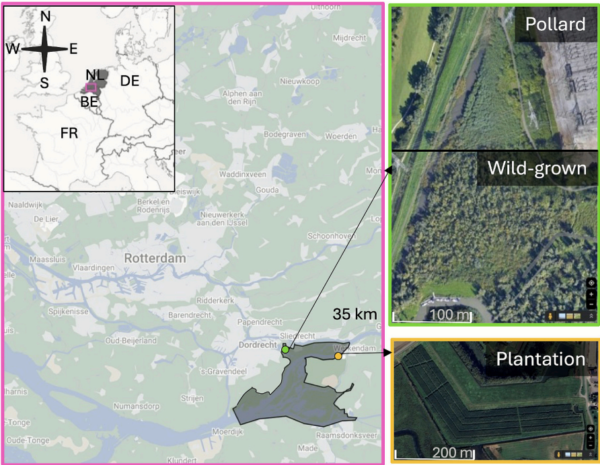
Understanding these potential trade-offs is particularly relevant in areas such as the Biesbosch wetlands in the Netherlands, where flood safety, habitat conservation and spatial constraints must be considered together.
Studying Willow Forest Types in the Biesbosch
To investigate these dynamics, researchers examined three types of riparian willow forest in the Biesbosch region:
- Wild-grown forests, which have developed naturally without management for decades
- Pollard forests, where trees are pruned every three to four years at about 1.5 to 2 meters height
- Plantation forests, managed as short-rotation coppice harvested approximately every two years
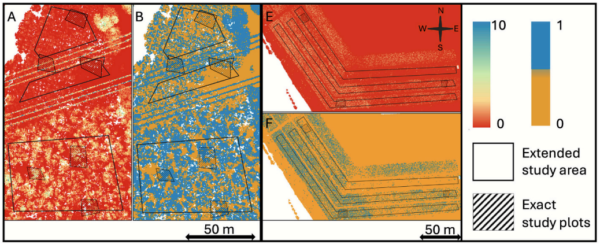
Field measurements were collected from multiple plots in each forest type. Researchers recorded structural characteristics such as tree density, trunk diameter, canopy height, litter thickness and dead wood. These features influence both habitat complexity and hydraulic resistance to waves.
Biodiversity was assessed using ground-dwelling invertebrates captured with pitfall traps over a 17-day sampling period in late 2020, supplemented by additional sampling in 2022. Specimens were identified to order level, and indicators such as abundance, richness and body size distribution were analyzed.
Remote sensing data from the Dutch national elevation dataset were also used to generate canopy height models and quantify vegetation cover and structural variability.
Wave attenuation was then simulated using a hydrodynamic model that accounts for vegetation drag and wave breaking. Parameters such as stem density and frontal surface area were derived from the field measurements. Simulations examined forest widths ranging from 50 to 500 meters under a wide range of storm conditions.
Finally, the study integrated biodiversity indicators, wave reduction performance and estimated costs into a trade-off framework. The economic comparison considered land prices, planting and maintenance costs over 50 years, as well as potential reductions in dike reinforcement needs.
Key Findings: Different Forests Deliver Different Benefits
The results showed clear structural and ecological differences between the forest types.
Wild-grown forests had the highest structural complexity. They contained thicker litter layers, more heterogeneous canopies and greater variation in tree size. These conditions were associated with the highest invertebrate richness and a broader range of body sizes among spiders and beetles.
Pollard forests showed intermediate ecological characteristics but had dense low crowns that increased their effectiveness in reducing waves.
Plantation forests had the most uniform structure, with shorter canopy height and lower vegetation cover. Invertebrate communities in these stands tended to include smaller body sizes and lower overall diversity.
Wave modelling indicated that pollard forests were the most efficient at attenuating waves relative to their width. Over wider distances, they reduced wave transmission more strongly than the other forest types. Plantation and wild-grown forests showed similar attenuation levels, although wild-grown forests performed slightly better at lower vegetation levels due to ground biomass.
The modelling suggested that achieving substantial wave reduction could require wider forests for wild-grown and plantation types than for pollard forests.
Costs and Trade-Offs in Hybrid Flood Defenses
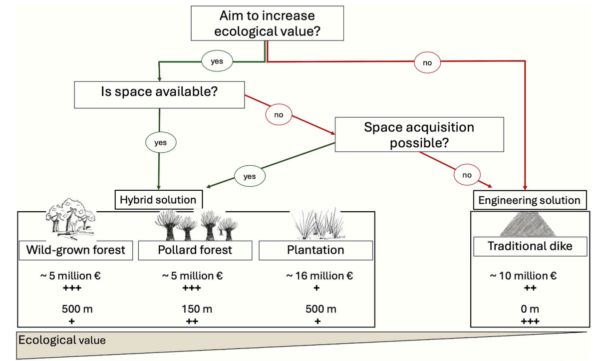
The cost analysis compared hybrid dike-forest systems with traditional engineered reinforcement. Estimated costs over a 50-year period included land acquisition, establishment and maintenance.
Although costs varied depending on forest width and management strategy, the hybrid systems analysed in the study were generally less expensive than large-scale dike reinforcement alone. Pollard forests required less space to achieve comparable wave reduction, while wild-grown forests delivered higher ecological value at similar long-term cost levels.
These results highlight the importance of selecting forest management strategies based on local priorities. In areas where space is limited and wave reduction is the primary goal, pollard forests may be more suitable. Where ecological restoration is also a priority, allowing forests to develop more naturally may provide greater biodiversity benefits.
Implications for Climate Adaptation
The trade-off framework developed in this research provides a way to evaluate nature-based flood defense options using multiple criteria. By combining hydraulic performance, ecological indicators and economic considerations, it supports more integrated decision-making in delta management.
Riparian willow forests will not replace traditional infrastructure entirely. However, when integrated into hybrid systems they can contribute to wave attenuation while supporting ecological functions. Approaches that combine engineered and nature-based elements may become increasingly important as climate change intensifies pressure on flood protection systems worldwide.
Reference: van Starrenburg, C., et al. (2026). A trade-off approach to optimize nature-based flood defense designs: riparian willow forests as case study. Ecological Engineering, 225, 107886. https://doi.org/10.1016/j.ecoleng.2025.107886.