
Researchers from Delft University of Technology have developed a machine learning framework that uses the spatial extent of drought to enhance crop yield predictions. This approach combines artificial neural networks and polynomial regression models, offering a promising tool for agricultural forecasting.
Understanding the Challenge
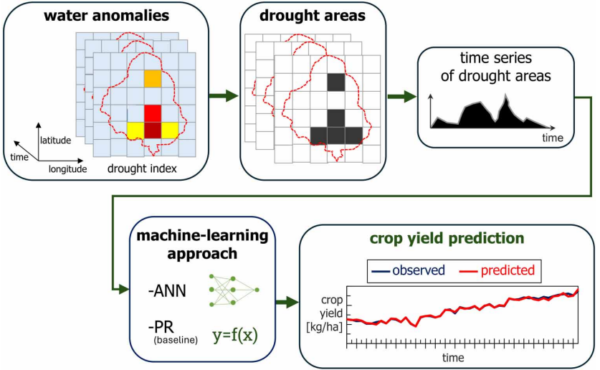
Droughts have become more severe and prolonged in recent decades, posing significant challenges to agriculture. These climatic events can lead to substantial financial losses and, in extreme cases, contribute to food insecurity and loss of life. Traditional crop-growth models, which estimate yield and plant development variables, have been widely used to assess drought impacts. However, these models are not explicit forecasting tools due to their reliance on physical assumptions, data availability, and multiple sources of uncertainty. As such, there is a critical need for improved methods that can predict the impacts of drought on agriculture more accurately and efficiently.
Machine learning (ML) models have emerged as viable alternatives for predicting the impacts of drought on agriculture. These data-driven approaches rely on historical input-output relationships rather than modeling internal biological mechanisms. Despite their success, a critical gap remains in how drought is addressed in these models. Most ML crop yield prediction studies primarily use drought indices as input variables, leaving the spatiotemporal characteristics, particularly the spatial coverage of drought-affected areas, underexplored. This research aims to address this gap by developing a machine learning approach that incorporates the spatial extent of drought to predict seasonal crop yields.
Innovative Methodology
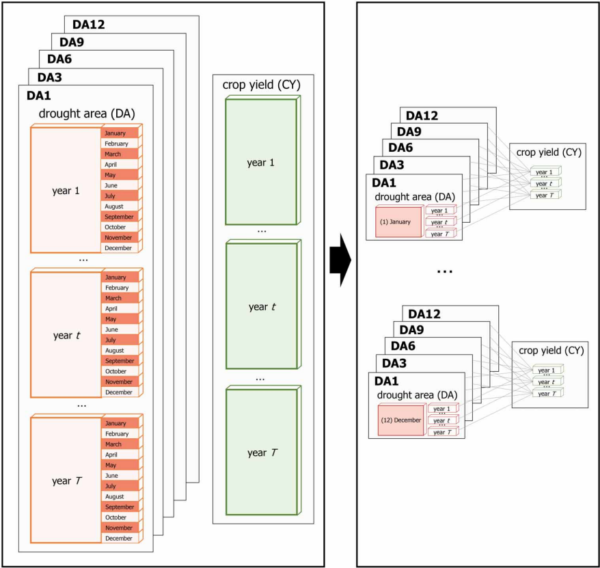
The researchers developed a machine learning framework that combines artificial neural networks (ANN) and polynomial regression (PR) models. The PR models provide baseline estimates, while the ANN models deliver refined predictions. This integrated approach was tested using 50 years of historical crop yield data and drought areas derived from the Standardised Precipitation Evapotranspiration Index (SPEI) at multiple aggregation periods (1–12 months).
The study focused on three regions in eastern India, where rice cultivation is prevalent and agriculture plays a vital economic role. Historical data from 1967 to 2015 was used to train and evaluate the models, with a focus on regional rice yield prediction. The methodology was applied independently to each region, allowing for tailored calibration and comparative performance assessment.
To calculate drought areas, the researchers used SPEI data, which considers the difference between precipitation and evapotranspiration. Drought areas were computed as the ratio between the cells in drought and the total number of cells of the region. This data was then used as input for the ML models, along with crop yield data for the Kharif season, which produces the largest crop yield in India.
Key Findings
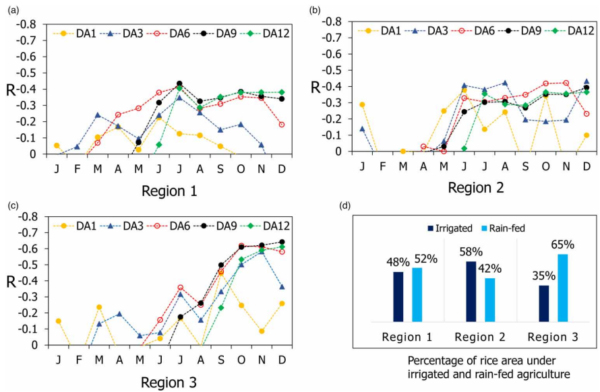
The results of the study demonstrate that ANN models consistently outperform PR models, achieving lower prediction errors. The best-performing ANN models achieved root mean square error values as low as 48.1 kg/ha. These findings indicate that spatiotemporal drought area dynamics and their temporal aggregation provide an effective preprocessing strategy for ML-based drought impact prediction.
The research highlights the potential of using the spatial extent of meteorological drought as an effective input for crop yield prediction. Different drought aggregation periods enable yield prediction at varying accuracy levels during the crop season, providing valuable insights for agricultural planning and decision-making.
Future Directions
This research offers a promising tool for enhancing agricultural forecasting and drought mitigation strategies. By incorporating the spatial extent of drought into crop yield predictions, the framework developed by the researchers provides a more accurate and efficient method for assessing the impacts of drought on agriculture. This approach could be adapted and applied to other regions and crops, further enhancing its utility and impact.
The authors have made a significant contribution to the field of agricultural forecasting, and their work opens up new avenues for research and development. For those interested in exploring this approach further, the full study provides a comprehensive overview of the methodology and findings.
Reference: Diaz, V., Osman, A. A., Corzo Perez, G. A., Maskey, S., & Solomatine, D. P. (2026). Spatiotemporal changes of drought area as input for a machine-learning approach for crop yield prediction. Hydrology Research, 57(2), 125-149. DOI: https://doi.org/10.2166/nh.2026.150