
This study explores the complex dynamics of hydropower operations in Brazil’s Paranapanema River Basin, examining how electricity demand and centralized management affect river flows. Utilizing wavelet analysis, it reveals scale-specific flow variability, providing insights into more adaptive hydropower governance.
Complex Dynamics in Hydropower Management
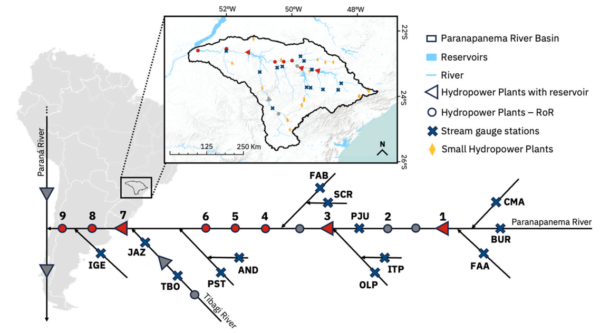
The Paranapanema River Basin in southeastern Brazil is vital to the nation’s energy infrastructure, containing a series of large hydropower plants regulated by a nationally coordinated dispatch system. This setup exemplifies reservoir-regulated rivers in Brazil, where multiple dams collaborate to provide electricity, significantly altering natural flow regimes. Understanding how these hydropower operations impact river discharge patterns is crucial, especially as Brazil’s energy landscape evolves.
Historically, hydropower has been the cornerstone of Brazil’s energy system, serving as both a primary electricity source and a stabilizing mechanism through river basin regulation. However, as Brazil expands its energy mix to include more thermal, wind, and solar power, the role of hydropower is being redefined. This transition, driven by external pressures rather than structured planning, has increased the complexity of managing the National Interconnected System (SIN), a vast network connecting electricity generators and consumers nationwide.
Hydropower now serves a dual role: its traditional base-load function and a fast-response capability to meet the demands of intermittent renewables like wind and solar. This shift has heightened the need for operational flexibility, often prioritizing immediate energy supply over integrated water resource management. The phenomenon of hydropeaking, characterized by rapid discharge fluctuations to meet intraday electricity demand, exemplifies this challenge. Despite regulatory frameworks that establish hydraulic constraints, enforcement is limited, allowing operators to impose significant variations with minimal regulatory oversight.
The complexity of hydropower operations is further compounded by the need to balance short-term flow modulation with long-term water availability and energy resilience. Current practices often treat these dimensions in isolation, neglecting the full spectrum of flow variability from sub-daily to annual scales. This gap in understanding limits the effectiveness of planning and regulatory frameworks, potentially leading to harmful ecological and infrastructural impacts.
Advanced Analytical Techniques
The research employs a sophisticated wavelet analysis framework to dissect the hydropower-induced variability in river discharge and reservoir volumes within the Paranapanema River Basin. This methodological approach allows for the decomposition of river discharge signals into frequency components associated with specific temporal scales, ranging from sub-daily to multi-annual. By analyzing continuous records under operational conditions, the study isolates fluctuations and reconstructs signals in original units, enhancing interpretability and supporting regulatory evaluation and energy planning.
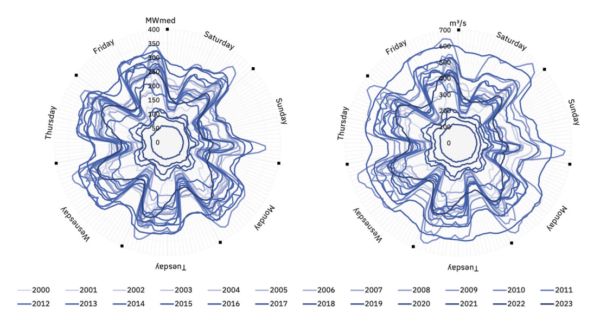
Wavelet analysis is particularly well-suited for this study due to its ability to handle the non-stationary nature of discharge influenced by interacting drivers such as climate variability, shifting energy demand, and evolving regulatory frameworks. The method’s dual descriptive and quantitative capacity is invaluable for characterizing flow modulation in impounded rivers and supporting standardized assessments across diverse hydropower contexts.
The study focuses on energy production and consequent flow variation in the Paranapanema River Basin, examining how hydropower operations shape river discharge patterns across various temporal scales. By employing a wavelet-based framework, the research characterizes and reconstructs flow modulation patterns, providing insights into how these patterns have evolved in response to changes in the energy mix and demand.
Insights and Conclusions
The study’s findings reveal that flow variability patterns in the Paranapanema River Basin align closely with electricity demand profiles, drought episodes, and institutional milestones in the Brazilian power sector. Hydropower operations exhibit distinct signatures at different time scales, highlighting the responsiveness and complexity of reservoir management. The research demonstrates that the proposed wavelet analysis framework provides a standardized and reproducible method for assessing variability in reservoir-regulated systems, enhancing the comparability of hydropower assessments and identifying operational dynamics that shape river flow regimes.
By reconstructing signals in original units, the study improves the interpretability of flow modulation patterns and supports more adaptive and ecologically grounded approaches to hydropower governance. The research underscores the need for regulatory and operational frameworks that incorporate the full spectrum of flow variability, from sub-daily to annual scales, to better support the evolving demands of Brazil’s energy system.
Future Directions and Impact
This research offers a transformative perspective on hydropower governance, suggesting that a more adaptive and ecologically grounded approach is possible. By providing a standardized framework for assessing flow variability, the study sets the stage for more comprehensive integration of flow variability into operational decision-making. This could lead to more sustainable and resilient energy systems, not only in the Paranapanema Basin but also in other reservoir-regulated systems worldwide.
We thank the authors for their valuable contribution to the field of hydropower research. If you have insights or feedback, feel free to reach out and share your thoughts.
Reference: Thais Fujita, Luz Adriana Cuartas, Juliana Andrade Campos, Peder Hjorth, Caluan Rodrigues Capozzoli, Edmilson Dias de Freitas, Cintia Bertacchi Uvo. “River flow response to changing electricity demand and centralized hydropower operations in the Paranapanema River basin, Brazil.” Journal of Hydrology: Regional Studies 62 (2025) 102815. DOI: https://doi.org/10.1016/j.ejrh.2025.102815