
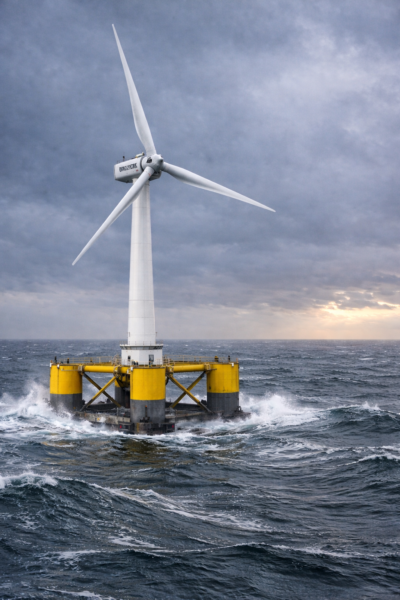
This study explores how LIDAR-assisted feedforward pitch control for floating offshore wind turbines uses upstream wind measurements to decrease structural load variations, resulting in reduced failure rates and operational expenditure savings of up to 11% across ScotWind sites, aiding the economic viability of deep-water renewable energy projects.
Addressing Challenges in Floating Offshore Wind
Floating offshore wind (FOW) technology enables access to wind resources in deep waters unsuitable for bottom-fixed turbines. Estimates indicate that 80% of Europe’s wind potential exists in depths exceeding 60 meters, making FOW important for expanding renewable energy capacity. However, as projects extend farther offshore, such as ScotWind sites averaging over 70 km from shore, operational challenges increase, including harsher conditions, limited accessibility, and higher operational expenditure (OpEx), potentially reaching 40% of the levelized cost of energy compared to 30% for bottom-fixed wind (BFW).
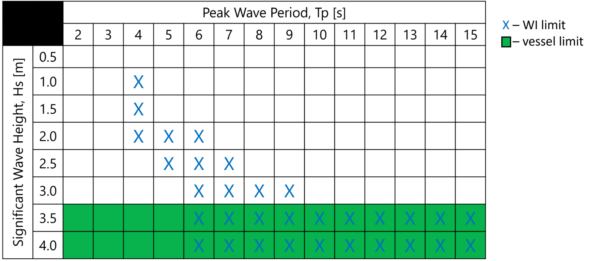
Maintainability is a central issue. Deep-water locations extend downtime due to weather-dependent access, influenced by significant wave height (H_s) and peak period (T_p). Turbine motion from floating platforms introduces “workability,” a safety measure for technicians, expressed as a workability index (WI) derived from platform-specific response amplitude operators (RAOs). WI values below 1 indicate restricted conditions, with impacts classified as slight (>90%), significant (60-90%), or major (<60%). This motion limits repairs and may accelerate component degradation, raising costs for vessels, personnel, and materials.
Economic factors, including inflation, supply chain constraints, and competition in leasing rounds like ScotWind (awarding 18 GW of floating capacity), underscore the need for cost reductions. LIDAR-assisted pitch control addresses these by using laser-based wind sensing to anticipate gusts, stabilize loads, and extend asset life, thereby lowering OpEx, improving safety, and supporting efficient offshore wind operations.
Methodology for LIDAR-Assisted Pitch Control
The research used simulations to assess LIDAR-assisted pitch control’s effect on FOW OpEx, based on the IEA 15-MW reference turbine on the VolturnUS-S semi-submersible platform. Modifications to NREL’s OpenFAST v3.4 incorporated LIDAR in the InflowWind module, while ROSCO v2.6 was adapted for feedforward control, targeting above-rated wind speeds where benefits are most pronounced.
The approach combines feedforward collective pitch control (FFCPC) and feedforward individual pitch control (FFIPC). FFCPC employs nacelle-mounted LIDAR for upstream wind velocity data, enabling uniform blade pitch adjustments to enhance rotor speed and power stability. FFIPC provides blade-specific adjustments based on azimuth to address cyclic loads from wind shear and turbulence. This feedforward method contrasts with feedback control, which responds after wind impact.
Simulations covered turbulent winds (3-25 m/s, normal turbulence model category B) and co-directional irregular waves, with four random seeds per wind speed for reliability. Outputs included loads on subsystems: rotor-nacelle assembly (RNA, encompassing blades, hub, and pitch system), pitch bearings, blade roots, tower base, and moorings. NREL’s MLife processed data using rainflow counting, Miner’s rule, and Wöhler exponents (m=4 for steel, m=10 for composites) to determine damage equivalent loads and failure rates, extrapolated over 20 years with site-specific Weibull wind distributions for ScotWind zones E1, NE1, and NE3 (each 1 GW, 15-MW turbines).
Failure rate reductions, notably ~20% for RNA, were input into the adapted Strath-OW O&M model, a Monte Carlo time-domain simulator accounting for climate, vessel fleets (service operation vessel with 3.5 m H_s limit, six daughter crafts at 2 m), and literature-based costs. Adjustments incorporated workability constraints from designs such as spar, tension-leg platform, semi-submersible, and barge, limiting access via H_s-T_p combinations. Baseline failure rates aligned with BFW, with 60 hours of scheduled maintenance per turbine annually and no daylight restrictions.
This method converts load reductions (e.g., up to 56% in rotor speed/power variability, 15% in bending moments) into OpEx estimates for practical FOW applications.
Results and Key Findings
Simulations showed FFCPC + FFIPC reduced standard deviations by up to 56% in rotor speed and power, over 15% in rotor loads and tower bending moments, and affected platform motions (pitch, surge) and mooring tensions.
Failure rate reductions were 19-21% for RNA, 44-46% for pitch bearings, 43% for blade roots, 27-30% for tower base, and 8-10% for moorings across sites, with NE3 showing the largest due to its 10.1 m/s average wind speed, activating feedforward more frequently.
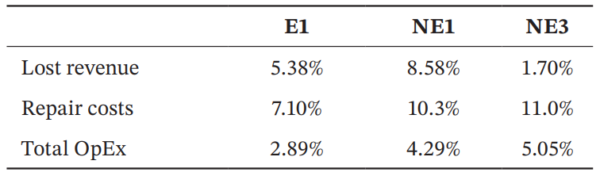
Without workability constraints, OpEx reductions were 3-5%: 2.89% at E1, 4.29% at NE1, and 5.05% at NE3, from 5-11% lower repair costs and 2-9% reduced lost revenue through fewer failures and downtime.
With workability limits, reductions reached up to 11% at sites like E1, varying by platform design. In certain cases, LIDAR-equipped FOW outperformed BFW baselines: up to 4.97% at NE3, 1.89% at NE1 for specific designs.
The authors state, “The quantification of OpEx reduction resulting from decreased failure rates highlights the potential savings, and reduction in the overall levelised cost of energy for future FOW developments.” This emphasizes LIDAR’s role in cost reduction at sites with accessibility constraints.
Implications and Future Directions
LIDAR-assisted control may support lighter structures, lower emissions from maintenance vessels, and improved safety by reducing technician transfers, contributing to the expansion of deep-water renewables under economic constraints.
We thank Andrew J. Russell, Jade McMorland, and their collaborators for this contribution to offshore wind engineering. For discussions on LIDAR applications or related work, contact the authors via the paper’s details to share insights.
Reference: Russell, A. J., et al. (2024). The Impact of LIDAR-Assisted Pitch Control on Floating Offshore Wind Operational Expenditure. Wind Energy, 27(11), 1450-1461. https://doi.org/10.1002/we.2951.