
This study examines the operational and economic impacts of integrating environmental constraints into hydropower scheduling. By analyzing reservoir management under these constraints, it offers insights into optimizing hydropower systems while balancing environmental and economic objectives, crucial for sustainable energy transitions.
Hydropower’s Role and Challenges
Hydropower is pivotal in achieving a low-carbon energy future, providing critical flexibility and energy storage. It stabilizes the integration of intermittent renewables like wind and solar. However, environmental constraints, essential for ecological preservation, complicate hydropower operations, affecting scheduling and flexibility.
These regulations aim to mitigate river regulation impacts, preserving environmental qualities. Constraints like minimum flow requirements and maximum ramping rates have distinct operational and economic implications, influenced by the hydropower system’s configuration, inflow conditions, and market price volatility.
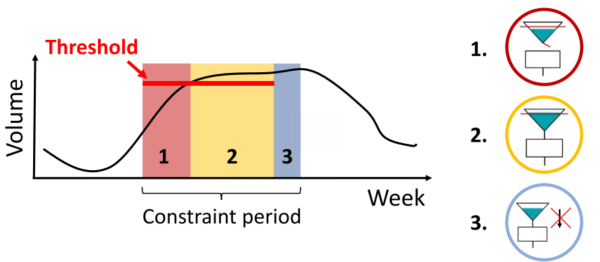
Large water level fluctuations in reservoirs are ecological stressors, impacting spawning grounds and increasing risks like landslides. Reservoir constraints aim to maintain water levels for various purposes. Despite their importance, these constraints complicate medium-term hydropower scheduling, where long-term uncertainties must be managed.
This research by Linn Emelie Schäffer and colleagues assesses the operational and economic impacts of integrating complex environmental constraints into medium-term hydropower scheduling (MTHS). This study is timely amid ongoing revisions of hydropower licenses in Norway, where such constraints are increasingly considered. It aims to enhance the scientific foundation for regulatory and operational decision-making in the Nordic hydropower system.
Innovative Research Methodology
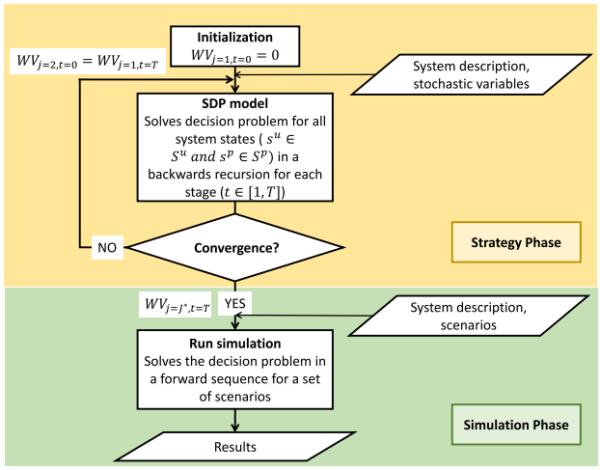
The research employs a multi-stage stochastic optimization model for medium-term hydropower scheduling (MTHS). This model maximizes profit under uncertainty over a planning horizon spanning months to years, assuming a risk-neutral, price-taking hydropower producer, aligning with Nordic practices.
Central to this research is a Stochastic Dynamic Programming (SDP)-based framework adept at handling non-convexities in hydropower scheduling, such as those introduced by environmental constraints. The study focuses on soft reservoir filling constraints and reservoir ramping rates, which are state-dependent and complex.
Advancements in the Stochastic Dual Dynamic Integer Programming (SDDiP) algorithm allow detailed modeling of these constraints, potentially improving operational decision-making. The study’s case analysis on two Norwegian watercourses provides practical context for evaluating these constraints’ impacts.
By integrating advanced modeling techniques, the research offers a comprehensive assessment of environmental constraints in MTHS, enhancing understanding and offering pathways for optimizing hydropower operations while maintaining ecological and economic balance.
Key Findings and Insights
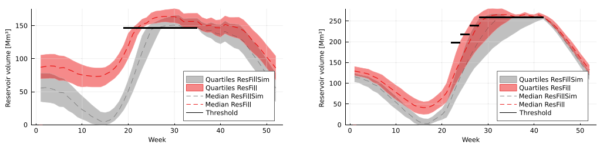
The research shows that integrating complex environmental constraints significantly alters optimal reservoir management strategies. Improved planning can mitigate economic losses associated with these constraints, though improvements depend on factors like power prices and hydropower system characteristics.
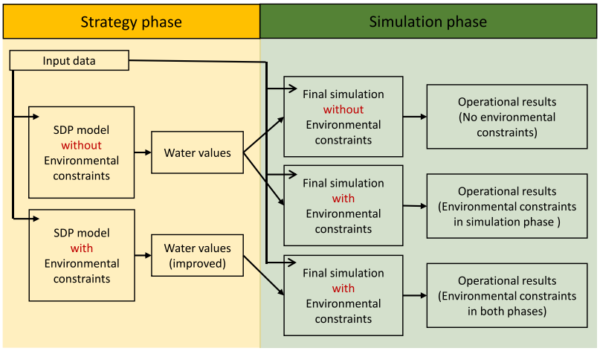
The study highlights the impact of these constraints on water value curves, indicating a non-concave expected future profit function. This emphasizes the importance of detailed modeling in capturing hydropower scheduling nuances under environmental constraints. The use of advanced techniques like the SDDiP algorithm demonstrates potential for precise operational decision-making amid complex constraints.
Future Directions and Impact
This research provides valuable insights into hydropower systems’ operational and economic dynamics under environmental constraints, paving the way for sustainable and efficient energy management practices. By detailing these constraints, the study informs regulatory frameworks and operational strategies.
As the energy sector evolves towards sustainability, this research highlights the need for ongoing innovation in hydropower scheduling and management. Future research could explore integrating additional environmental and economic factors, enhancing hydropower systems’ robustness against evolving challenges.
We commend the authors for their significant contribution to the field. For further engagement or insights, we encourage reaching out to the authors. Your input is invaluable in advancing our collective understanding and application of sustainable energy practices.
Reference: L.E. Schäffer, T.H. Bakken, A. Helseth, M. Korpås. “Optimal operation of hydropower systems with environmental constraints on reservoir management.” Renewable Energy 261 (2026) 125258. DOI: https://doi.org/10.1016/j.renene.2026.125258