
Researchers from Delft University of Technology and Aalto University have utilized smartphone data to explore multi-modal urban travel patterns. This study provides insights into how people navigate cities, offering valuable information for future transportation policies and highlighting the importance of understanding evolving urban mobility needs.
Decoding Urban Mobility Challenges
Urban mobility is a complex and dynamic phenomenon, essential for effective transportation planning and policy-making. Traditional data sources, such as infrequent surveys or smart card records, often fall short in capturing the full spectrum of multi-modal travel behaviors. These conventional methods lack the temporal, spatial, and modal comprehensiveness needed to understand the intricate patterns of urban travel. As cities grow and evolve, so do the mobility needs of their inhabitants, making it imperative to have detailed and up-to-date insights into these patterns.
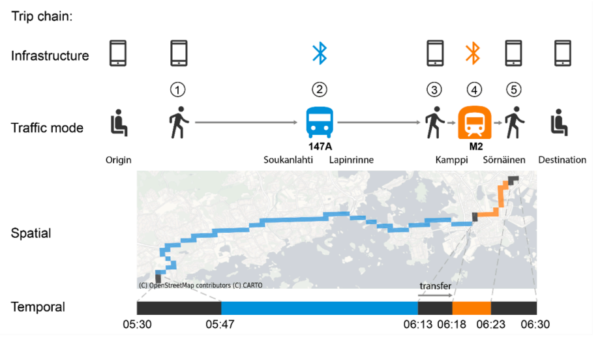
Emerging mobility data sources are proving instrumental in capturing these patterns and enabling additional insights. This study, conducted by researchers from Delft University of Technology and Aalto University, leverages a digitally collected trajectory-level dataset obtained from a smartphone application operated by the public transport authority of Helsinki, Finland. This dataset, known as TravelSense, provides a rich source of information on modal choices alongside temporal and spatial travel characteristics. By employing this novel dataset, the study aims to explore the capabilities of this new data source and analyze mobility patterns over a three-year period, from 2022 to 2024.
The research addresses the need for a more detailed understanding of multi-modal urban mobility patterns, particularly in the context of post-pandemic behavioral changes. The study identifies key traveler groups and examines shifts in travel behaviors, offering valuable input for shaping evidence-based mobility policies. The insights gained from this research are expected to be relevant not only for the Helsinki region but also for other urban areas seeking to enhance sustainable travel behavior and adapt to evolving urban mobility needs through enhanced multi-modality.
Leveraging Smartphone Data for Insights
The researchers utilized the TravelSense dataset, a digitally collected travel diary from a smartphone application, to analyze multi-modal mobility within the Helsinki region. This dataset emerged as a promising source of information for detailed multi-modal traveler trajectories, capturing temporal, spatial, and modal aspects of mobility. The TravelSense application, operated by the public transport authority of Helsinki, collects data with user consent, ensuring privacy and anonymity.
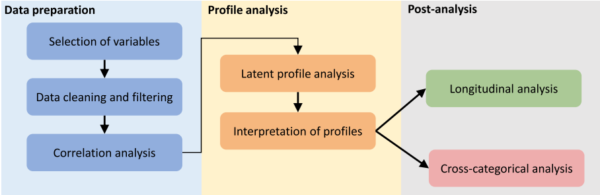
To analyze the data, the researchers employed Latent Profile Analysis (LPA), a statistical model used to identify latent subpopulations within a population based on a set of variables. This approach allowed the researchers to classify travelers based on temporal, spatial, and modal attributes over a week-long period. The profiles were then compared across three consecutive years, from 2022 to 2024, to identify changes in travel behavior over time.
The study also performed a cross-categorical analysis to offer combinatorial insights into temporal-spatial-modal activities. This comprehensive approach enabled the researchers to capture the full complexity of urban mobility patterns, providing a more detailed understanding of how people navigate cities. By leveraging this novel dataset and innovative methodology, the study offers valuable insights into multi-modal travel behavior, highlighting the potential of digitally collected travel diaries for transport research.
Revealing Urban Travel Dynamics
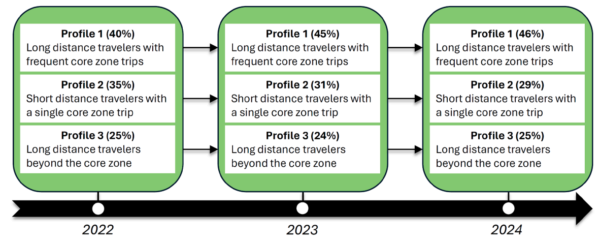
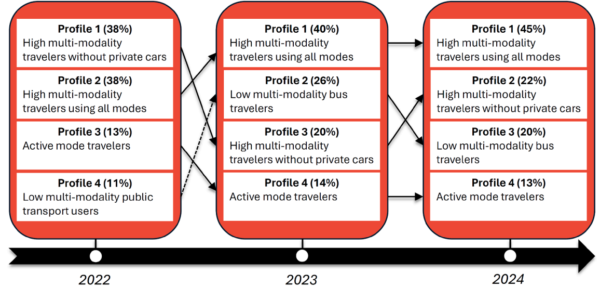
The study’s findings reveal significant insights into urban travel patterns. While spatial travel patterns remained relatively stable over the three-year period, temporal and modal patterns exhibited greater variability. A distinct shift was observed between 2022 and subsequent years, likely reflecting post-pandemic behavioral changes. Key traveler groups identified include exclusive active mode users, who accounted for 13% annually, and non-private car users, whose share declined from 38% in 2022 to approximately 20% in 2023 and 2024.
The research underscores the value of novel data sources like TravelSense in capturing the complexities of multi-modal travel behavior. By providing detailed insights into temporal, spatial, and modal travel patterns, the study offers valuable input for shaping evidence-based mobility policies. These findings are crucial for transport authorities seeking to support sustainable travel behavior and adapt to evolving urban mobility needs through enhanced multi-modality.
Future Directions for Sustainable Mobility
The implications of this research are far-reaching, offering valuable insights for transport authorities and policymakers. The study highlights the potential of digitally collected travel diaries to enhance our understanding of multi-modal travel behavior, providing a more comprehensive view of urban mobility patterns. As such data sources become more common, transport stakeholders should be prepared to address the associated challenges and opportunities, ultimately enhancing transport network performance and supporting sustainable mobility initiatives.
Reference: Sipetas, C., Geržinič, N., Huang, Z., Cats, O., & Mladenović, M. N. (2026). Year-on-year analysis of multi-modal digital travel diaries: Temporal, spatial and modal traveler profiles. Transportation Research Part A: Policy and Practice, 203, Article 104734. DOI: https://doi.org/10.1016/j.tra.2025.104734