
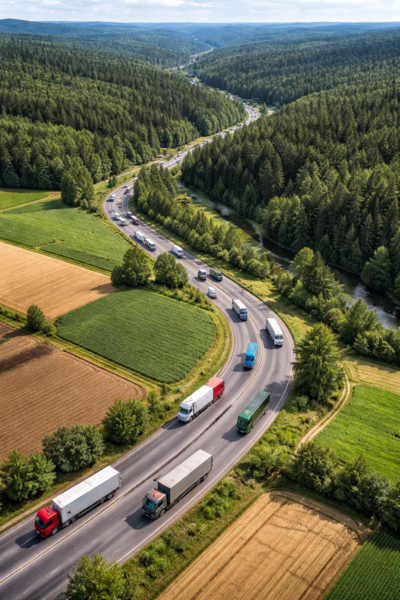
Explore an integrated framework that combines data-driven modeling with simulation technologies to facilitate collaboration between small agriculture and forestry businesses, improving resource utilization and addressing seasonal demand variations in transportation management, offering practical insights for enhanced efficiency in developing EU economies like Latvia.
Addressing Seasonal Challenges in Agricultural and Forestry Transportation
Small enterprises in agriculture and forestry encounter significant challenges due to seasonal transportation demands. Agricultural transport peaks during harvest periods, requiring intensive vehicle and driver use for limited times, while forestry transport increases in winter with improved road access. This results in resource inefficiencies: high-demand seasons lead to shortages of specialized equipment and labor, increasing costs, while off-seasons leave assets idle and require payments to retain drivers.
In developing EU countries such as Latvia, small businesses often operate within a single sector, resisting collaboration due to traditional approaches and equipment incompatibilities. Forestry vehicles typically include three-axle trucks with hydraulic loaders for logs, whereas agricultural operations use tractors with semi-trailers for bulk cargo like grain, loaded by machinery. Without intersectoral resource sharing, potential efficiencies are overlooked, such as agricultural firms transporting timber in winter with modifications.
This matters because agricultural and forest freight represents one-fifth of Latvia’s road cargo, according to national statistics. Inefficient practices raise operational costs and affect sustainability in economic, social, and environmental dimensions. Existing models in literature frequently neglect seasonal variations, emphasizing isolated supply chains over synergies. Collaboration can reduce idle periods, share labor, diversify operations, and improve resilience in these key sectors.
Methodology: Integrating Data-Driven Techniques with Simulation for Intersectoral Collaboration
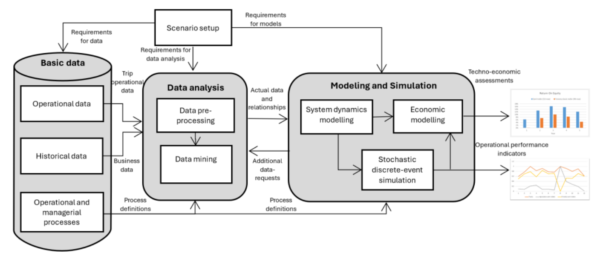
The research presents an integrated framework combining web-based data management, machine learning, system dynamics, discrete-event simulation, and a multi-user web environment to support cross-sectoral collaboration in transportation. It extends established logistics simulation methods by incorporating data-driven elements and focusing on agriculture-forestry integration.
Data collection uses a web platform for small agricultural firms, gathering trip details including routes, loads, fuel, and overtime for centralized management. Preprocessing involves cleaning and normalization for analysis.
Symbolic regression, implemented via genetic programming, derives analytical formulas from datasets without prior assumptions. It produces expressions such as trip costs based on distances and volumes (e.g., Equation 1: C_trip ≈ 0.85 * empty_distance + 1.69 * volume …). Models are validated with 80/20 train/test splits, achieving R² values near 0.97 and low errors.
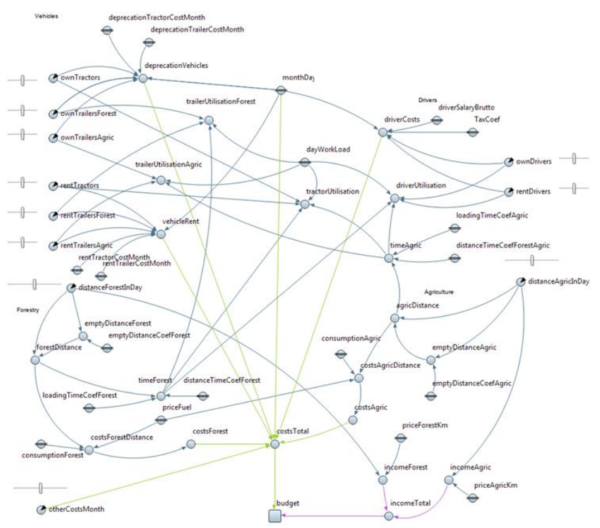
System dynamics models operational flows like transport, loading, and maintenance, linked to an economic model for scenario assessment using technical and economic metrics. Over 20 nodes process inputs (e.g., trailer numbers, distances) to outputs like utilization and costs, shown in causal diagrams.
Stochastic discrete-event simulation incorporates randomness, evaluating KPIs, graphs, and online views for scenario insights.
Scenarios include a baseline (agriculture-only) and cooperatives: Scenario 1 adds one forestry semi-trailer; Scenario 2 involves multiple for sharing. A multi-user web setup separates front/back ends, supporting online experiments via PHP.
Economic evaluation in Excel assesses feasibility, including costs, ROI, and emissions.
Tested in Latvia’s EIP-AGRI project, this methodology enables data-informed decisions for small businesses, promoting collaborative transport.
Results: Improved Resource Utilization Through Collaborative Scenarios
The case study examines a small agricultural firm, demonstrating benefits from cross-sector collaboration via simulations. Initial data from over 61 forestry and 12 agricultural firms reveal seasonal patterns: agricultural trips show shorter distances in peaks and greater spread off-peak; forestry distances vary irregularly.
Data-driven models provide formulas, such as trip costs (R² 0.973-0.977) and unit costs per km for specialized trailers.
Baseline: 3 agricultural trailers result in 173 trips, 28.7 thousand km, 0.23 truck utilization.
Scenario 1 (add 1 forestry): Adds 176 forestry trips, 30.2 thousand km, increases truck utilization to 0.47, forestry trailer to 0.72.
Scenario 2 variants: 3 agricultural/2 forestry: 348 forestry trips, 60 thousand km, truck utilization 0.70. 3/3: 439 trips, 75.7 thousand km, utilization 0.83. 2/3: Balances at 115 agricultural/485 forestry trips, 103 thousand km total, truck utilization 0.81.
Diversification enhances year-round loads, though higher configurations raise costs, one additional trailer often achieves notable improvements. As noted, “the provision of timber transportation with just one semi-trailer will already significantly improve the use of the company’s resources.”
Implications and Future Directions: Expanding to AI and Blockchain in Logistics
This framework suggests potential extensions to third-party logistics and incorporation of artificial intelligence and blockchain for enhanced data management, including monitoring transport conditions to ensure compliance with standards.
We thank the authors for their contribution to engineering research. For insights or collaboration, contact them via the paper’s details. Echoing the conclusions: “data-driven simulation… can certainly be regarded as a new trend in the development of computer modeling technologies.”
Reference: Merkurjeva, G., et al. (2025). Data-driven Simulation in Transportation Management through Cross-Sectoral Collaboration. Baltic J. Modern Computing, 13(4), 758-777. https://doi.org/10.22364/bjmc.2025.13.4.02