Circular product design grapples with ethical dilemmas involving hazardous substances. This research from Delft University of Technology categorizes these challenges, offering a framework for designers, toxicologists, and policymakers to navigate ethical issues, balancing safety and sustainability within the circular economy model.
Navigating Ethical Challenges in Circular Design
In the evolving landscape of circular economies, industrial designers encounter ethical dilemmas akin to those in traditional linear economies. The core issue arises from the use of hazardous substances, posing significant ethical challenges in circular product design. The circular economy model, emphasizing resource reuse, cannot afford the reintroduction of harmful chemicals and materials that jeopardize human health and the environment. However, eliminating or substituting these substances is not always feasible due to design requirements or conflicting values.
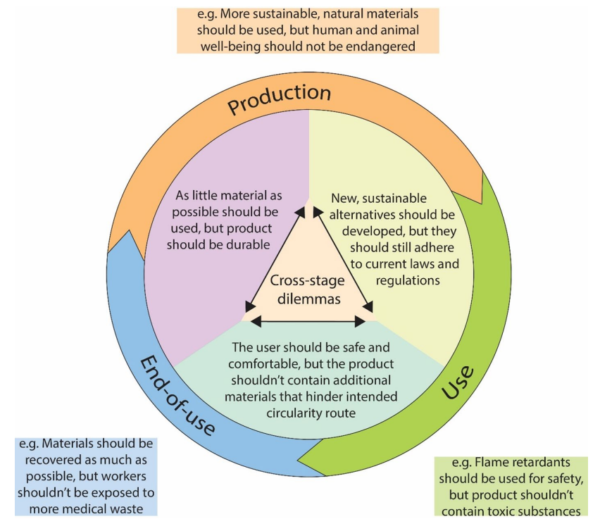
This research, conducted by Ida Krstulović at Delft University of Technology, explores the ethical dilemmas faced by designers striving to create products that are both safe and sustainable. The study highlights the challenges of balancing various moral values, such as human health, environmental preservation, and justice, throughout a product’s life cycle. By categorizing these dilemmas into stages—production, use, end-of-use, and transitional phases—the research provides a framework for understanding the ethical implications at each stage of a product’s life.
These dilemmas manifest in real-world scenarios. For instance, the choice between using a single material to facilitate recycling or multiple materials to enhance repairability presents a moral conundrum. Similarly, selecting an environmentally friendly material like aluminum may increase the product’s carbon footprint due to higher energy consumption during production. These decisions force designers to navigate a complex web of ethical considerations, often requiring trade-offs between conflicting values.
Innovative Methodology for Ethical Design
The research employs a comprehensive approach to categorize ethical dilemmas in circular product design. By drawing on the principles of Value Sensitive Design (VSD), the study offers a structured method for recognizing and addressing value conflicts in the design process. VSD, developed by Batya Friedman and colleagues, provides a framework for integrating human values into design through conceptual, empirical, and technical inquiries.
Krstulović’s research builds on this foundation by categorizing ethical dilemmas specific to circular product design. The study utilizes a non-systematic literature review, examining case studies and relevant examples from databases like Scopus and Google Scholar. The queries focused on terms such as “safe-and-sustainable-by-design,” “design ethics,” and “design dilemmas.” This approach allowed for a broad understanding of the ethical issues arising in material selection and design practices.
The research also considers recent developments in Safe-and-Sustainable-by-Design (SSbD) frameworks, which aim to integrate safety and sustainability into the product life cycle. By aligning with these frameworks, the study provides a tool for designers to anticipate and address ethical issues that might otherwise be overlooked. This categorization tool serves not only designers but also toxicologists, policymakers, and other stakeholders, promoting ethical awareness and decision-making in circular product design.
Insights and Conclusions
The research successfully categorizes ethical dilemmas in circular product design, offering a practical tool for stakeholders to navigate these challenges. By structuring the dilemmas around the stages of a product’s life cycle, the study provides a clear framework for understanding the ethical implications at each phase. This categorization aids in recognizing patterns in design practice and sensitizes stakeholders to ethical issues.
The study emphasizes that ethical dilemmas in circular product design are not merely about assessing risks or life cycle impacts but also involve moral considerations. The research underscores the importance of ethical reflection and moral reasoning in making justifiable design decisions. By providing a comprehensive overview of ethical dilemmas, the study contributes to the broader discussion on sustainability and ethics in industrial design.
Future Directions and Industry Impact
This research offers valuable insights into the ethical challenges of circular product design, providing a framework that can be applied across various industries. By highlighting the importance of ethical awareness, the study encourages designers and stakeholders to consider the moral implications of their decisions. The categorization tool developed in this research has the potential to enhance risk assessment and life cycle assessment processes, promoting a more comprehensive and sustainable approach to product development.
For those interested in exploring these ethical dilemmas further or contributing to this field, the research offers a foundation for future studies and practical applications. We thank Ida Krstulović for her contribution to this important area of study and encourage readers to engage with the research for a deeper understanding of the ethical challenges in circular product design.
Reference: Krstulović, I. (2026). Being Concerned with Substances of Concern: A Classification of Ethical Dilemmas in Circular Product Design. Science and Engineering Ethics, 32(2), Article 17. DOI: https://doi.org/10.1007/s11948-026-00585-0