
This research investigates the impact of seagrass decline on tidal hydrodynamics in coastal lagoons. Using advanced 3D modeling, it examines how seasonal and long-term changes in seagrass characteristics affect flow conditions in the Arcachon lagoon, France, offering insights into managing these vital ecosystems.
Seagrass Decline: A Growing Concern
Seagrasses are vital to coastal ecosystems, regulating sedimentation and erosion. Their decline, particularly among intertidal species, poses significant challenges. The loss of seagrasses affects tidal hydrodynamics, altering current velocities, tidal asymmetry, and high-tide water levels. These changes can increase suspended sediment concentration, reduce light availability, and exacerbate seagrass loss. Despite their importance, limited research has focused on how seagrass loss influences hydrodynamics in shallow coastal lagoons.
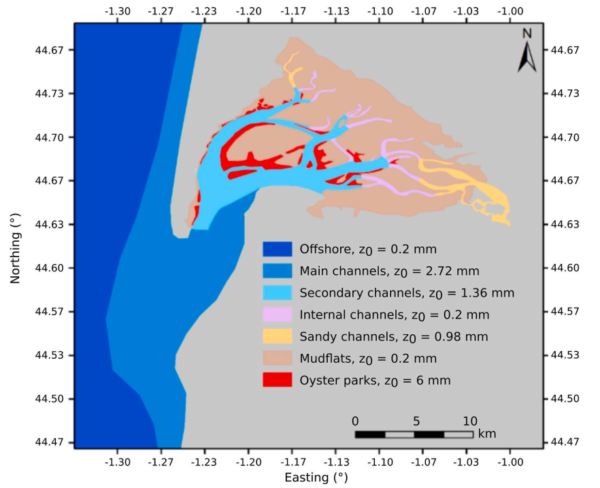
The Arcachon lagoon in France, with its extensive Zostera noltei and Zostera marina meadows, offers a unique setting to study these effects. Over the past three decades, the lagoon has experienced significant seagrass decline, providing an opportunity to investigate the relative impacts of seasonal changes and long-term decline on tidal hydrodynamics.
Advanced 3D Modeling: A New Approach
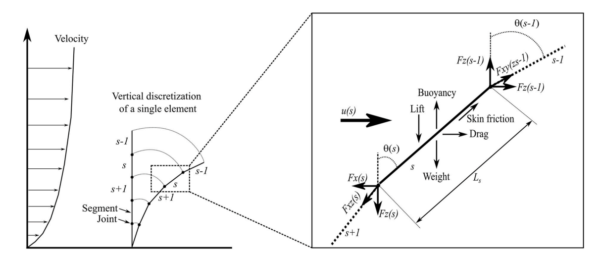
The researchers used the MARS3D hydrodynamic modeling software to simulate tidal hydrodynamics in the Arcachon lagoon. This model, developed by IFREMER, solves the Navier-Stokes equations using a finite difference method. A new vegetation-flow module was developed to account for the influence of vegetation on the flow, considering leaf bending and vegetation impact on the current profile.
The model was calibrated and validated using extensive datasets collected over 30 years. Scenario analyses compared pre-decline and post-decline states of the meadows during summer and winter, allowing assessment of the relative impact of seasonal changes and seagrass decline on tidal hydrodynamics.
Key Findings: Tidal Hydrodynamics Transformed
The study found that seagrass decline leads to significant changes in tidal hydrodynamics. In summer, reduced seagrass coverage resulted in a 100% increase in bottom flow velocities on the tidal flats, while flow velocities in the channels decreased by 20%. The impact was less pronounced in winter. Both the multi-decadal decline of Zostera meadows and the seasonal loss between summer and winter led to comparable modifications in tidal-flow parameters.
These changes suggest that seagrass decline can enhance suspended sediment concentration, reduce light availability, and contribute to further seagrass loss. Additionally, altered hydrodynamics may affect sediment management due to increased siltation in channels.
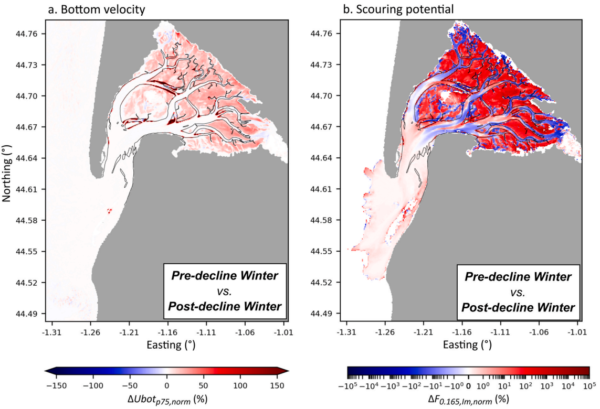
two, − 103 divided by 10, and -105 divided by 1 000.
Looking Ahead: Implications for Coastal Management
This research underscores the critical role of seagrasses in regulating tidal hydrodynamics and the potential consequences of their decline. The findings highlight the need for effective management strategies to protect and restore seagrass meadows, which are vital for maintaining healthy coastal ecosystems. Future research could explore the long-term impacts of seagrass decline on biodiversity and ecosystem services in coastal lagoons.
Reference: Arnaud Le Pevedic, Mathis Cognat, Aldo Sottolichio, Florian Ganthy. “Drastic changes in tidal hydrodynamics following seagrass decline and their seasonal variations in a shallow lagoon.” Coastal Engineering 205 (2026) 104948. DOI: https://doi.org/10.1016/j.coastaleng.2026.104948