
This research explores the potential of paddy field dams (PFDs) in flood mitigation. Utilizing the Storm Water Management Model (SWMM), the study shows notable flood peak reduction, offering a viable alternative to conventional flood management strategies in the flood-prone regions of central Taiwan.
Flood Mitigation in Agricultural Zones: A Persistent Challenge
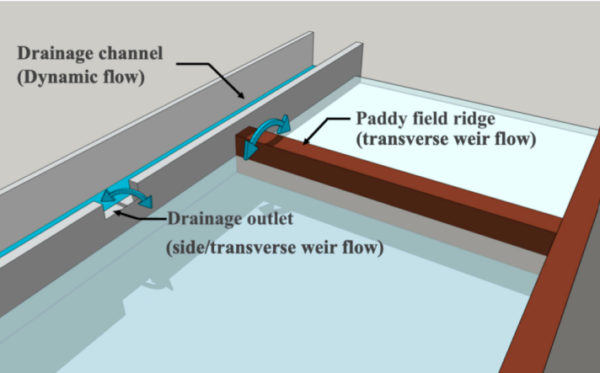
Flooding is a persistent issue globally, worsened by climate change and rapid urbanization. In East and Southeast Asia, natural floodplains are increasingly replaced by impervious infrastructure, heightening flood risks in agricultural zones. Paddy fields, traditionally for rice cultivation, offer potential solutions due to their water retention capabilities. However, quantifying their flood mitigation effectiveness is complex, given the intricate hydrological constraints involved.
In Taiwan, paddy fields are recognized for their multifunctional environmental benefits, including flood regulation and groundwater recharge. Despite these benefits, technical evaluations of interventions like Paddy Field Dams (PFDs) are needed to maximize flood mitigation potential. This study addresses this gap by employing hydrodynamic analysis to evaluate PFD effectiveness under complex hydraulic conditions in central Taiwan.
Advanced Techniques: Utilizing the SWMM Model
The research employs the Storm Water Management Model (SWMM) to simulate the flow dynamics and backwater effects that govern water exchange between paddy storage units and drainage channels. By incorporating bi-directional weir structures in paddy field boundaries, the study assesses the flood mitigation potential of PFDs under extreme rainfall events.
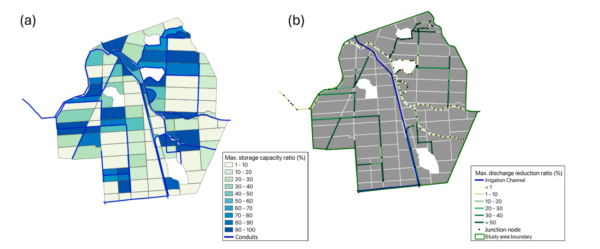
Subfigure (b) presents the maximum discharge reduction ratio achieved in individual drainage canals during the same event.
The SWMM model provides detailed analysis of terrain gradients and junction hydraulics, influencing hydraulic heads within fields. This approach offers a high-resolution understanding of hydrodynamic processes, identifying optimal PFD implementation locations for maximal flood-mitigation benefits. The study’s methodology departs from conventional strategies, offering a targeted framework for decentralized flood mitigation deployment.
Key Findings: Effective Flood Peak Reduction
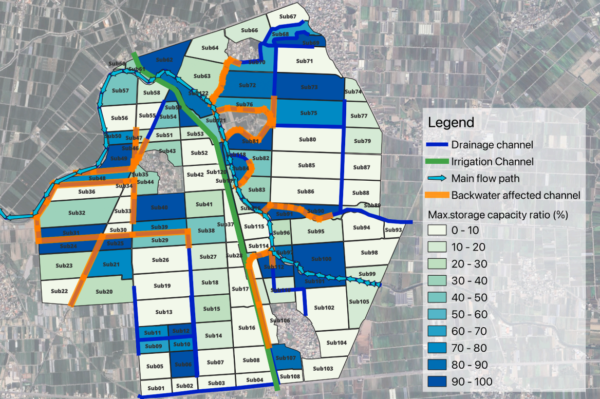
The simulations reveal significant flood peak attenuation, with discharge reductions exceeding 60% in minor drainage channels. In primary conduits, reductions reached 11.5% during a historical storm event and ranged from 10.4% to 17.6% across 10- and 50-year design storm scenarios. Spatial analysis highlights the heterogeneous performance of PFDs, governed by localized hydrodynamic-topographic coupling.
The research identifies a dynamic interaction between piezometric pressure evolution within PFDs and hydraulic head fluctuations in adjacent drainage channels. This hydraulic coupling modulates the effective floodwater storage capacity of PFDs, exerting a first-order control on their flood mitigation performance. These findings emphasize the importance of considering field elevation gradients and local channel hydraulics in PFD design and placement.
Future Directions: Enhancing Flood Resilience
This study establishes a hydrodynamically informed framework for targeted decentralized flood mitigation measures. By highlighting the potential of multifunctional paddy field infrastructure, it offers a practical alternative to conventional strategies. The effectiveness of PFDs can be improved by considering localized hydrodynamic conditions in their design and placement.
We thank the authors for their valuable contribution to flood management. For those interested in exploring this approach or contributing insights, we encourage engagement in this ongoing dialogue.
Reference: Cheng-Wei Yu, Sin-Syuan Shih, Won-Ho Nam. “Hydrodynamic evaluation of paddy field dams for flood mitigation using the SWMM model.” Agricultural Water Management 328 (2026) 110305. DOI: https://doi.org/10.1016/j.agwat.2026.110305