
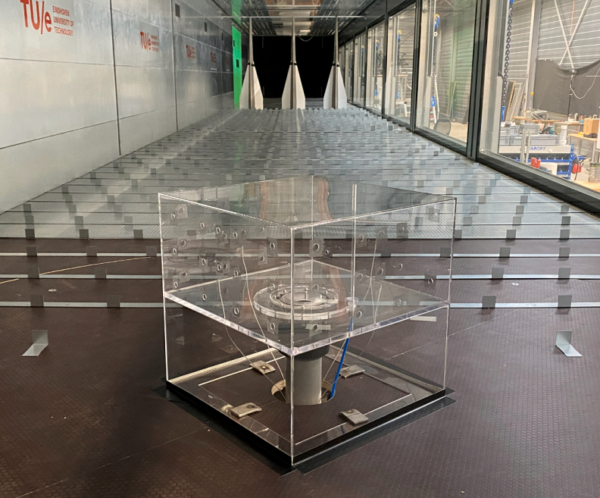
Researchers have developed an experimental benchmark to quantify how pollutants re-enter buildings through ventilation systems. Using wind-tunnel experiments, this study provides key insights into pollutant dispersion, aiding in the enhancement of risk management strategies in occupational settings.
Understanding the Pollutant Re-Introduction Challenge
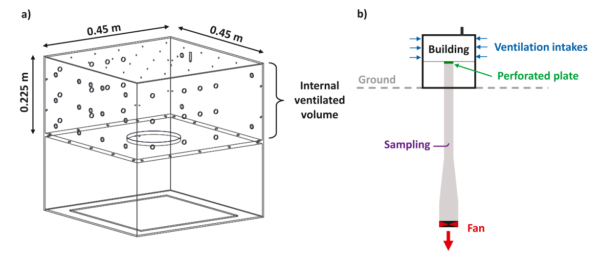
Occupational risk prevention often relies on ventilation systems to mitigate chemical hazards. Typically, pollutants are captured at their source, transported through ventilation ducts, and released outdoors. However, this process can inadvertently lead to the re-introduction of unfiltered pollutant
s into the same or neighboring buildings, depending on wind conditions. This phenomenon, known as pollutant re-introduction, poses significant challenges for risk assessment and control measures.
The potential for pollutants to re-enter buildings through ventilation systems is a critical concern, especially in environments where multiple activities occur, such as campuses with laboratories and office spaces. The re-introduction of pollutants can lead to unexpected exposure to chemicals, undermining the effectiveness of ventilation systems designed to supply fresh outdoor air. The complexity of predicting pollutant re-introduction is compounded by various factors, including wind conditions, building geometry, and ventilation system design.
While pollutant transfer and dispersion have been studied in different configurations, the specific issue of pollutant re-introduction through mechanical ventilation remains underexplored. Existing studies often focus on related topics, such as the re-introduction of contaminants through open windows or the dilution of pollutants from exhaust stacks. Therefore, there is a pressing need for comprehensive research to address the challenges associated with pollutant re-introduction through mechanical ventilation systems.
Innovative Experimental Approach
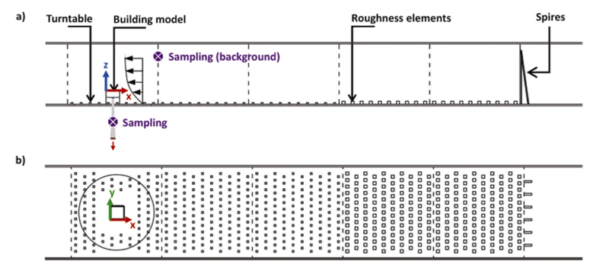
The research team developed an experimental benchmark using a reduced-scale building model to study pollutant dispersion and re-introduction. The model simulates wind flow around the building, the mechanical ventilation system, and the emission and tracking of a tracer gas in an atmospheric boundary layer wind tunnel (ABLWT). This setup allows for controlled experimentation to quantify the effects of wind conditions on pollutant re-introduction.
The building model represents an isolated cubical structure with dimensions of 18 × 18 × 18 m³, featuring a mechanically ventilated volume in the upper half. The ventilation system is designed to maintain an internal depressurization of -20 Pa and an air change rate of 6 h⁻¹. The researchers incorporated a single-flow mechanical ventilation system with passive air inlets and a mechanical exhaust fan, simulating typical ventilation in modern buildings.
To study the influence of wind conditions, the researchers measured tracer gas concentrations in the ventilation exhaust duct for 13 wind directions and 3 wind speeds. This comprehensive approach allowed the team to map the concentration of pollutants inside and outside the building, providing valuable data for validating pollutant dispersion models in computational fluid dynamics (CFD) frameworks.
Key Findings and Their Significance
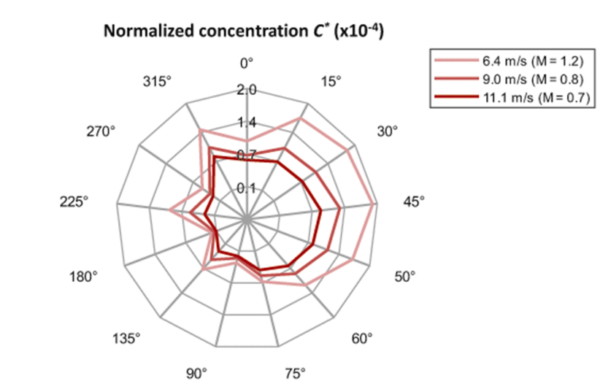
The experimental setup successfully demonstrated the ability to combine neutral atmospheric wind conditions, mechanical ventilation, and pollutant dispersion into a single experimental framework. The measurements revealed the influence of wind direction and speed on the re-introduction of pollutants through ventilation systems. The data showed that certain wind conditions could lead to higher concentrations of reintroduced pollutants, highlighting the importance of considering wind effects in risk assessments.
The research provides a crucial benchmark for validating CFD simulations of pollutant dispersion both outside and inside buildings. The findings emphasize the need for accurate modeling of pollutant re-introduction to implement effective risk management strategies in occupational environments. By quantifying the effects of wind conditions on pollutant re-introduction, the study offers valuable insights for designing ventilation systems that minimize exposure risks.
Future Directions and Impact
This research paves the way for more accurate risk assessments and improved ventilation system designs in buildings. The experimental benchmark can serve as a foundation for future studies exploring complex scenarios and validating advanced CFD models. By enhancing our understanding of pollutant re-introduction, this work contributes to the development of safer and healthier indoor environments.
We extend our gratitude to the authors for their valuable contribution to this field. If you have insights or wish to collaborate on further research, please reach out. Together, we can continue to advance our understanding of pollutant dispersion and improve occupational safety.
Reference: Romain Guichard, Anjali Krishnan Radhakrishnan Jayakumari, Stefanie Gillmeier, Ali Bahloul. “Quantification of pollutant re-introduction through ventilation openings into a building: A benchmark based on wind-tunnel experiments.” Building and Environment 291 (2026) 114262. DOI: https://doi.org/10.1016/j.buildenv.2026.114262