
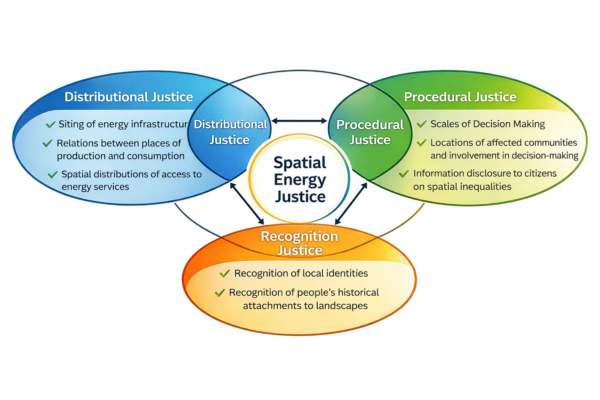
This study examines the spatial dynamics of energy justice by engaging citizens in discussions about regional energy transitions. Focusing on Overijssel, Netherlands, researchers uncover how citizens perceive justice in energy policy, offering insights into socio-spatial inequalities and highlighting potential areas for policy improvement.
Understanding the Core Issue
As the world shifts towards renewable energy, the installation of wind turbines and solar parks in rural landscapes has sparked local concerns about fairness and justice. These concerns are critical because they can significantly affect the societal acceptance of energy transitions. While the literature on energy justice is expanding, there remains a gap in understanding citizens’ perspectives on justice within regional energy transitions. This research addresses this gap by exploring the aspects that citizens consider relevant when discussing a just energy transition in a regional context.
In the Netherlands, the concept of justice has become a cornerstone of national energy policy, particularly following the National Climate Agreement of 2019. The agreement led to the creation of 30 “Energy Regions,” administrative layers tasked with developing regional energy strategies. These regions are designed to facilitate decision-making about the spatial integration of renewable energy facilities closer to local communities, while avoiding conflicts between municipalities. However, the delegation of decision-making to these regions raises questions about how justice is perceived and enacted at different scales, from local to global.
The study focuses on the province of Overijssel, where citizens’ perspectives on energy justice are explored through focus groups. The research aims to unpack the construction of energy justice and its spatial dimensions as perceived by citizens. By doing so, it seeks to illuminate potential injustices that might be overlooked when studying energy transitions solely from the perspective of policymakers and experts.
Innovative Research Approach
The researchers conducted eleven focus groups with 42 participants from diverse backgrounds across four cities in Overijssel. These focus groups served as platforms for citizens to express their views on energy justice using maps and other visual materials. This participatory approach allowed the researchers to gather rich, qualitative data on citizens’ concerns regarding energy transitions in their region.
The study employed a spatial lens to analyze justice concerns, drawing on a framework that considers distributional, procedural, and recognition justice. Distributional justice focuses on the fair allocation of burdens and benefits, procedural justice examines access to decision-making processes, and recognition justice considers the respect and acknowledgment of vulnerable citizens’ needs.
The research also explored the multi-scalar nature of justice concerns, acknowledging that energy policies and changes at one scale can create injustices at another. By engaging citizens in discussions about energy justice, the study aimed to capture a broader range of concerns, including those related to socio-economic and environmental inequalities, as well as energy system issues.
Key Findings and Insights
The findings reveal that citizens’ justice claims are deeply intertwined with spatial dimensions, including spaces, places, and scales. Participants expressed concerns about how regional energy transitions impact existing socio-spatial inequalities, ranging from household to global levels. They highlighted that energy policies at one scale could exacerbate injustices at another, such as national subsidies disproportionately benefiting affluent neighborhoods or renewable energy facilities affecting rural landscapes more than urban areas.
The study underscores the relational nature of justice and spatiality, demonstrating that citizens’ interpretations of fairness are shaped by the spaces and scales they reference. This insight is crucial for policymakers aiming to address justice concerns in regional energy transitions effectively.
Policy Implications and Future Directions
This research offers valuable insights into the spatial justice considerations that underpin citizens’ concerns about regional energy transitions. By highlighting the multi-scalar character of these concerns, the study provides a framework for improving policy processes and communication about energy transitions. Future research could further explore how these insights can be integrated into energy policy and governance to ensure more equitable outcomes.
Reference: Haarbosch, S., Kloppenburg, S., Van Vliet, B., & Metze, T. (2026). Exploring the Spatial Dynamics of a Just Regional Energy Transition: What If We Ask Citizens? Environmental Policy and Governance. DOI: https://doi.org/10.1002/eet.70044