
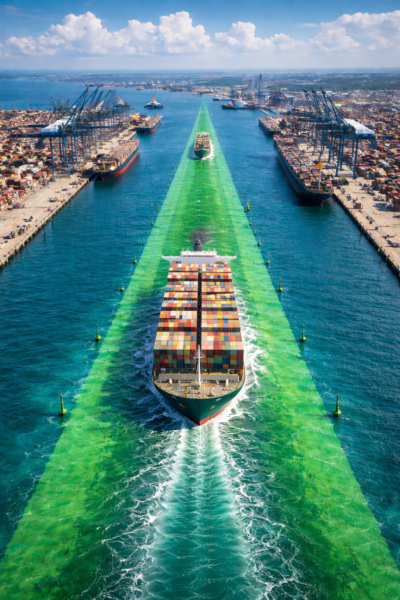
Forging “Zero-Emission Highways of the Sea”: New research maps how international collaboration between ports, cities, and industries is creating the first viable pathways to decarbonize global maritime trade.
Zero-Emissions Shipping, in our cities and backyards
Maritime shipping is the backbone of global trade but a major source of greenhouse gases, with emissions projected to surge to 17% of the global total by 2050. This escalating environmental challenge demands urgent, scalable solutions. The transition affects global supply chains, coastal city air quality, international climate policy, and the health of marine ecosystems.
The concept of “green corridors” isn’t new. It originated in urban planning with greenways and evolved into “Green Transport Corridors” for efficient, multimodal freight in Europe. In shipping, the 2021 Clydebank Declaration marked a pivotal moment, framing “Green Shipping Corridors” (GSCs) as routes where zero-emission shipping is catalyzed. However, research remained fragmented, with limited understanding of GSCs as an integrated global phenomenon, their taxonomy, and their specific implications for the port-city ecosystems they connect.
How can Green Shipping Corridors help our port-regions?
This study asks: How can the emerging concept of maritime Green Shipping Corridors be understood and mapped as a framework for decarbonizing shipping and fostering sustainable port-city regions? The research goal is to provide a comprehensive, multidisciplinary review to define GSCs, trace their origins, and analyze their implementation. Crucially, it moves beyond a purely technological view, systematically examining the complex stakeholder networks and spatial planning implications essential for their success.
This research innovates by synthesizing a global taxonomy of maritime GSCs and proposing a novel conceptual framework for their development. It distinguishes between “port-centric” corridors (driven by local air quality and community interests, like Los Angeles-Shanghai) and “route-centric” ones (driven by national strategic interests like energy leadership). Most significantly, the study expands the traditional three pillars of sustainability (social, economic, environmental) by adding a critical fourth: **institutions and actors**. This underscores that robust governance and multi-stakeholder collaboration—between governments, ports, shippers, energy providers, and communities—are foundational pillars for building viable green maritime corridors and sustainable port-city ecosystems.
Research Results
The research maps over 30 global GSC initiatives, identifying a concentration in North America, Europe, and East Asia. It catalogs the diverse stakeholders involved, from ports and class societies to energy providers and NGOs. A key insight is the pioneering role of city-to-city networks (like C40) in overcoming geopolitical barriers. The analysis of the first major trans-Pacific GSC between Los Angeles and Shanghai reveals a collaborative “gate-to-gate” model, where cargo owners, carriers, and port operators each have defined roles in deploying zero-emission ships and infrastructure.
GSCs have the potential to act as “special economic zones at sea,” accelerating policy and fuel innovation. They could reshape port-city land use, prioritizing green logistics hubs and renewable energy integration. Ports, shipping lines, and clean tech firms stand to benefit from new markets. The research calls for urgent empirical studies on GSCs’ local socio-economic impacts, land-use conflicts, and models for inclusive community engagement in the energy transition.
Green Shipping Corridors are more than just shipping routes; they are testbeds for the collaborative governance and integrated planning required for a sustainable blue economy. As the author concludes, “disaggregated and transparent data is needed” to turn these ambitious corridors into equitable and effective realities. This research provides the essential map and compass for that journey.
Thank you to author Mina Akhavan for this comprehensive contribution. For researchers, policymakers, or industry professionals interested in the future of sustainable shipping and port-city development, this work is an indispensable resource.
Reference: Akhavan, M. (2025). Decarbonising Maritime Transport: The Role of Green Shipping Corridors in Making Sustainable Port-City Ecosystems. *Ocean and Society*, 2, Article 9411. https://doi.org/10.17645/oas.9411*