
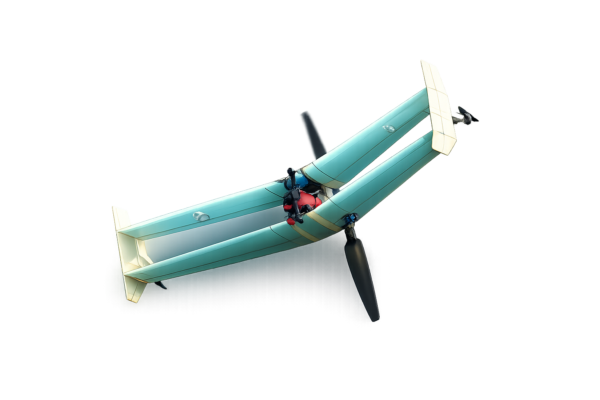
Researchers at Delft University of Technology have developed an analytical model that estimates fixed-wing UAV airspeed using only propeller power and rotational speed feedback from standard electronic speed controllers. This computationally efficient, model-free solution provides a practical alternative or redundancy to conventional Pitot tubes, achieving strong accuracy on real flight data.
The Challenge of Reliable UAV Airspeed Measurement
Accurate airspeed information is essential for fixed-wing UAV operations. It is used in control algorithms for gain scheduling and flight envelope protection. Conventional systems rely on Pitot tubes and differential pressure sensors to measure dynamic pressure. These sensors are effective in controlled conditions but remain vulnerable to icing, clogging from dust or water, and errors from temperature variations.
Physical redundancy through additional sensors, such as microphones or ultrasonic anemometers, can improve reliability but increases weight, cost, and system complexity. Analytical redundancy offers a more efficient path by deriving airspeed from existing measurements. Earlier approaches have employed aircraft dynamic models, servo signals, machine learning on IMU data, or sensor fusion techniques. However, many require detailed vehicle models, supplementary hardware, or significant computational resources.
The Delft team addressed this by focusing on data already provided by modern electronic speed controllers (ESCs): input power and propeller rotational speed. Their approach avoids the need for a full vehicle dynamics model and supports integration with off-the-shelf components.
A Data-Driven Propeller Feedback Model
The researchers combined data from Blade Element Momentum (BEM) simulations, wind-tunnel experiments, and flight tests using the Cyclone tailsitter UAV (1 kg take-off weight, 0.9 m wingspan). They first determined the electro-mechanical efficiency of the ESC-motor system (η ≈ 0.87) to convert measured electrical input power to aerodynamic propeller power.
Applying dimensional analysis via the Buckingham-π theorem, they related propeller power to the advance ratio J = V_a / (n D). Because the power coefficient curve is not globally invertible, they applied a selection criterion to identify monotonic intervals suitable for inversion, focusing on the forward-flight regime (J > J_crit ≈ 0.20).
Two model structures were derived using LASSO regression for sparsity and generalization:
- An indirect model estimating the advance ratio from the power coefficient before computing airspeed.
- A direct model estimating airspeed directly from power P and rotational speed ω (rad/s): V_a = β₁ ω + β₂ (P² / ω⁵)
An in-flight coefficient identification procedure was also developed, using only GPS earth-frame velocity data under assumptions of constant horizontal wind and small roll angle. Propeller acceleration effects were evaluated and found negligible for this UAV class. The models were validated across simulation, laboratory, and flight datasets, with corrections applied for the tailsitter configuration.
Validation Results and Model Performance
On unseen flight test data, the direct model achieved a normalized Root Mean Square Error (nRMSE) of 5%, corresponding to an absolute RMSE of approximately 0.53 m/s when normalized over the tested airspeed range. Performance remained consistent when coefficients were identified via the GPS-based in-flight procedure, demonstrating practical viability for field deployment.
The direct model exhibited superior performance for in-flight calibration and was adopted as the primary solution. Accuracy was highest under coordinated flight with small angles of attack and sideslip, though reasonable results were observed during more dynamic maneuvers.
The paper states: “This work introduces a novel analytical model for estimating the airspeed of fixed-wing Unmanned Aerial Vehicles (UAVs) using solely propeller power and rotational speed measurements. […] The final model generalizes well achieving a normalized Root Mean Square Error (nRMSE) of 5% on unseen flight data.”
In conclusion, the authors note: “We demonstrated that it is possible to estimate the airspeed of a UAV using only propeller power and rotational speed measurements, without relying on a vehicle model or computationally intensive algorithms. […] The resulting system provides a robust and computationally efficient solution for real-time airspeed estimation across diverse fixed-wing UAV platforms.”
Implications and Directions for Future Work
This propeller-based estimation method offers a pathway to enhance UAV sensor resilience by leveraging existing hardware. It reduces dependence on dedicated airspeed sensors while maintaining low computational demands, supporting broader application across fixed-wing platforms with unobstructed propeller inflow.
The study identifies opportunities to extend the approach beyond axial-flow assumptions, incorporate low-advance-ratio regimes, and examine effects on larger UAVs with heavier propellers.
We thank Evangelos Ntouros, Pavel Kelley, and Ewoud J.J. Smeur for their contribution. Engineers or researchers working on UAV sensing, propulsion feedback, or analytical redundancy are invited to share insights or discuss potential collaborations via the comments or editorial contact.
Reference:
Ntouros, E., Kelley, P., & Smeur, E. J. J. (2026). Airspeed estimation for UAVs using only propeller feedback. Aerospace Science and Technology, 168, 110999. https://doi.org/10.1016/j.ast.2025.110999
Data and code are available at https://doi.org/10.4121/8bcec6ba-c5478-4595-b629-4378feac6dcb.