

This research introduces a structural-based inverse approach that integrates MT-InSAR characteristics with numerical simulations of damage mechanisms, enabling the identification of the minimum number and optimal placement of persistent scatterers to assess surface displacements’ representativeness for specific infrastructure monitoring needs, surpassing traditional density-based evaluations in precision and reliability.
The Challenge in Infrastructure Monitoring
A significant share of global infrastructure, constructed decades ago, fails to meet current service requirements or comply with modern standards. Intensified environmental stressors, such as climate-related events, accelerate degradation, increasing the risk of structural damage and failures. This situation has elevated infrastructure monitoring to a worldwide priority, prompting guidelines like the U.S. National Bridge Inspection Standards, China’s Standards for Technical Condition Evaluation of Highway Bridges, Italy’s national guidelines, and Germany’s standards. These frameworks largely depend on visual inspections and non-destructive testing, which are resource-intensive, expensive, and challenging to implement at scale. Compliance with inspection intervals does not always ensure structural integrity, as evidenced by historical incidents.
Multi-Temporal Interferometric Synthetic Aperture Radar (MT-InSAR) offers an alternative for Structural Health Monitoring (SHM), providing millimeter-accurate displacement measurements over extensive areas without on-site instrumentation. It utilizes Persistent Scatterers (PSs)—points with consistent radar backscatter—to identify anomalies in structures including bridges, tunnels, buildings, dams, and railways. However, PS distribution remains unpredictable, affected by surface properties, weather, sensor resolution, acquisition geometry, and deformation nature. This variability impacts the quantity and spatial arrangement of PSs, potentially limiting monitoring reliability.
Existing evaluation methods primarily use PS density as an indicator of suitability, presuming higher density improves effectiveness. This metric has limitations: MT-InSAR detects only surface displacements, which may not reflect internal behaviors; no standard density threshold defines adequacy; and it overlooks structural factors like geometry, loading conditions, and damage mechanisms. For instance, a uniformly loaded beam may require few PSs to represent its deflection, whereas localized damage demands targeted placement. Dependence on density alone can lead to inaccurate assessments of MT-InSAR’s capabilities.
This challenge is critical because inadequate monitoring risks human safety, economic disruption, and high repair costs. With aging infrastructure prevalent—from Amsterdam’s quay walls to international bridges—reliable, scalable monitoring is essential for early detection, efficient maintenance, and risk mitigation.
Research Methodology and Key Innovations
The study presents a structural-based inverse approach to determine MT-InSAR’s suitability for SHM, reversing the standard process by starting with simulated damage and evaluating if surface measurements suffice. It targets progressive mechanisms, suitable for MT-InSAR’s revisit intervals. High-fidelity Finite Element Method (FEM) models simulate the structure and mechanisms, yielding a displacement matrix X with columns as time-step snapshots. Proper Orthogonal Decomposition (POD) reduces it to a basis matrix Ψ of dominant modes.
Surface representativeness is assessed by comparing a pseudo sensor (accessing all nodes) and virtual MT-InSAR (surface nodes only). Pivoted QR factorisation ranks points for reconstruction via linear mapping minimizing ||aL – b||_2^2. Mean and maximum errors are evaluated; comparable errors indicate surface adequacy.
For suitable cases, ideal PSs—minimal points capturing behavior—are identified using modified pivoted QR, introducing a “Detected” part for iterative ranking. Radial Basis Function (RBF) kernels compute correlations K(x,y) = exp(-γ||x-y||^2), with γ=1/m. Regions form from correlations above a threshold (e.g., 0.8); variation determines the number, excluding redundants. MT-InSAR positional uncertainties (e.g., 3-4 m horizontal) are incorporated via RBF kernels, refining regions as intersections. Gaussian noise is considered, with reconstruction affected proportionally but systematically addressable.
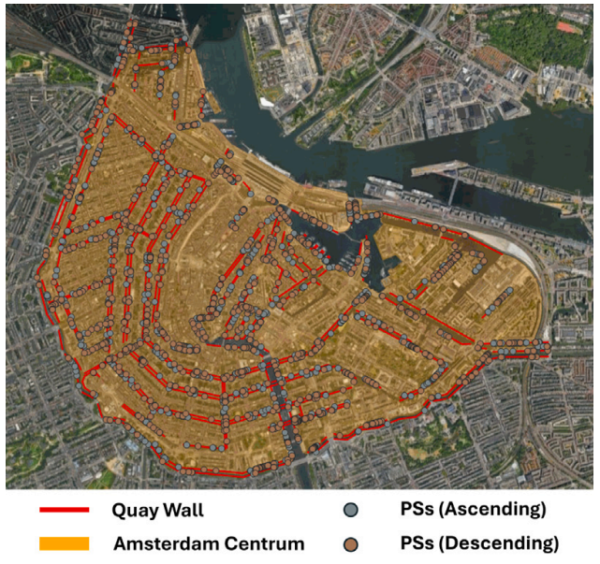
Applied to Amsterdam’s Marnixkade quay wall (FEM-validated), three mechanisms were simulated: traffic loading, central pile degradation, and random pile degradation. Ideal PSs benchmarked city-wide: quay walls segmented into 29.7 m overlaps, real 2011-2020 TerraSAR-X PSs compared against regions for coverage and errors. This method advances beyond density by incorporating mechanism specifics and uncertainties, offering scalability.
Key Results and Conclusions
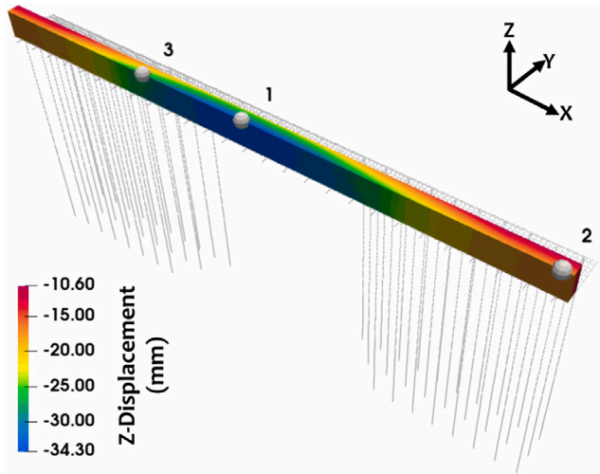
For Marnixkade traffic loading, three ideal PSs yielded average reconstruction errors below 0.1 mm, comparable to pseudo sensor; regions symmetric, first at peak displacement, others at gradients.
Central pile degradation required two PSs, with similar error convergence; regions at maximum and lesser-affected areas. Random degradation needed two PSs, capturing asymmetry at high- and low-degradation zones. City-wide, 25.11% ascending and 24.2% descending segments had PSs. Central degradation showed limited coverage due to small first region, resulting in high errors. Traffic loading had broader coverage across regions, yielding lower errors. Random degradation coverage was intermediate.
The study concludes: “This work represents a significant advancement in MT-InSAR-based SHM, providing a more targeted and structurally informed approach for real-world infrastructure monitoring.” And “the proposed approach provides a structured, robust and scalable framework for evaluating MT-InSAR’s applicability in SHM.”
Implications and Future Potential
This approach supports mechanism-specific satellite monitoring, extendable to various infrastructures. Future extensions may include nonlinear reconstructions or parameter sensitivity analyses. As noted, “the proposed approach integrates structural behaviour characteristics with MT-InSAR measurement properties, moving beyond traditional assessments based solely on PS density.”
Reference: Kuai, H., et al. (2026). Identification of mechanism-specific persistent scatterers for enhancing MT-InSAR in Structural Health Monitoring applications. Engineering Structures, 352, 122103. https://doi.org/10.1016/j.engstruct.2026.122103