
This innovative research unveils a web-based tool harnessing OGC 3D Tiles 1.1 and WebGPU to streamline the conversion, streaming, and interactive rendering of vast urban digital twins, outpacing older standards with smarter, attribute-aware tiling that boosts efficiency and user engagement.
The Challenge of Visualizing Large-Scale Urban Digital Twins and Why It Matters
In the realm of urban planning and sustainable design, 3D city models (3DCMs) and urban digital twins (UDTs) are indispensable. Cities worldwide, from Berlin to New York, are generating these detailed digital replicas and releasing them as open data to support better decision-making. Yet, despite this surge, intuitive web-based tools for exploring these models are surprisingly scarce. Desktop software often demands specialized skills and installations, leaving everyday professionals, like planners or engineers, without easy access to these valuable 3D insights.
The root issue? These datasets are enormous, pushing web browsers to their limits. Browsers, after all, are primarily designed for documents, not rendering massive 3D environments with limited memory. Outdated standards like OGC 3D Tiles 1.0 and WebGL compound the problem: 3D Tiles 1.0 batches models into files that strip away semantic details, like distinguishing a building’s roof from its walls, and bloats metadata files, slowing everything down. WebGL, tied to aging graphics tech, can’t fully tap into today’s powerful GPUs.
This gap is critical because seamless 3D visualization fosters collaboration, ensures accurate digital representations of real-world systems, and drives smarter urban strategies. Streaming formats like OGC 3D Tiles and I3S help by breaking data into manageable chunks, but we need broader embrace of advanced tools. Enter attribute-driven tiling, which weaves in non-spatial attributes for richer models; think analyzing energy use in buildings. Without robust web solutions, engineers miss out on interactive, progressive views that could transform their work.
Methodology and Implemented Innovations
The team crafted an interoperable web application featuring a 3D tiler and WebGPU viewer to handle CityJSON files, converting them into streamable OGC 3D Tiles 1.1 format for smooth rendering. The setup splits duties: clients handle uploads and visualization with dual WebGPU/WebGL support for benchmarking, while servers parse geometries, attributes, and generate tiles based on user-selected priorities.
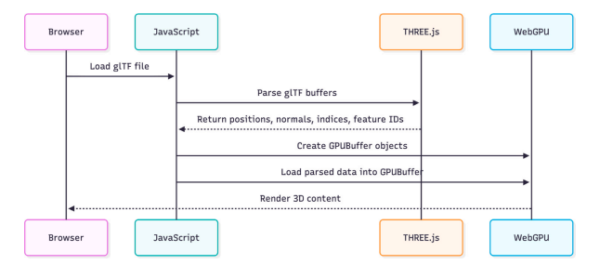
Pre-processing kicks off with the ‘cjio’ library to extract data from CityJSON, adding vertex normals if needed and triangulating surfaces via ear-clipping to suit browser primitives. For partitioning, a density-based QuadTree ensures even tile sizes, enabling 3D Tiles 1.1’s implicit tiling—which slims down metadata by computing structures on the fly. Tile hierarchies feed into tileset.json, with content as glTF 2.0 .glb files. To retain CityJSON’s rich semantics, glTF extensions like EXT_mesh_features (for sub-component IDs) and EXT_structural_metadata (for binary attribute storage) are key.
The viewer parses tileset.json and streams tiles using a loader that balances loads with geometric error (GE) and screen space error (SSE), calculated as SSE = (GE * screenHeight) / (2 * distance * tan(FOV/2)). LRU caching speeds up navigation, while the rendering pipeline uses THREE.js to prep glTF data for WebGPU buffers. Interactivity shines through feature picking, rendering IDs offscreen to link selections to attributes for styling and queries. Showcasing the “attribute-aware” edge, use cases prioritize attributes like “isWatertight” for validation visuals, flagging invalid buildings early, or “roofType” for categorizing structures, making tiling adaptable and reproducible across scenarios.
Results and Conclusions
Testing across datasets like Rotterdam and Zurich revealed the tiler’s efficiency, processing millions of elements in milliseconds with near-linear scaling. Implicit tiling and glTF extensions in 3D Tiles 1.1 preserved semantics, cut metadata bloat, and enabled deeper interactions. WebGPU shone on modern hardware, delivering up to 7x faster rendering than WebGL, jumping from 12 FPS to 90 FPS on complex models, thanks to better GPU leverage, though it lagged on older setups due to driver immaturity. Use cases validated attribute-driven tiling’s practicality: prioritizing non-watertight buildings or gable roofs made key features pop at initial views, enhancing targeted analysis. As the researchers note, “the OGC 3D Tiles 1.1 standard enables substantially richer user interactions compared to version 1.0, and WebGPU delivers significantly improved rendering performance over WebGL on modern graphics hardware.”
Implications and Future Potential
As WebGPU matures and hardware evolves, expect even denser tiles and reduced network loads, propelling digital twins into metaverses and real-time GIS. This could revolutionize smart city apps with seamless, data-rich interactions.
Reference: Usta, Z., Akın, A.T., Ohori, K.A., Stoter, J., 2026. Visualization of Urban Digital Twins on the web with attribute-driven adaptive tiling. Environmental Modelling and Software 197, 106863.