
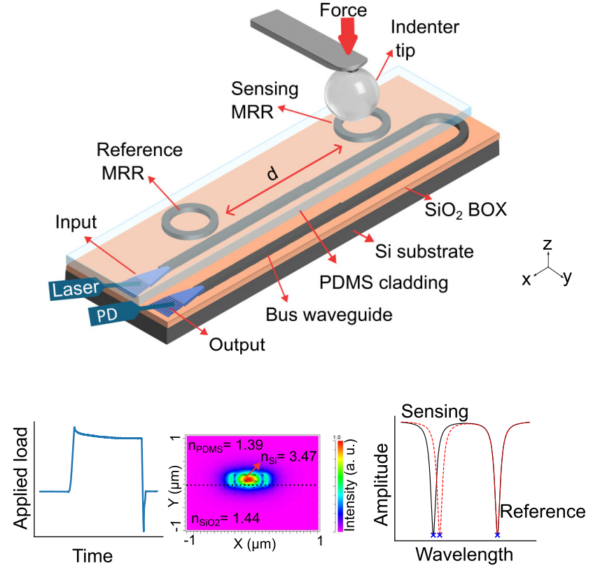
Explore the potential of silicon photonic microring arrays coated with PDMS to detect localized forces through elasto-optic shifts, offering real-time mapping at micrometer resolution on flat surfaces, ideal for unbiased cellular studies and advancing mechanobiology, soft-matter metrology, and tactile interfaces in a scalable, biocompatible format.
Addressing Microscale Force Measurement in Soft and Biological Matter
Measuring small forces generated by cells and tissues is essential for understanding mechanobiology, including processes like adhesion, migration, and signaling. These forces, typically in the piconewton to micronewton range, require sensors with high sensitivity, real-time operation, and micrometer-scale spatial resolution across multiple points. Such capabilities support research in soft-matter mechanics, tissue engineering, and disease modeling.
Current techniques, however, do not fully meet these needs. Atomic force microscopy provides nanoscale resolution and force sensitivity but is slow and less effective in dynamic biological settings. Optical tweezers offer precise control at the molecular level but are restricted to single points with limited multiplexing. Traction force microscopy maps forces on deformable substrates, yielding insights into cell-matrix interactions, yet resolution is limited by marker density and computational factors.
Pillar arrays achieve piconewton sensitivity for lateral forces, but their topography can influence cell behavior, favoring planar surfaces for accurate studies. Fiber-optic sensors are suitable for confined areas but provide sparse sampling, complicating wide-field mapping. Nanomaterial-based sensors enable remote readout with high resolution in varied environments, though they often use discrete elements rather than integrated arrays, posing challenges for planar applications.
These gaps emphasize the need for platforms that integrate flat surfaces, multiplexed readout, and spatial mapping while maintaining biological compatibility. Without them, investigating real-time force distributions in soft materials remains constrained, impacting progress in mechanobiology and related fields.
Sensor Design, Fabrication, and Elasto-Optic Modeling
The study develops silicon photonic microring resonators (MRRs) with a polydimethylsiloxane (PDMS) cladding to convert localized forces into resonance wavelength shifts via the elasto-optic effect. Each sensor includes sensing MRRs and a reference MRR for drift compensation, coupled to a shared bus waveguide on a silicon-on-insulator substrate. Waveguides are 450 nm wide and 220 nm thick, with a 3 µm PDMS layer optimized for optomechanical performance.
Calibration uses a nano-indenter with an 11 µm radius tip and 199 N/m spring constant, applying loads up to 80 µN in step-hold-release profiles. Alignment is achieved with an angled camera, and transmission spectra are recorded via a tunable laser. Resonances are fitted with Lorentzians, with differential shifts isolating force effects.
Designs in Synopsys OptoDesigner feature rings with radii of 3.95–4.05 µm for wavelength-division multiplexing, fabricated at the CORNERSTONE foundry. PDMS (Sylgard 184, 1:30 ratio) is spin-coated and cured, resulting in a thickness of 2.9 ± 0.23 µm.
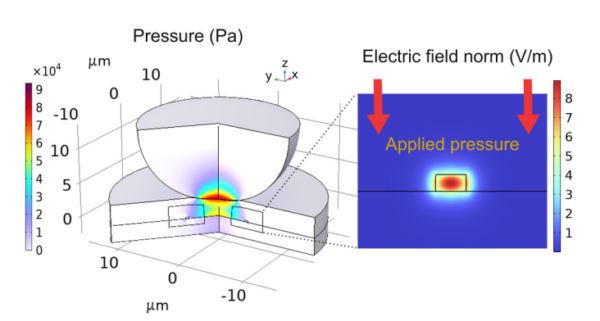
The model defines sensitivity as ∂λ_r/∂F = (λ_r / n_g) × (∂n_eff / ∂F), driven by stress-induced refractive index changes in PDMS per n_x ≈ n_0 – C_1 σ_x – C_2 (σ_y + σ_z) and equivalents. COMSOL simulations employ 2D axisymmetric mechanics for indentation, followed by optical analysis at 1550 nm. PDMS parameters include Young’s modulus of 0.57 MPa, Poisson’s ratio of 0.49, n_0 of 1.396, and fitted C_1 of 120 TPa⁻¹, C_2 of 70 TPa⁻¹. Lateral offsets yield Gaussian responses, supporting spatial resolution.
This approach confirms the transduction mechanism and allows for position-specific calibration in multiplexed arrays.
Performance Metrics and Experimental Outcomes
Tests show a linear resonance shift with responsivity of 66 ± 8 fm/µN, consistent with simulated 71 fm/µN, and a noise floor of 0.79 pm yielding 12 µN resolution. Q-factors range from 5×10³ to 2.1×10⁴, with a median of 1.6×10⁴, affected by bending and PDMS losses; higher Q values enhance resolution.
A five-ring linear array at 15 µm pitch supports multiplexing, with position-dependent shifts and FWHM of 23–26 µm under average loads of 74 µN. The 10×5 2D array maps 120 µN forces from a 250 µm tip, localizing responses to nearby pixels with nearest-neighbor crosstalk of -8 to -10 dB.
Simulations verify pressure distributions and lateral profiles (FWHM 17.4 µm at 80 µN), affirming the elasto-optic operation and temperature-compensated readout for micronewton forces.
Applications and Outlook
This platform supports live-cell assays, tissue probing, and tactile skins, as noted: “The shown combination of biocompatible claddings, strong opto-mechanical coupling, and foundry-ready photonics, presents a route towards scalable, real-time force mapping for soft-matter metrology, tactile interfaces, and in vitro mechanobiology.”
Reference: Safarloo, S., et al. “Elasto-optic transduction in polymer-cladded silicon microring arrays for real-time 2D force mapping.” Optics Express 34, 8721 (2026). DOI: 10.1364/OE.484401.