
Drawing from a comprehensive database of 972 energy geostructure case studies spanning 27 countries and eight types, this analysis examines geographical trends, thermal performance metrics, design features, and CO₂ reduction potential, underscoring their role in integrating low-enthalpy geothermal energy into sustainable urban heating and cooling systems.
Sustainable Urban Energy Challenges and the Relevance of Energy Geostructures
Energy geostructures (EGs) serve as dual-purpose systems, providing structural support while utilizing low-temperature geothermal energy from the ground. These include elements such as piles, walls, tunnels, slabs, barrettes, quay walls, pavements, and anchors, equipped with embedded pipes that circulate a fluid, typically water with antifreeze, to extract heat for winter heating or inject it for summer cooling. They also facilitate seasonal heat storage, helping to balance energy demands without requiring additional excavation or land use, thereby offering cost advantages over conventional borehole heat exchangers.
Key challenges include the fragmented knowledge of EGs’ global adoption, performance, and design practices. Initial concepts, such as Brandl’s 2006 proposal for integrating heat systems into load-bearing structures, demonstrated feasibility, but later research identified complexities in thermo-mechanical interactions, site variability, and urban integration. Performance is influenced by soil thermal properties, groundwater conditions, pipe configurations, and thermal cycling history, yet site-specific studies limit broader generalizations. The lack of unified standards, especially for non-pile EGs, often results in conservative designs that may restrict innovation and lead to over-engineering. Additionally, limited datasets hinder the validation of thermo-mechanical models and the development of empirical tools.
For engineers, these issues are significant in the context of urban energy demands and climate goals. Traditional heating and cooling systems contribute to high CO₂ emissions and environmental strain, whereas EGs reduce emissions, land use, and operational impacts. With urban growth intensifying energy needs, EGs enable renewable integration into buildings and networks. Adoption is concentrated in Europe due to policy support and data availability, but is expanding globally. Comprehensive databases address these gaps, supporting standardized designs and broader implementation for low-carbon, resilient infrastructure.
Methodology: Building and Examining a Global EG Database
The research involved compiling a modular, expandable database of 972 EG case studies from 1985 to 2023, sourced from over 80 journal articles, contributions from more than 20 companies, and expert input. Covering 27 countries, primarily in Europe, with approximately 70 cases from the U.S., China, Japan, and Australia, the database recognizes a European focus attributable to the researchers’ networks and regional technology maturity, while incorporating diverse examples for wider applicability.
Organized into sections by EG type; energy piles (789 cases), slabs (60), walls (79), tunnels (27), pavements (9), quay walls (4), barrettes (3), and anchors (1), it gathers details on location, geometry, pipe configurations, soil and groundwater conditions, heat exchange rates, monitoring, costs, and references. The dataset encompasses real installations, test sites, numerical studies, feasibility assessments, designs, and ongoing projects, forming a harmonized resource for comparative analysis.
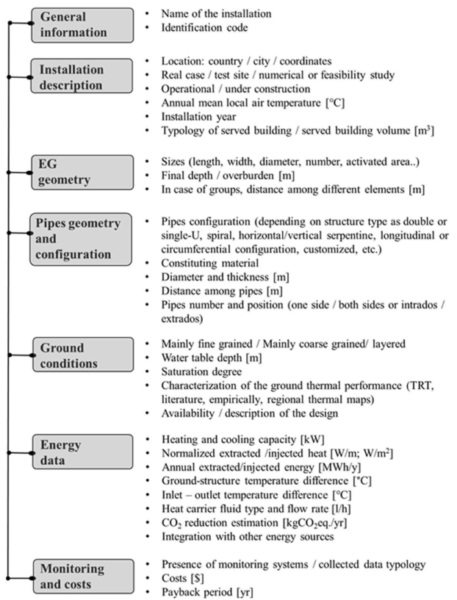
The evaluation addressed diffusion trends (historical and geographical), heat exchange efficiency (in W/m or W/m² from monitoring or validated models), geometric characteristics (across operational and study cases), influencing factors (pipe layouts, environmental, and operational conditions), emerging technologies, and environmental benefits (e.g., CO₂ reductions). Data completeness varies, with geometry nearing 100% coverage but thermal properties lower (e.g., 2% for pile stratigraphy), reflecting richer details in academic sources for newer EGs compared to practical reports for established ones. Economic data, such as costs and payback periods, remain limited, constraining full cost-benefit assessments.
This approach provides a quantitative, cross-technology overview that integrates established and emerging EGs, identifying connections between technology maturity, location, and performance. It consolidates diverse sources to yield reliable trends, despite variations in data coverage.
Principal Findings and Implications
Europe leads in EG adoption, with Austria, Switzerland, Germany, the UK, Italy, and France accounting for the majority of installations, driven by early implementation and incentives, though no direct policy correlation is evident. Energy piles exhibited steady growth from 2001 to 2017, walls increased after 2017, and tunnels remain less common due to heat ownership issues and a focus on retrofitting existing infrastructure. Emerging types, such as quay walls and barrettes, have seen installations since 2018, indicating potential for expansion.
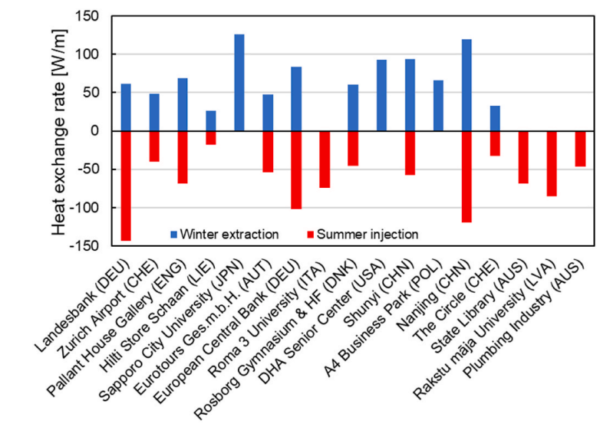
Heat exchange rates differ by type: piles range from 30–150 W/m, affected by climate and pipe design; walls perform well in deep, saturated sites (e.g., 35–36 m depths); tunnels achieve 10–60 W/m², influenced by groundwater and aerothermal conditions. Geometric preferences include piles for small- to medium-scale projects (10–25 m length, 50–100 cm diameter), walls for large surfaces (2,500–7,500 m²), and tunnels at intermediate depths (10–30 m overburden).
Performance ties to site factors: U-loops for piles, up-down patterns for walls, in layered, moist soils under cool-temperate conditions with balanced loads. Emerging EGs present installation challenges but enable diversification; composites, such as pile-wall combinations, enhance system resilience.
Environmentally, EGs reduce CO₂ emissions, up to 0.361 kg/kWh compared to house coal, in the 20% of cases with energy data. Additional costs are 1–2% of construction, with payback periods of 2–15 years and levelized costs of 80–115 €/MWh, competitive against fluctuating fossil fuel prices.
The analysis confirms EGs’ viability for sustainable energy, with piles as the most established type and others advancing, while emphasizing the need for expanded data on newer variants and non-European regions.
Future Directions for Energy Geostructures
As urban energy requirements increase, EGs offer opportunities for embedding renewables into infrastructure, potentially at district scales or in hybrid configurations. Ongoing research could address data limitations, promote standardized guidelines, and drive further innovations.
Thanks to D. Salciarini and the research team for this contribution. For EG experiences or collaboration, contact details are available in the original paper.
For the full study, see: Salciarini, D., et al. “Database-driven analysis of energy geostructures using a global dataset: Diffusion, efficiency, and environmental performance.” Renewable Energy 256 (2026): 124373. https://doi.org/10.1016/j.renene.2025.124373.