
From Devastation to Resilience: Exploring Strategies for Sustainable Post-Disaster Reconstruction
This research develops the Build Back Circular framework, integrating circular economy principles—narrowing, slowing, closing, and regenerating resource loops—into post-disaster recovery, with a focus on the 2023 Kahramanmaraş earthquakes in Türkiye, to promote resource efficiency, resilience, and inclusive urban development through ten actionable strategies and stakeholder collaboration.
The Challenge of Post-Disaster Recovery and Its Importance
Natural disasters present significant challenges to infrastructure, economies, and communities worldwide. In 2023, approximately 400 natural hazard events affected 93.1 million people, caused $202.7 billion in economic losses, and resulted in over 86,000 deaths. The United Nations anticipates a 40% increase in such events by 2030 due to climate-related hazards, highlighting the need for resilient recovery systems.
The 2023 Kahramanmaraş earthquakes in Türkiye illustrate these issues, with magnitudes of 7.8 and 7.6 followed by a 6.4 aftershock, impacting 11 cities and over 14 million people. The events led to more than 48,000 fatalities, damage to nearly 500,000 buildings, and economic costs of $103.6 billion, representing 9% of Türkiye’s GDP that year. Additionally, the earthquakes produced 50 to 920 million tons of debris, the largest volume from an earthquake in recent decades, containing hazards such as asbestos and toxic chemicals that pose environmental and health risks. Reconstruction efforts must address housing needs for 2.3 million displaced individuals while managing resource demands.
Conventional recovery often follows linear models that increase resource consumption and vulnerability. The circular economy (CE) offers an alternative by shifting to regenerative systems through principles of narrowing (reducing resource use), slowing (extending product life), closing (recycling), and regenerating (improving ecosystems). Although CE has been applied in contexts like the COVID-19 pandemic—for instance, repurposing materials for masks or monitors—its use in natural disasters is limited, typically to waste management. This overlooks CE’s potential in urban development, where spatial planning supports resource sharing and community resilience, as observed in initiatives in cities like Amsterdam and Malmö.
Building on the UN’s “Build Back Better” (BBB) framework, developed after the 2004 Indian Ocean Tsunami and incorporated into the Sendai Framework for Disaster Risk Reduction, this research examines the integration of CE with disaster management. Post-crisis phases provide opportunities for sustainable recovery aligned with Sustainable Development Goals (SDGs) such as SDG 11 (Sustainable Cities and Communities) and SDG 13 (Climate Action). In Türkiye, where recovery continues, incorporating CE can help reduce costs, foster innovation, and support long-term stability.
Research Methods and Framework Development
The study uses an exploratory qualitative design to examine the integration of CE into disaster recovery, given the emerging nature of this field. A multi-method approach triangulates data from an integrative literature review, a workshop, and semi-structured interviews to ensure robustness and practical relevance, especially for Türkiye’s ongoing reconstruction.
The integrative literature review synthesized sources to advance theory. Searches in databases like Scopus and Web of Science used terms such as “circular*” with “earthquake OR disaster” and “recovery OR reconstruction.” After screening for relevance—focusing on papers in English and Turkish addressing built environment impacts and CE strategies—42 papers were analyzed. Coding was based on disaster management phases (mitigation, preparedness, response, recovery), CE principles (narrowing, slowing, closing, regenerating), and key actors, leading to initial strategy clusters that informed the Build Back Circular (BBC) framework.
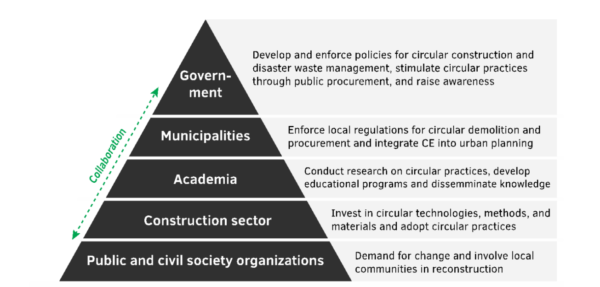
Key actors in BBC Framework
An exploratory workshop in Ankara in January 2024 involved 24 professionals from government, academia, construction, and NGOs. Participants, divided into groups, used an adapted “Circular Collaboration Canvas” to discuss challenges, ideas, resources, partners, and actions for CE in affected cities. The 90-minute session, including presentations, helped refine the research scope.
Semi-structured interviews with 21 experts, each with at least 10 years of experience in CE, construction, or disaster management, provided further insights. Experts were recruited through networks and snowballing, with online interviews lasting 30 to 100 minutes exploring strategies, actors, and barriers. Analysis was abductive, iterating between literature themes and emerging data to finalize the framework.
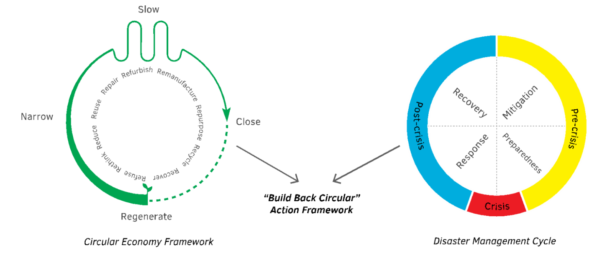
This method combines BBB’s resilience focus with CE principles, resulting in the BBC framework, illustrated in figures such as the disaster cycle (Fig. 1) and research design (Fig. 2). The approach emphasizes stakeholder involvement for applicability.
Key Findings and Conclusions
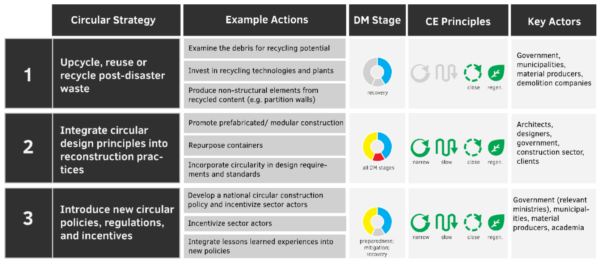
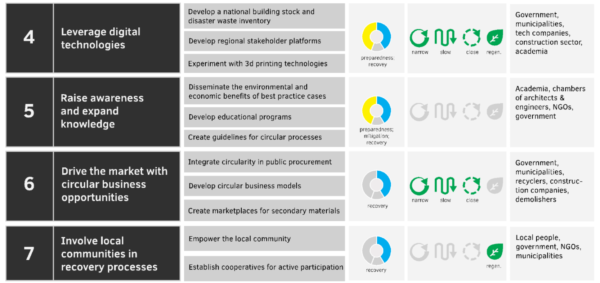
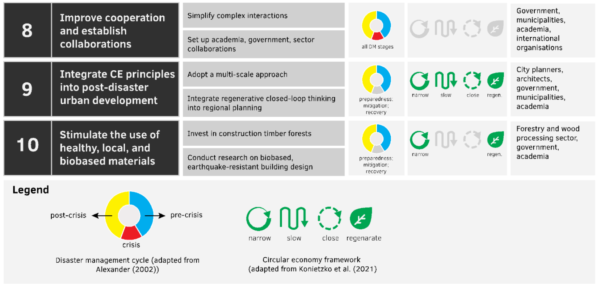
The Build Back Circular (BBC) framework identifies ten strategies to incorporate CE into recovery, aligned with disaster management phases, CE principles, and actors:
- Upcycle, reuse, or recycle post-disaster waste—such as sorting debris for use as aggregates or in furniture.
- Integrate circular design principles—including modular prefabrication and design for disassembly.
- Introduce circular policies—through regulations and incentives at national levels.
- Leverage digital technologies—using GIS, drones, and marketplaces for resource management.
- Raise awareness and expand knowledge—via educational programs and guidelines.
- Drive the market with circular business opportunities—such as public procurement and innovation hubs.
- Involve local communities—to build skills and ownership.
- Improve cooperation and collaborations—among multi-level stakeholders.
- Integrate CE into post-disaster urban development—for regenerative planning across scales.
- Stimulate use of healthy, local, biobased materials—such as timber for sustainable structures.
Key actors include government for policy enforcement, municipalities for planning, academia for education, the construction sector for implementation, and civil society for advocacy, forming a collaborative ecosystem.
The framework aims to improve efficiency, resilience, and equity, addressing gaps in existing literature and practice.
Implications and Future Potential
The BBC framework offers a model for applying CE in various disaster contexts, potentially informing international policies. Further studies could assess its quantitative impacts or adaptations for different regions.
We thank Sultan Çetin and Julian Kirchherr for this contribution. Readers with insights or collaboration ideas are encouraged to contact the magazine. As noted in the research, “CE may be a panacea at least in post-crisis recovery. Overlooking the benefits of CE in this context would be a considerable missed opportunity.”For more details, refer to: Çetin, S., Kirchherr, J. The Build Back Circular Framework: Circular Economy Strategies for Post-Disaster Reconstruction and Recovery. Circ.Econ.Sust. (2025). https://doi.org/10.1007/s43615-024-00495-y.