
Probabilistic Assessment Reveals Escalating Damages from Rising Sea Levels
This study evaluates coastal flood impacts on European road and rail networks across global warming scenarios, projecting baseline annual damages of €519 million rising potentially to €1,090 million at 4°C, with greater affected lengths for roads but higher costs for rails, signaling needs for targeted adaptation in coastal areas.
The Challenge of Coastal Flooding for Transport Systems
Europe’s coastal regions support high population densities and critical infrastructure, with approximately one-third of the EU population living within 50 km of the coast. These areas feature extensive transport networks vital for mobility, trade, and communication. Global warming is projected to increase the frequency and intensity of extreme sea level events, leading to heightened coastal flooding, as noted in the IPCC’s Sixth Assessment Report.
Surface transport infrastructure, including roads and railways, is concentrated in low-elevation coastal zones (LECZs) up to 10 m above mean sea level. The European Union is advancing the Trans-European Transport Network (TEN-T), targeting completion of a core network by 2030 and a comprehensive network by 2050, with significant portions in coastal areas. However, these developments face growing flood risks, which could result in direct damages and indirect effects such as supply-chain disruptions and reduced access to services.
Prior studies have addressed coastal flood risks broadly, focusing on metrics like population or GDP exposure, but have not specifically examined impacts on transport infrastructure at a European scale. Assessments of fluvial flooding exist for roads and railways separately, but coastal flood evaluations incorporating both under current and future warming levels have been limited. Challenges include representing linear networks in coarse data, varying damage functions by infrastructure type, and differing reconstruction costs across countries. Flooding can account for 5% to 60% of direct losses in infrastructure-dense regions, underscoring the need for detailed risk information. Without adaptation, annual coastal flood damages in Europe could reach €240 billion by 2100 under high-emission scenarios, a 170-fold increase from current levels.
Passenger and haulage transport in LECZs predominantly rely on roads in most countries, heightening vulnerability to disruptions. Countries with substantial coastal networks, such as the UK, Italy, France, Norway, and Denmark, may experience notable impacts, while smaller economies could face disproportionate effects relative to GDP.
Research Methods and Analytical Framework
The assessment examines coastal flood risks to European road and rail networks under baseline conditions (1980–2020) and global warming levels of 1.5°C, 2°C, 3°C, and 4°C relative to 1850–1900. Risks are quantified using Expected Annual Length Affected (EALA) in km/year and Expected Annual Damage (EAD) in euros/year, incorporating event probabilities and damages.
OpenStreetMap (OSM) data provides detailed network representation, treating segments as line objects with attributes such as type (e.g., primary, secondary, tertiary roads; conventional electrified/non-electrified rails). Roads follow classifications from prior studies, with rails supplemented by European Transport Policy Information System data.
Hazard information derives from process-based modeling using LISFLOOD-ACC, producing flood maps for extreme sea level return periods (1–1,000 years) under each scenario, including sea-level rise, storm surges, waves, tides, and proxy-based protection levels.
Vulnerability incorporates type-specific depth-damage curves and reconstruction costs. Roads use six curves considering type, accessories, and flood velocity; rails draw from empirical data with costs from EU projects, adjusted for variability. Maximum damages are indexed to 2015 EU-28 GDP per capita and rescaled nationally.
The adapted Global Multi-hazard Transport Risk Analysis model intersects flood maps with segments to calculate inundated lengths and depths. Damages integrate flooded length, depth-damage fractions, and maximum values, with probabilistic sampling (1,000 per segment) accounting for uncertainties via distributions. Results aggregate at continental, national, and regional scales, with medians and 5th–95th percentiles. Supplementary comparisons address government expenditures and transport volumes.
This framework addresses limitations in prior assessments by using detailed data and probabilistic methods for coastal scenarios.
Findings on Risks and Projections
Under baseline conditions, coastal floods affect 1,592 km of networks annually (EALA), with median EAD of €519 million (€318–722 million). Roads account for the majority of EALA, with tertiary roads at 630 km (40%), while rails contribute half the EAD (€275 million) due to higher reconstruction costs. At 1.5°C warming, EALA increases 60% to 2,542 km, EAD 58% to €818 million (€530–1,108 million); at 2°C, EALA to 2,648 km (66%), EAD to €844 million (€550–1,140 million); at 3°C, EALA to 3,083 km (93%), EAD to €1,002 million (€645–1,361 million); at 4°C, EALA to 3,317 km (108%), EAD to €1,090 million (€695–1,487 million). Rail’s share of EAD increases with warming.
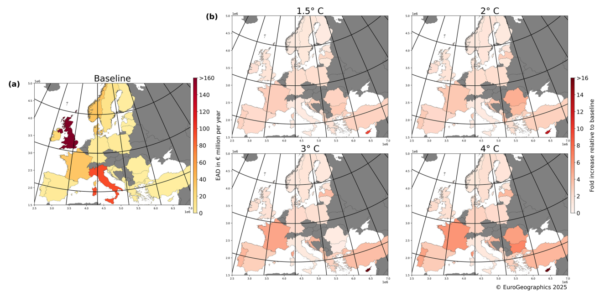
At the national level, baseline EALA is highest in Italy (436 km), UK (355 km), France (195 km), Norway (100 km), and Denmark (94 km), with 1.5°C increases ranging from 12% in Norway to 114% in France. Roads exceed rails in EALA across all countries and scenarios, though LECZ transport depends heavily on roads. Baseline EAD is highest in the UK (€272 million), Italy (€93 million), Norway (€35 million), France (€34 million), and Denmark (€33 million). Relative increases are largest in Cyprus (tenfold at 1.5°C), followed by Bulgaria, France, Croatia, and Romania (approximately threefold each).
EAD as a percentage of GDP is highest in Denmark, UK, Norway, Ireland, and Italy, increasing with warming. Relative to transport expenditures, baseline EAD requires additional allocation in Denmark (1.5%, rising to 2.3% at 1.5°C, +€18 million median), Ireland (+€20 million), and UK (+€155 million), up to €33 million, €28 million, and €263 million at 4°C. Shifts may prioritize rails in Croatia, Bulgaria, and France with advancing warming.
Implications for Policy and Practice
The projections indicate potential shifts toward rail systems in LECZs to enhance resilience. “Adaptation expenditures will increase with every fraction of global warming in most countries.”
We acknowledge Khin Nawarat and the research team for this contribution to climate risk assessment. Readers with input on transport resilience are encouraged to share via comments or contact the authors. For further reading: Nawarat, K. et al. Coastal flood risk to European surface transport infrastructure at different global warming levels. Nat. Clim. Chang. https://doi.org/10.1038/s41558-025-02510-y (2026).