
Unveiling Fire Effects on Tunnels: A Detailed Examination of Nonlinear Finite Element Strategies That Simulate Thermo-Mechanical Responses, Validating Models Against Large-Scale Tests to Inform Structural Assessments and Improve Design Practices in Reinforced Concrete Infrastructure – Essential Insights for Engineers.
Addressing Tunnel Fire Risks: Significance for Structural Design
Tunnel fires, although infrequent, can lead to significant structural damage and socioeconomic disruptions. In confined environments, temperatures can exceed 1000 °C, causing material degradation, thermal expansion, and concrete spalling in reinforced concrete (RC) linings. This may result in cracking, reinforcement melting, and extended closures.
Prescriptive design methods, such as those in EN 1992-1-2:2004, provide conservative guidelines based on tabulated data from simpler elements. However, for intricate tunnel structures, these approaches may not fully capture the interactions of thermal gradients and mechanical loads. Performance-based design offers a more precise alternative, but requires advanced tools to evaluate residual capacity and robustness.
Given the growing use of heavy vehicles and electric batteries, accurate modeling is essential. The research by Sanabria Díaz, Lantsoght, and Hendriks addresses this by validating numerical strategies against experimental fire tests, contributing to a better understanding of tunnel behavior under fire.
Modeling Approaches: Comparing NLFEA Strategies with Experimental Data
The study simulated three large-scale (1:5) fire tests of HZMB immersed tunnel segments, involving scenarios with and without fire-protective coatings, under applied service loads (2427 kN vertical, 437 kN horizontal per side).
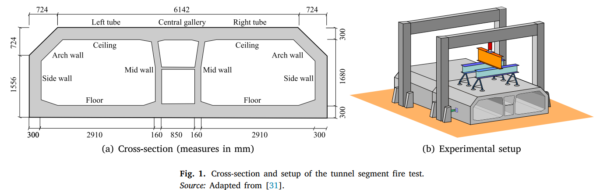
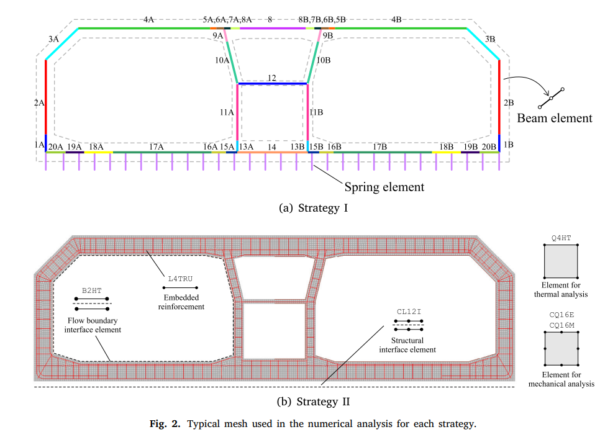
Two nonlinear finite element modeling strategies were evaluated using a staggered thermo-mechanical analysis:
- Strategy I (SAFIR): Employed 2D beam elements (Euler–Bernoulli, 100 mm mesh) for mechanical analysis and 2D plane elements for thermal analysis. The concrete model used a plastic-damage formulation with explicit transient creep strain and cooling-phase degradation.
- Strategy II (DIANA): Utilized 2D continuum elements (plane stress or plane strain, 30 mm mesh) with a total-strain fixed-crack model, including Hordijk tension softening, parabolic compression with confinement effects, and embedded truss elements for reinforcement. Transient creep was implicit per Eurocode, with a custom subroutine to limit steel property recovery during cooling.
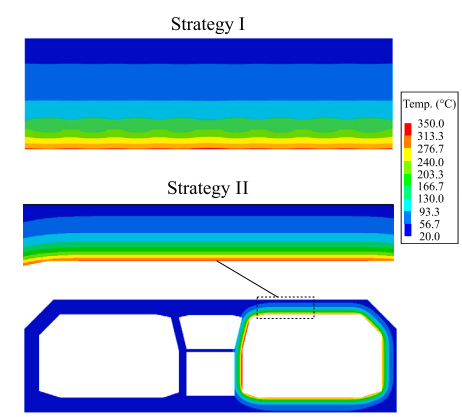
Material properties followed EN 1992-1-2:2004. In unprotected scenarios, spalling was modeled at a rate of 2.5 mm/min starting at 740 °C over a 60 mm inner layer by adjusting thermal properties—a macroscopic method that influenced temperature predictions.
Fifteen models were analyzed, allowing comparisons of temperatures, deflections, crack patterns, and bending-moment redistribution between models and experiments.
Simulation Outcomes: Key Findings on Temperature and Damage
The models showed good agreement with experimental data:
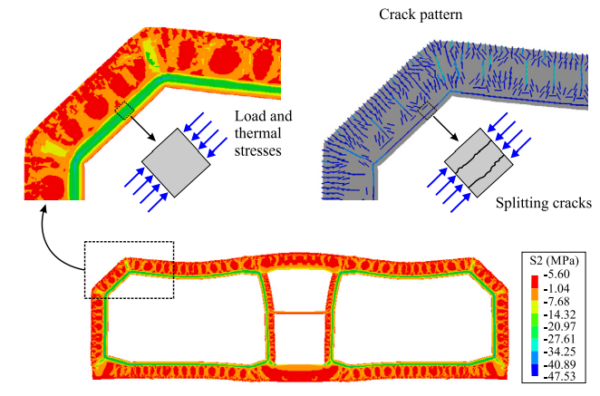
- In protected tunnels, no spalling occurred, with concrete temperatures remaining limited, though cracking extended to unheated sides and non-exposed tubes.
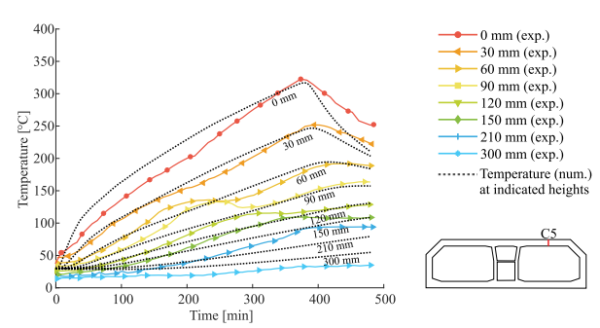
- Unprotected tunnels without spalling modeling underestimated internal temperatures.
- Explicit spalling inclusion aligned temperature profiles more closely with tests, indicating rebar temperatures exceeding 1000 °C and faster degradation.
- Crack patterns from Strategy II reproduced the observed longitudinal and splitting cracks, including those from compressive rings.
- Both strategies captured moment redistribution and cold-side damage, highlighting thermal gradient effects.
As noted in the research:
“The analyses demonstrate the relevance of proper spalling modelling on the tunnel’s temperature distribution. The models also show a good agreement with the experimentally observed damage patterns.”
Additionally:
“Significant damage was observed in the unheated side of the tunnel for all three scenarios, implying serious concerns about the service life of the tunnel after a severe fire event.”
Displacements exhibited some variation, likely due to 2D simplifications, but structural integrity was accurately predicted.
Practical Insights: Recommendations for Tunnel Analysis
The study confirms the applicability of both beam-based (SAFIR) and continuum-based (DIANA) NLFEA strategies for tunnel fire assessments. Strategy I suits efficient evaluations with fewer parameters, while Strategy II provides detailed insights into cracking and shear.
Key observations include:
- Explicit spalling modeling is important for unprotected concrete in intense fires.
- Cracking on unheated sides occurs consistently—consider in service-life evaluations.
- 2D models effectively capture overall behavior; 3D extensions could enhance accuracy.
Forward Outlook: Advancing Fire-Resistant Tunnel Engineering
These strategies support performance-based design, aiding in fire protection optimization and post-event evaluations. Future efforts may incorporate 3D modeling and hygro-thermo-mechanical phenomena for refined predictions.
The models are available on GitLab for further exploration.
We thank Rafael Sanabria Díaz, Eva Lantsoght, and Max A.N. Hendriks for their contribution to fire safety engineering.
Reference: Díaz, R.S., Lantsoght, E., & Hendriks, M.A.N. (2025). Structural behaviour of tunnels exposed to fire using numerical modelling strategies. Fire Safety Journal, 152, 104335. https://doi.org/10.1016/j.firesaf.2024.104335