New research from TU Delft demonstrates how a Dutch digital platform for modular timber construction applies the DART co-creation framework to overcome the sector’s unique challenges of fragmentation, inefficiency and resistance to change, fostering stakeholder collaboration, transparency and scalable low-carbon practices.
The construction industry accounts for approximately 40% of global energy use, around 30% of greenhouse gas emissions and roughly half of all resources extracted worldwide. With the world currently on a 2.9 °C warming trajectory (or 2.0 °C if net-zero pledges are fully met), the sector must move away from its traditional linear “take, make, dispose” model toward circular, low-carbon approaches.
Three fundamental barriers stand in the way. First, the uniqueness of the construction context: every project is highly customised, client-driven and embedded in someone else’s operational routines, with varying municipal regulations and design-first processes that differ markedly from other engineering disciplines. Second, longstanding inefficiencies: manual, subjective workflows generate frequent errors, reworks and waste, and attempts to layer sustainability requirements often increase complexity rather than reduce it. Third, widespread resistance to change: many established stakeholders, including profitable traditional contractors, perceive sustainable and digital innovations as threats to proven business models.
These challenges matter because the built environment shapes our cities, economies and climate impact for decades. Without effective mechanisms to address them, the industry will struggle to meet carbon-reduction and circularity targets.
Delving into the Research: Methods and the Innovative Platform Approach
The authors conducted a qualitative single-case study of an early-stage Dutch platform provider specialising in prefabricated modular timber elements. The company was selected because it is actively scaling, integrates detailed digital-twin models for every component, and emphasises collaboration with architects, contractors and clients in a national context committed to circular construction.
Data collection combined three-month ethnographic immersion—one researcher participated in daily stand-ups, team meetings and informal interactions—with 11 semi-structured interviews across business development (4), engineering (4) and software (3) teams. Interviews explored sustainability steps, barriers and solutions until thematic saturation was reached. Reflexive field notes, triangulation and ethical approval ensured rigour.
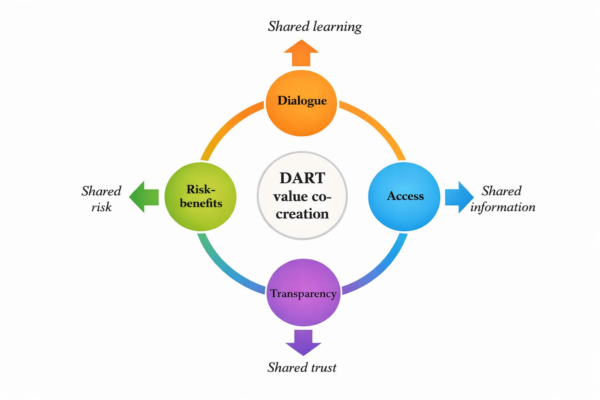
Thematic analysis identified challenges and platform responses, which were systematically mapped to the DART framework (Dialogue, Access, Risk-benefit, Transparency). The platform itself is the core innovation: a digital system that parametrically defines timber modules, generates digital twins for planning and quality control, automates material quantities and sustainability metrics, and supports iterative stakeholder input.
Core Findings: Challenges Identified and the Iterative Framework Developed
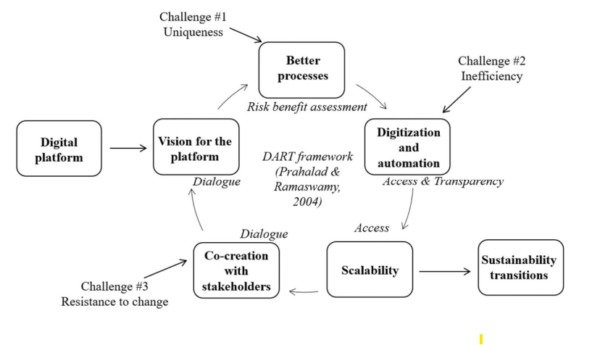
The research confirms the three challenges outlined above and shows how the platform addresses them through five linked practices:
- Articulating a clear platform vision that balances speed, safety, flexibility, aesthetics and carbon performance
- Streamlining processes to reduce errors, downtime and personnel dependence
- Implementing digitalisation and automation (including AI-supported design) to improve efficiency and embed sustainability data
- Designing for scalability across projects and markets with minimal additional resources
- Enabling continuous co-creation through feedback loops with diverse stakeholders
These practices form a circular, iterative framework that extends the DART model. Vision supports dialogue; improved processes manage risk-benefit trade-offs; digital tools enhance access and transparency; scalability widens access; and ongoing co-creation sustains dialogue. The framework illustrates how digital, physical (modular timber) and social (stakeholder collaboration) elements reinforce one another.
Broader Implications for Practice and Future Directions
The study offers engineers and platform developers a practical roadmap for integrating co-creation principles into construction digitalisation. It highlights the value of configurable component libraries, automated life-cycle assessment links and participatory design workshops to reduce fragmentation and resistance.
Future research could quantify outcomes (embodied carbon per m², waste reduction, cost savings) and examine platform scaling in different regulatory and market contexts.
We thank Johan Ninan, Alexandru Zaharia and Marian Bosch-Rekveldt for this clear and actionable contribution. As the authors conclude: “Ultimately, these platforms promote stakeholder collaboration, enhance transparency, and contribute to sustainability goals, such as carbon reduction and circular construction.”
Engineers working on digital construction, modular systems or sustainability transitions are invited to share experiences or questions with the authors.
Reference: Ninan, J., Zaharia, A., & Bosch-Rekveldt, M. (2026). How digital platforms enable sustainability transitions in the built environment. Construction Management and Economics. https://doi.org/10.1080/01446193.2026.2629869