
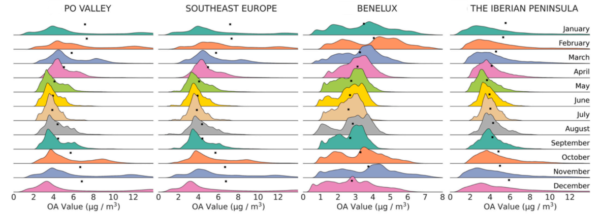
This study integrates chemical transport models with machine learning to create high-resolution maps of organic aerosol concentrations across Europe. It offers critical insights into exposure levels, supporting future epidemiological research and air quality policy development by providing detailed data on spatial and temporal variability.
Deciphering the Organic Aerosol Puzzle
Organic aerosol (OA) is a major component of atmospheric particulate matter (PM), impacting both human health and climate change. In Europe, OA constitutes about 50% of total aerosol mass, with regional and seasonal variations. Winter sources include biomass burning and fossil fuels, while summer sees biogenic emissions predominate. Urban areas face higher vehicular emission contributions.
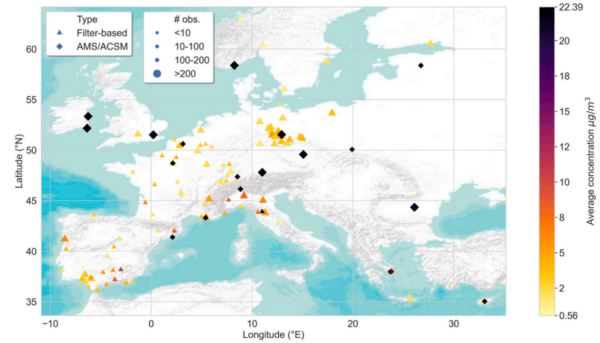
OA’s health implications are significant. Air pollution links to various health issues, including respiratory and cardiovascular diseases. PM is estimated to cause 4.2 million premature deaths annually. Among PM components, organic carbon (OC) or OA are associated with adverse health effects, including increased hospital admissions for myocardial infarction and diabetes.
Despite these risks, large-scale, long-term, high-resolution OA data is needed to assess chronic health impacts. Current estimation methods include ground-based observations, chemical transport models (CTM), and satellite products. Ground observations are accurate but limited in coverage, while satellite products often lack temporal and chemical resolution.
Innovative Approach: Merging Models and Machine Learning
This research tackles high-resolution OA estimation by integrating a chemical transport model (CAMx) with a random forest (RF) machine learning approach. CAMx provides initial OA simulations at a 15 km resolution, which are bias-corrected and downscaled using the RF model, resulting in detailed maps of daily OA concentrations across Europe. Initial CAMx simulations showed moderate agreement with observations, with a correlation coefficient of 0.55. By combining these outputs with high-resolution land-use data and training the RF model on approximately 48,000 daily OA measurements from 137 sites, prediction accuracy improved, achieving a correlation coefficient of 0.65 and reducing the root mean square error by about 15%. The resulting maps offer European daily OA concentrations at a 250 m resolution for alternate years from 2011 to 2019, capturing key spatial features and intracity variations. Seasonal analysis revealed higher concentrations in winter, with long-term trends indicating a general decline in OA levels over the study period.
Results & Conclusions: Mapping OA Exposure
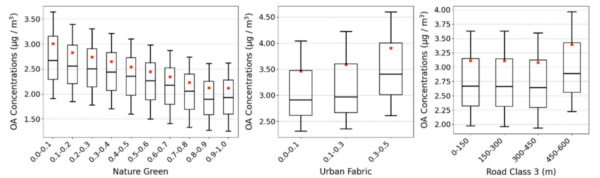
The high-resolution maps provide a detailed view of OA concentrations across Europe, supporting epidemiological research and air quality policy. Exposure estimates indicate that half of the European population experiences OA levels above 3 µg/m3, with about 50 million people exposed to levels exceeding 5 µg/m3, the WHO guideline for total PM2.5. The model’s ability to capture spatial features and seasonal variations in OA concentrations underscores its potential as a tool for researchers and policymakers. The findings highlight the importance of targeting specific aerosol components in air quality regulations, given the varying toxicity levels of different aerosol constituents.

Future Directions and Opportunities
This research marks a significant advancement in air quality monitoring and assessment. By providing high-resolution OA maps, it lays a foundation for future epidemiological studies and targeted air quality policies. The integration of chemical transport models with machine learning techniques showcases the potential for innovative approaches to enhance understanding of air pollution and its impacts.
The authors encourage researchers and policymakers to utilize these findings and engage with the study’s contributors for further collaboration. This study not only advances scientific knowledge but also offers practical tools for addressing the pressing issue of air pollution.
Reference: Banos, D. T., Upadhyay, A., Cheng, Y., Jiang, J., Vasilakos, P., Nava, A., Ševera, P., et al. High-resolution modelling of organic aerosol over Europe: exploring spatial and temporal variability and drivers. Environment International, 209, 110143. DOI: https://doi.org/10.1016/j.envint.2026.110143