
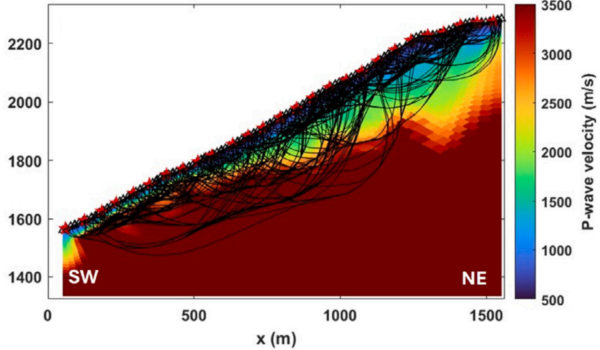
Delving into the Cuolm da Vi slope with advanced 3D seismic tomography unveils critical insights into one of the Alps’ largest active slope instabilities, enhancing geotechnical analysis and hazard assessment in mountainous areas.
The Challenge of Slope Instabilities
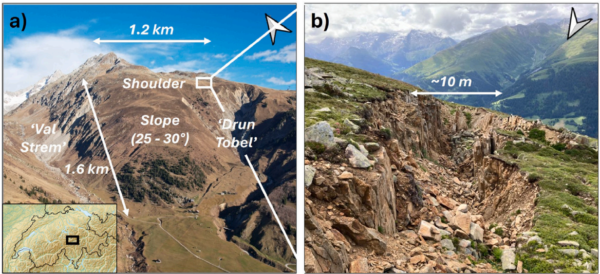
Gravitational slope instabilities, including landslides, are significant natural hazards worldwide. These events have caused nearly 56,000 fatalities from 2004 to 2016 and result in billions of US dollars in damages annually. Climate change is expected to increase the frequency and severity of these failures due to extreme weather patterns. A comprehensive understanding of the internal structure and dynamics of unstable slopes is essential for effective risk assessment and mitigation strategies.
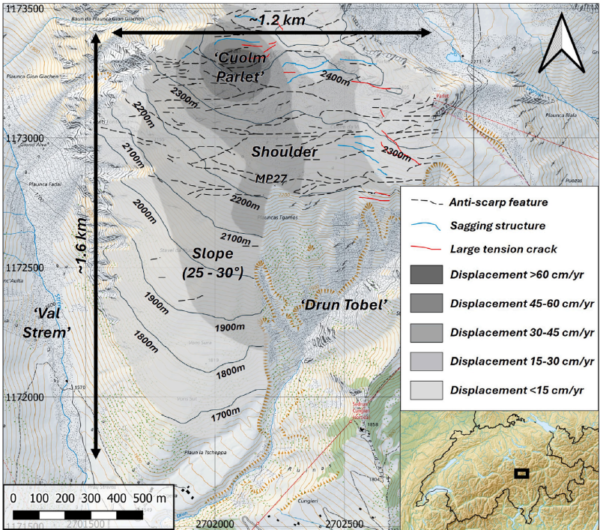
The Cuolm da Vi (CdV) slope instability in the Swiss Alps is a major active mass movement, with an estimated unstable volume of 150 million cubic meters. Characterized by significant displacement rates and complex deformation mechanisms, primarily driven by toppling, previous studies have left questions about its depth and internal structure unanswered. Addressing these gaps is crucial for advancing our understanding of slope instability processes and improving hazard assessments in mountainous regions.
Traditional methods like remote sensing and geodetic tools offer extensive coverage and long-term monitoring but are limited in providing direct insights into subsurface structures. Geophysical methods, particularly seismic techniques, allow for non-invasive imaging and monitoring of the subsurface in two and three dimensions, offering critical insights into slope instability processes.
3D Seismic Tomography: A New Approach
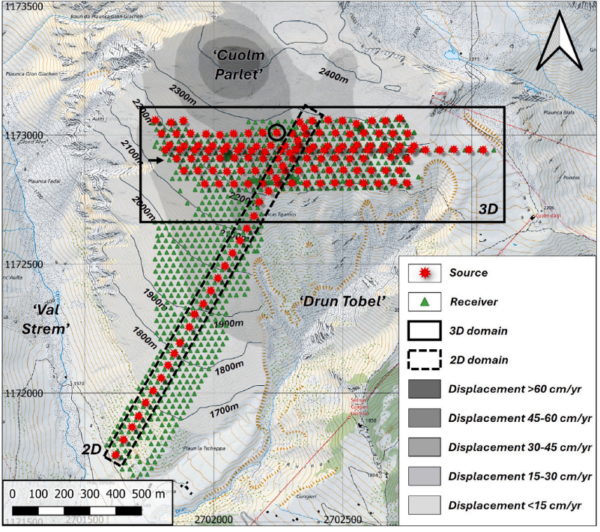
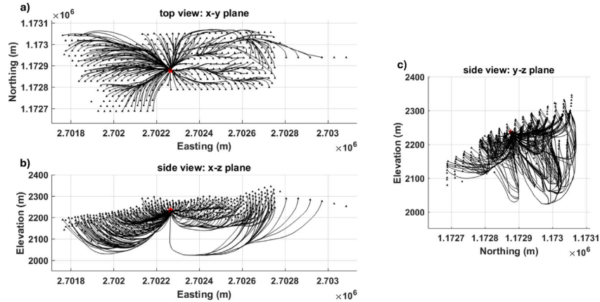
Researchers conducted a high-resolution 2D and 3D seismic first-arrival traveltime tomography analysis of the CdV slope instability. This extensive seismic survey involved deploying over 1000 autonomous nodes across a 0.7 km2 area and acquiring data from 144 controlled-source shots. The primary objective was to develop a detailed 3D model of the unstable body and gain insights into its internal structure and spatial extent.
The methodology employed represents a significant advancement in geophysical imaging. By utilizing a large-scale nodal array and controlled-source seismic techniques, researchers achieved high-resolution subsurface models. Autonomous nodes facilitated efficient data acquisition over challenging alpine terrain, while controlled-source shots provided precise control over seismic energy. This approach captured detailed subsurface velocity distribution, revealing significant heterogeneities and structural complexities within the CdV slope.
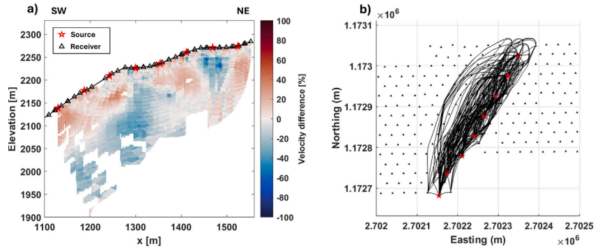
The study’s findings highlight the critical role of 3D imaging in accurately characterizing complex instability structures. The comparison between 2D and 3D velocity models underscores the importance of accounting for out-of-plane effects, such as lateral ray bending, which can significantly impact subsurface characterizations. By leveraging 3D seismic tomography, researchers overcame the limitations of traditional 2D investigations for a comprehensive understanding of the CdV slope instability.
Results and Conclusions
The seismic survey revealed substantial subsurface heterogeneities within the CdV slope, including extensive low-velocity zones extending up to depths of 200 meters. These zones indicate severe rock mass disintegration, highlighting the structural complexity of the instability. The findings align with previous research suggesting toppling as the dominant deformation mechanism, further corroborating the intricate nature of the CdV slope.
The 2D and 3D velocity models provide crucial constraints for estimating the total unstable rock volume. These models serve as a foundation for future geotechnical analyses and hazard assessments, offering valuable insights into the dynamics of the CdV slope. The study demonstrates the feasibility and effectiveness of large-scale nodal seismic deployments in alpine terrains, paving the way for further applications in monitoring and characterizing deep-seated slope instabilities.
Implications and Future Potential
This research marks a significant step forward in geophysical imaging and hazard assessment. The successful application of 3D seismic tomography to the CdV slope instability opens new avenues for studying similar phenomena in other mountainous regions. By providing detailed insights into the internal structure and dynamics of unstable slopes, this approach can enhance understanding of slope failure processes and improve hazard assessments.
The study’s findings underscore the importance of integrating advanced geophysical techniques into risk mitigation strategies, particularly in the context of climate change. As the frequency and severity of slope instabilities rise, accurately characterizing and monitoring these phenomena will be crucial for safeguarding communities and infrastructure in vulnerable regions.
We thank the authors for their valuable contribution to the field and invite readers to engage with this research. For further inquiries or to share input, please reach out to the authors.
Reference: Tjeerd Kiers, Cédric Schmelzbach, Hansruedi Maurer, Florian Amann, Johan Robertsson. “Imaging one of the largest Alpine slope instabilities with 3D seismic first-arrival traveltime tomography.” Journal of Applied Geophysics 247 (2026). DOI: https://doi.org/10.3929/ethz-c-000796152