
Researchers explore triple-frequency signals from GPS, Galileo, and BeiDou to enhance precise point positioning (PPP). By addressing inter-frequency clock bias (IFCB), this study aims to reduce convergence time and improve accuracy, offering promising advancements for high-precision applications in geodesy, navigation, and surveying.
Why Triple-Frequency Signals Matter
Precise point positioning (PPP) is a satellite-based navigation technique offering high accuracy at low cost. Traditionally reliant on dual-frequency signals, PPP resolves carrier phase ambiguities to achieve precision. The advent of GNSS systems like GPS, Galileo, and BeiDou, transmitting on three frequencies, presents new opportunities to enhance PPP accuracy and efficiency.
The challenge is leveraging these triple-frequency signals effectively. A significant obstacle is the inter-frequency clock bias (IFCB), a discrepancy in clock products computed from different frequency combinations. This bias affects triple-frequency PPP accuracy, especially for GPS with its new L5 signal. Addressing IFCB is crucial to harnessing triple-frequency benefits. Fixing carrier phase ambiguities to correct integer values can greatly improve positioning performance over ambiguity-float PPP. However, IFCB in the third frequency has hindered practical triple-frequency PPP implementation. This research develops a method to estimate and correct IFCB, enabling enhanced PPP with triple-frequency signals.
Methodology: Tackling IFCB in Triple-Frequency PPP
The researchers devised a method to process triple-frequency signals from GPS, Galileo, and BeiDou, focusing on resolving IFCB. Using a raw observation model, they estimate and correct IFCB, facilitating triple-frequency signal use in PPP technology.
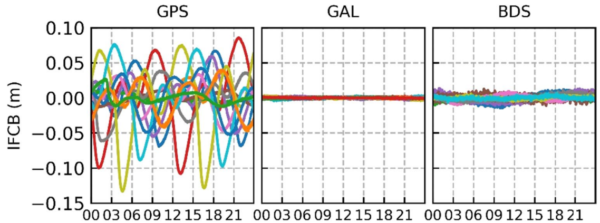
For GPS, they implemented a correction method improving extra-wide-lane uncalibrated phase delay (UPD) estimation quality. This correction is vital for accurate triple-frequency PPP. The raw UPD estimation method applies directly to Galileo, unaffected by IFCB, with 24 operational satellites. Notably, all Galileo satellites except E24 show zero extra-wide-lane UPD value. Using MGEX network multi-GNSS observations over 15 days, the study analyzed positioning solutions with combined GPS, Galileo, and BeiDou triple-frequency PPP ambiguity resolution (AR). A modified reference satellite selection strategy effectively involved GPS L5 ambiguity in PPP AR, enhancing performance.
Results: Precision and Efficiency in Positioning
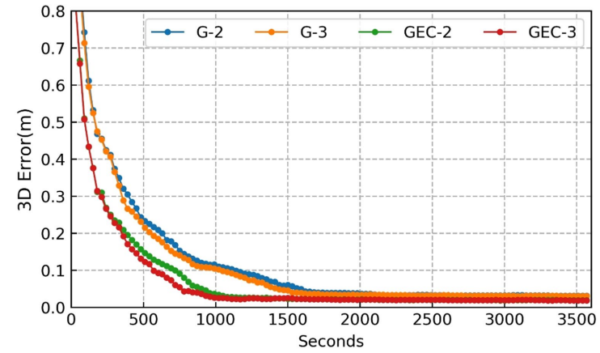
This study shows triple-frequency GNSS PPP AR’s potential to improve positioning performance. Achieving an average 3D positioning error of 2.2 cm and a convergence time of 10.8 minutes, the third frequency reduced convergence time by 15.6% compared to dual-frequency GNSS PPP AR. However, it contributed marginally to accuracy after convergence.
The findings underscore the proposed methodology’s effectiveness in addressing triple-frequency PPP challenges, particularly IFCB. By implementing IFCB corrections and leveraging triple-frequency signals, the research offers a promising path for enhancing PPP technology.
Future Prospects and Applications
This research advances precise point positioning, offering new possibilities for high-precision applications needing rapid convergence. Effectively using triple-frequency signals from GPS, Galileo, and BeiDou opens opportunities for geodesy, autonomous navigation, and surveying advancements. The innovative approach to IFCB challenges paves the way for further exploration and refinement of triple-frequency PPP techniques. As GNSS technology evolves, integrating more frequencies and improved signal processing methods will likely boost positioning accuracy and efficiency.
We thank the authors for their valuable contribution to the field and invite anyone with insights or interest in this research to reach out and share their thoughts.
Reference: Pan Li, Xinyuan Jiang, Xiaohong Zhang, Maorong Ge, Harald Schuh. GPS Solutions (2020) 24:78. DOI: https://doi.org/10.1007/s10291-020-00992-1